
DataCamp
DataCamp is an online learning platform for data and AI skills. Interactive browser-based courses, career tracks and recognised certifications cover Python, SQL, Power BI and generative AI, backed by an AI Tutor and the DataLab notebook.
What is DataCamp?
DataCamp is an online learning platform built around a single purpose: teaching data and artificial intelligence skills to people who need them at work. It is operated by DataCamp, Inc., a Delaware corporation headquartered in New York, with further offices in London, Leuven and Dubai.
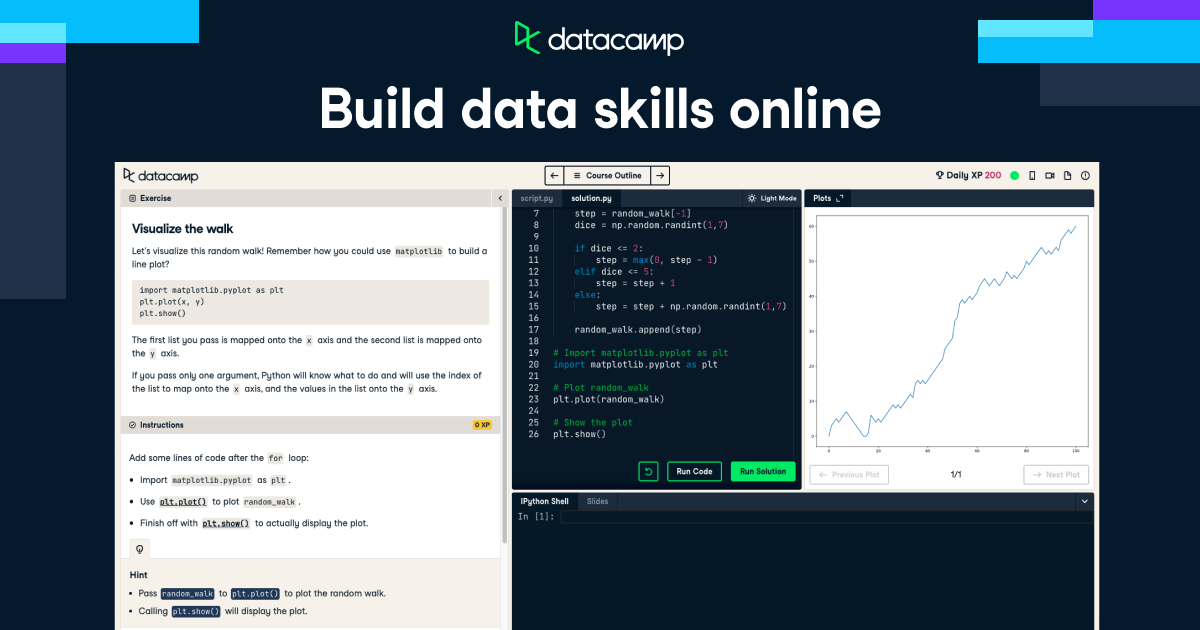
Everything runs in the browser. There is no software to install and no environment to configure: a short video is followed immediately by a coding exercise graded as you type. That format is applied across a catalogue the pricing page puts at more than 790 courses, organised into Skill Tracks, Career Tracks, guided projects, skill assessments and certifications. The technologies covered run from Python, R and SQL to Power BI, Tableau, Excel, Google Sheets, Docker, dbt, Airflow, PySpark, Snowflake, Databricks, Azure, AWS and Git.
The generative AI layer is where the platform has moved most recently. Dedicated category pages exist for Claude, ChatGPT and OpenAI, and Microsoft Copilot, alongside role-oriented courses such as AI for Finance, AI for Marketing, AI for Human Resources, AI for Consulting and AI for Sales. Two proprietary features carry the AI story. The AI Tutor gives personalised help inside the AI-native variants of courses and is metered through a credit system. DataLab is an AI data notebook that reverses the usual workflow: attach a data source, whether a CSV file, Google Sheets, Snowflake or BigQuery, describe in plain language what you want to know, and the AI Assistant writes and runs code you can review, tweak and share.
A substantial part of the business is B2B. DataCamp for Business splits into Teams, Small Business and Enterprise plans, with industry pages for healthcare, technology, energy, government, finance and insurance, consulting and retail, and integrations spanning SSO, LMS, LXP, HRMS and BI tools. The company claims 19 million learners, 5,000 business customers, 3,000 academic organisations and a presence in more than 180 countries, with 80% of the Fortune 1000 among its users.
Education is served directly too: DataCamp Classrooms is free for teachers and their students for six months per class, the interface is localised in 19 languages, and iOS and Android apps complete the offering.
What it does
- Learn Python, R, SQL, Power BI, Tableau and Excel through interactive in-browser exercises
- Follow structured Career Tracks and Skill Tracks that run from beginner to job-ready
- Ask an AI Tutor for help without leaving the exercise you are stuck on
- Analyse your own data in DataLab by describing what you need in plain language
- Earn industry certifications in data analysis, data science, SQL and AI engineering
- Practise on guided projects and pre-configured sandboxes for AWS, Azure, OpenAI and Anthropic
- Manage licences, assign learning paths and track progress across a whole organisation
When to use DataCamp / When not to
A quick filter to help you decide if DataCamp is the right fit.
When to use DataCamp
- Complete beginners with no coding or statistics background, since the catalogue explicitly assumes no prerequisites
- Career changers aiming at data analyst, data scientist or data engineer roles through structured Career Tracks and certifications
- Companies upskilling mixed technical and non-technical teams, with 5,000+ business customers and 80% of the Fortune 1000 claimed
- Teachers and academic institutions, who get DataCamp Classrooms free for six months per class
- Non-technical professionals who need to analyse their own data, through DataLab's plain-language interface
When not to use DataCamp
- Developers wanting programmatic access, since no public API documentation is published
- Anyone under 16, except Classrooms users, where the stated minimum is 13
- Organisations that require EU data residency, as the sign-up screen states data is stored in the USA
- Learners hoping to finish whole courses at no cost, because the Basic plan unlocks only the first chapter of each one
- Buyers who expect refunds or the ability to pause an annual plan, as fees are non-refundable and yearly subscriptions cannot be paused
How to use DataCamp
A typical end-to-end flow, from setup to results.
- Create a free account with an email address or a Google sign-in
- Pick a single course, a Skill Track or a Career Track according to your objective
- Work through short videos followed by coding exercises graded instantly in the browser
- Call on the AI Tutor inside AI-native course variants whenever an exercise blocks you
- Keep an eye on your credit balance: Subscription Credits reset yearly with no rollover, Top-up Credits expire after twelve months
- Open DataLab and attach a data source, whether a file, a database, Google Sheets, Snowflake or BigQuery
- Describe in plain text what you want to know, then review, tweak and share the code the AI Assistant writes
- Sit a certification and publish the professional profile that comes with it
- For a team, set one up from the purchase portal, then manage licences and monitor progress
- At enterprise scale, connect Google or Microsoft SSO or SAML 2.0 and push data into your LMS, LXP or BI tool
Pros & Cons
Pros
- Nothing to install: courses, coding exercises and projects all run in the browser
- A permanent free plan that still grants certificates of completion and a professional profile
- Unusually broad catalogue spanning data engineering, analytics, cloud, machine learning and generative AI
- Structured tracks that lead to recognised certifications rather than isolated lessons
- ISO 27001:2017 certification, a public Trust Center, a published DPA and a named EU representative
- A documented opt-out from AI model training, which comparable platforms rarely offer
- Interface localised in 19 languages, eight billing currencies, and free access for teachers and their classes
Cons
- The free plan unlocks only the first chapter of each course, so it is a sampler rather than a usable tier
- The 28.00 USD headline price is conditional on an annual commitment
- All fees are non-refundable, including unused periods and purchased credits
- Annual subscriptions cannot be paused, and renewal is automatic by default
- AI Tutor credits expire and are forfeited if a plan lapses, taking unlocked content with them
- Data is stored in the United States with no announced EU residency option, and AI training is on by default
- No public API is documented and no support email is published: support runs through a help-centre form only
Pricing & Plans
A permanent free plan, named Basic, is available and grants access to the first chapter of every course. The lowest paid entry point is the Premium plan at 28.00 USD per month, billed annually. Teams starts at the same 28.00 USD per user per month, also billed annually, while Small Business pricing depends on organisation size and Enterprise pricing is quoted on request. Eight billing currencies are offered, including USD, EUR and GBP.
- free - first chapter of every course
- free professional profile
- certificates of completion
- cheat sheets and tutorials
- mobile learning
- 28.00 USD per month billed annually - 790+ courses
- projects
- certificates and industry certifications
- Career and Skill Tracks
- course credits included
- 28.00 USD per user per month billed annually
- from two people - everything in Premium plus group management
- activity tracking
- licence management tools and Google or Microsoft SSO
- priced on organisation size
- up to 500 employees - everything in Teams plus SSO
- customisable learning pathways
- three hours of premium services and Advanced Reporting
- quoted on request - everything in Teams plus SAML 2.0 SSO
- LMS and LXP integrations
- Skill Matrix
- Activity Log
- co-branded experience and custom content
- free - six months of access per class for teachers and their students
- over 50% off the regular price for eligible college students
Data, GDPR & hosting
A consolidated view of how DataCamp handles your data.
GDPR overview
GDPR implementation is concrete and documented. DataCamp Belgium BV, company number 0542351249, Martelarenlaan 38, 3010 Kessel-Lo Leuven, Belgium, is named as the EU representative, with DataCamp, Inc. as controller. Transfers outside the EEA, Switzerland and the United Kingdom, principally to the United States, rely on the applicable Standard Contractual Clauses. Rights of access, rectification, erasure, portability, objection and restriction are set out, alongside an absolute right to opt out of direct marketing and marketing profiling, and a route to complain to a local supervisory authority. A Data Processing Addendum is published and incorporated into the Terms of Use, and both privacy@datacamp.com and a dedicated privacy form are offered. No personal data is knowingly gathered from children under 13. The site never writes the words GDPR compliant outright, but every substantive mechanism is in place.
Who owns the data?
DataCamp, Inc., a Delaware corporation headquartered in New York, owns and operates the websites, the e-learning platform and the mobile application, and acts as the data controller for European purposes. Three wholly-owned subsidiaries form the wider group with which data may be shared: Data Science Central UK Ltd., DataCamp Belgium BV and Optima Learning Technologies FZ-LLC. Learners keep rights over their own User Content, and organisations can edit their company details directly in account settings. An account and its data can be deleted permanently from those settings, while records that cannot be removed there are handled through the dedicated privacy contact form.
Reuse rights
DataCamp collects registration and support details, learning history and exercise submissions. Section 10 of the privacy policy governs artificial intelligence: inputs submitted to AI-Native Features, together with the surrounding exercise context, are processed by AI systems, and personal data such as a learner's name, learning history and past submissions may be transmitted to third-party large language model providers. DataCamp may use exercise submissions, inputs and outputs to train AI models and improve its services, and learners can opt out at any time through a documented help-centre procedure, although content flagged for safety review stays in scope and the opt-out never extends to third-party platforms. Data also feeds direct marketing, mobile notifications and targeted advertising delivered through Facebook, Google and other ad networks, with customer.io handling communication channels. Under the CCPA, sharing with advertising partners may qualify as a sale, and a Do Not Sell page is provided. End users cannot freely reuse the platform's own course material, which remains DataCamp's property.
Data retention & training
Hosting summary
Learner data is stored in the United States. The sign-up screen states it plainly, and the privacy policy confirms that personal data may be transferred outside the European Economic Area, Switzerland and the United Kingdom, principally to the US. Those transfers rely on the applicable Standard Contractual Clauses, whether the recipient is a group company or a third-party service provider. DataCamp says personal data is held only on access-restricted servers inside controlled facilities, encrypted at rest and in transit, with single sign-on, multi-factor authentication and directory sync available through Okta, Microsoft and other identity providers. ISO 27001:2017 certification is claimed on both the DataLab pages and the Trust Center, where the subprocessor list, including AI and LLM providers, is published. One caveat for anyone checking the infrastructure themselves: the domain resolves to a CloudFront edge node in Zurich, which reflects content delivery and not the jurisdiction where data is actually held.
Things to keep in mind
Risks and trade-offs to weigh before adopting DataCamp.
- Renewal is automatic at the then-current rate by default, and the opt-out is buried in account settings
- Fees and credits are non-refundable, so an unused year is simply money lost
- AI Tutor credits expire, Top-ups after twelve months and Subscription Credits with no rollover, and unlocked content disappears when a plan lapses
- Model training on your submissions is enabled by default, and opting out covers neither content flagged for safety review nor anything processed by third-party platforms
- All data sits in the United States under Standard Contractual Clauses, which may not satisfy a strict EU data-residency policy
- The Terms impose individual arbitration under US law and waive class actions, with only a thirty-day written window to opt out
- Leaning on the AI Tutor to clear exercises can produce certificates that outrun real competence: the credential is only worth the practice behind it
Setup & Integrations
Technical difficulty
Very low for individuals. There is nothing to install: courses, coding exercises and projects all run in the browser, with Chrome, Safari or Firefox recommended and Internet Explorer 11 or higher supported. Signing up takes an email address or a Google account, and DataLab advertises that no technical skills are needed to go from data to insight. iOS and Android apps are on the stores. Enterprise rollout is another matter: Google or Microsoft SSO needs no IT involvement, but SAML 2.0, LMS, LXP and HRMS integrations and the Data Connector amount to a proper IT project.
Deployment
Apps stores
Integrations
Supported languages
Behind DataCamp
Fundraising
Social
Resources
All the official URLs gathered for verification and reference.
Alternatives
Tools that compete with or complement DataCamp.
Frequently asked questions
Do I need any prior knowledge to get started?
Do I have to install any software?
What does the free account actually include?
How much does a paid plan cost?
Is there a student discount?
Can I pause my subscription?
Is my data used to train AI models?
Where is my data stored?
Is there a mobile app?
Does DataCamp offer a public API?
Should you pick DataCamp?
DataCamp is a mature and unusually broad platform for anyone who needs to become genuinely useful with data. Its central strength is the progression it offers: you can start with no prerequisites at all, work through structured tracks in the browser without installing anything, and finish with a certification employers recognise. The recent AI layer, an AI Tutor sitting inside exercises and the DataLab notebook that turns a plain-language question into reviewable code, makes it considerably more than a video library.
The governance side is better documented than on most comparable platforms. ISO 27001:2017 certification, a public Trust Center, a published Data Processing Addendum, a named EU representative and, notably, a documented opt-out from AI model training all point to a company that has done the work.
Two reservations deserve weight before committing. The first is commercial rigidity: the free Basic plan unlocks only the first chapter of each course, so it samples rather than serves; the 28.00 USD headline price assumes an annual commitment; fees and credits are non-refundable; and an annual subscription cannot be paused. The second is data: everything is stored in the United States under Standard Contractual Clauses, and training on your submissions is enabled by default, so an organisation with a strict EU residency policy has homework to do.
Developers should also note that no public API is documented, and that support runs entirely through a help-centre form with no published email address.
For individuals retraining towards data roles, for teachers who can use Classrooms free of charge, and for companies rolling out data literacy across mixed technical populations, DataCamp is a strong and well-supported choice. For anyone needing to integrate it programmatically or to keep data inside the EU, the fit is weaker.
- Choosing a selection results in a full page refresh.
- Opens in a new window.