
Lynapse
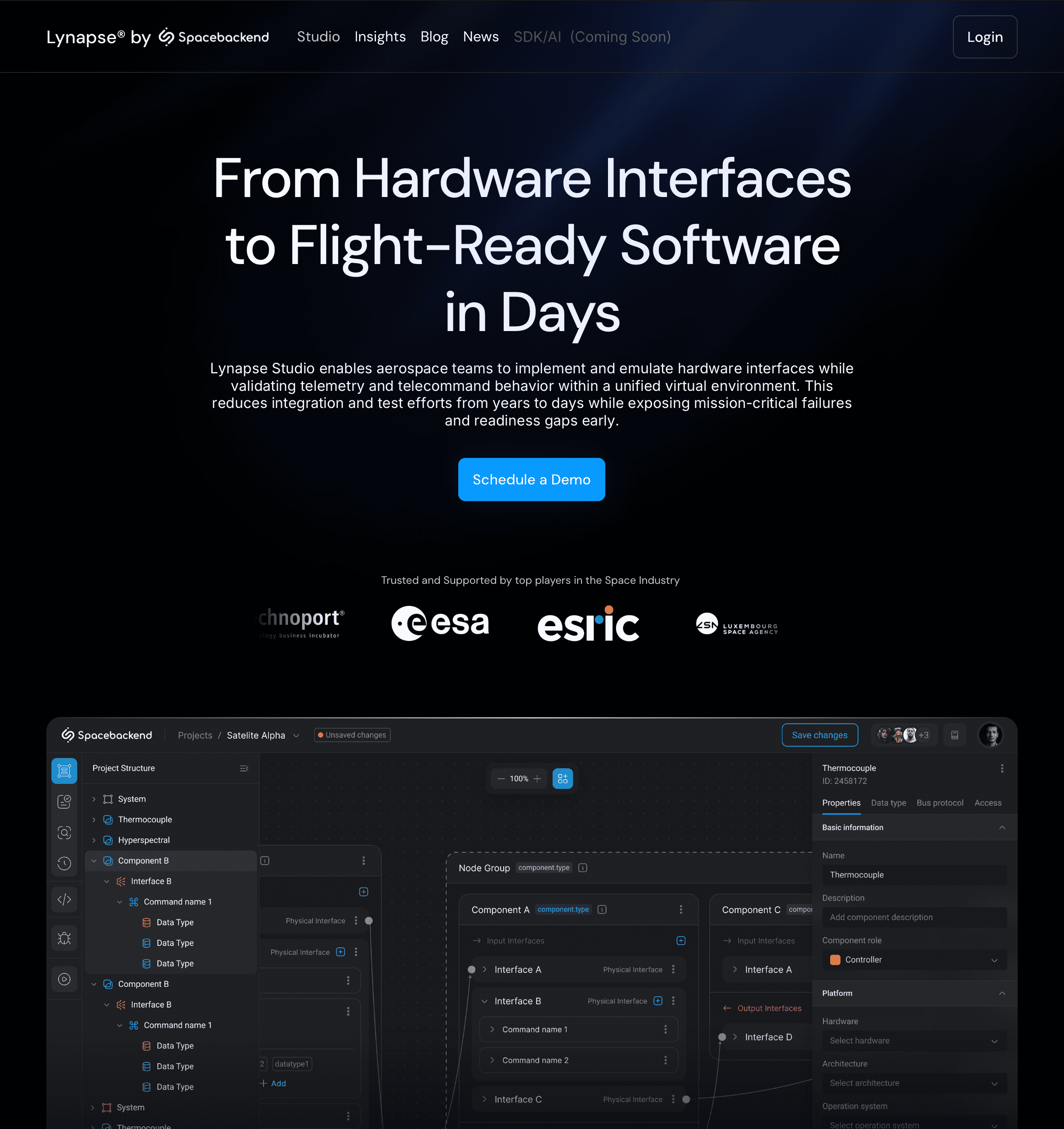
Lynapse is an AI-powered system integration platform for aerospace teams. It turns Interface Control Documents and datasheets into structured digital models, generates platform-agnostic flight-ready source code, then tests and validates it in a virtual environment.
What is Lynapse?
Lynapse is the engineering platform built by Spacebackend LU SaRL, a Luxembourg deep-tech company founded in 2024 and based at Esch-sur-Alzette, with a subsidiary in Spain. It addresses a narrow but expensive problem: in aerospace, making multi-vendor hardware talk to flight software still runs on Interface Control Documents, manual hand-offs and late-stage testing, and the schedule slips that follow cost programmes years. Lynapse compresses that path, and the company states its ambition plainly, integration and test effort reduced from years to days.
The platform comes in two products. Lynapse Studio is the full chain. It ingests any ICD or datasheet and converts it into a structured digital model of the hardware interfaces. AI then reads that documentation to flag ambiguities and missing information, while an engineer inspects and configures the model before anything is implemented. From the approved model, Studio generates platform-agnostic, flight-ready source code, then runs automated functional testing and validation in a high-fidelity virtual environment, on generated code or on code the team wrote itself. That software-in-the-loop stage is the point: interface failures surface months before physical assembly. Lynapse Insights is the lighter, read-only companion. It parses a single datasheet and sorts every field into three states, parsed, ambiguous or missing, anchored to the exact spot it came from, and returns a downloadable inspection report.
The design principle running through both is engineers-in-the-loop. AI handles the interpretation of ambiguous documentation, but every step is observable, controllable and engineer-approved, and the generated output is meant to be deterministic and reviewable rather than merely plausible. Studio also covers team work, model versioning, Git-based code history and automated command sequences.
Three deployment routes are advertised: a hosted Cloud workspace, an On-Premises install for sensitive or export-controlled projects, and an SDK and API for CI/CD pipelines that is still announced as coming soon. The tool is aimed at satellite and lunar integration, defence readiness and multi-vendor robotics, and remains close to its first public release.
What it does
- Convert an ICD, datasheet or protocol specification into a structured digital model of the hardware interfaces
- Analyse interface documentation with AI to surface ambiguities and missing information
- Generate deterministic, platform-agnostic, flight-ready source code from an approved model
- Run automated functional testing and validation on generated or customer-supplied code
- Emulate hardware and validate telemetry and telecommand behaviour in a virtual environment
- Version digital models and track code history through Git-based traceability
- Build initialisation sequences and automated command execution flows
When to use Lynapse / When not to
A quick filter to help you decide if Lynapse is the right fit.
When to use Lynapse
- Aerospace integration teams wiring multi-vendor hardware into satellites, landers and spacecraft
- AIT/AIV engineers who need integration readiness established before physical assembly begins
- Firmware and embedded engineers who scope and write drivers from datasheets and protocol specs
- Defence and government programmes that require an on-premises deployment for sensitive projects
- Teams that want software-in-the-loop testing while the hardware is still months away
When not to use Lynapse
- Consumers and individual hobbyists: the terms restrict the service to organisational, professional use
- Anyone under 18, who is explicitly excluded by both the terms and the privacy policy
- Teams expecting a certified flight-safety tool: the vendor disclaims any fitness or flight-safety warranty
- Buyers who need published pricing or self-service sign-up, since everything runs through an order form
- Developers wanting an API or SDK today, as both are announced but not yet released
How to use Lynapse
A typical end-to-end flow, from setup to results.
- Book a demonstration or an introductory call through the scheduling link published on the product site
- Agree scope, deployment mode and fees in an order form, since there is no self-service sign-up for Studio
- Choose your deployment: a hosted Cloud workspace, or an On-Premises install inside your own network
- Upload an ICD, datasheet or protocol specification into the workspace
- Let the platform convert the document into a structured digital model of the hardware interfaces
- Review the AI analysis, which flags ambiguous and missing fields for engineer attention
- Inspect and configure the digital model until it is complete, correct and platform-ready
- Generate platform-agnostic, flight-ready source code from the approved model
- Run automated functional tests and software-in-the-loop validation against the emulated hardware
- For a single datasheet, join the Lynapse Insights waitlist instead: new accounts start with three free credits
Pros & Cons
Pros
- The customer keeps ownership of both the uploaded data and the generated models, code and test artefacts
- An explicit, unconditional commitment not to train generally available or third-party AI models on Customer Data
- An on-premises option for sensitive, classified or export-controlled projects
- Engineer review is built into every stage, with output presented as deterministic and traceable
- Export control and sanctions are addressed head-on, citing EU Regulation 2021/821 and US EAR and ITAR
- Complete, dated legal documentation under Luxembourg law, with a Data Processing Agreement offered
- Testing accepts code the team wrote itself, not only code the platform generated
Cons
- No public pricing at all: no pricing page, no amount and no tier, everything goes through an order form
- The product is close to launch rather than established: Studio's first public release is set for the second half of 2026
- The advertised login workspace at app.lynapse.com did not respond when checked on 2 September 2026
- Documentation is not publicly readable, sitting behind a login wall, so the integration effort cannot be assessed
- The SDK and API are announced but not available, so there is no way to script the platform today
- No security certification such as ISO 27001 or SOC 2 is claimed or published anywhere on the site
- No hosting country is named and the subprocessor list is only available on request, not published
Pricing & Plans
No price is published. Neither the product site nor the company site exposes a pricing page, and no amount, tier or entry ticket appears anywhere in the public material. The terms of service state that fees are set out in the applicable order form, quoted exclusive of VAT, billed in advance on a monthly or annual cadence and generally non-refundable, with automatic renewal unless either party gives thirty days' notice. Pricing may be revised at renewal with thirty days' notice. There is no permanent free plan and no free trial for Lynapse Studio. The only published free allowance concerns Lynapse Insights, which is not yet launched: every new account is said to start with three free credits, one credit covering one datasheet, with no card required to join the waitlist. Prospective customers should therefore expect a negotiated, contract-based quotation rather than a listed subscription price.
- a hosted workspace for teams to import ICDs
- manage models
- run tests and share validation results
- Lynapse Studio running inside the customer's own network for sensitive projects and strict compliance
- embeds ICD parsing
- analysis
- code generation and test automation into CI/CD and internal engineering tools
- No price
- tier name or billing amount is attached to any of these options
- scope and fees are set in an order form
Data, GDPR & hosting
A consolidated view of how Lynapse handles your data.
GDPR overview
Implementation is detailed and concrete. The controller is named as Spacebackend LU SaRL at its Esch-sur-Alzette registered office, with RCS Luxembourg B288832, reachable at contact@spacebackend.com. The privacy policy maps each purpose to an Article 6 legal basis, contract, legal obligation, legitimate interests or consent, and lists the full set of data subject rights, including access, rectification, erasure, restriction, objection, portability and withdrawal of consent, with a stated response time of about one month. The supervisory authority is identified as the Luxembourg CNPD. Spacebackend acts as processor for Customer Data under a Data Processing Agreement, and as controller for account and billing data. Transfers outside the EEA rely on the European Commission's Standard Contractual Clauses. Notably, the site applies the GDPR thoroughly but never claims to be GDPR compliant in those words.
Who owns the data?
The customer keeps ownership. Under the terms, you retain all right, title and interest in your Customer Data and in the Generated Output derived from it, and Spacebackend explicitly claims no ownership of your ICDs, datasheets, source code or digital models. You grant the vendor only a limited, non-exclusive, worldwide licence to host, copy, process, transmit and display that data as far as needed to run the service for you. Spacebackend retains ownership of the platform itself, its software, models and algorithms. One asymmetry deserves attention: any feedback or suggestion you send is covered by a perpetual, irrevocable, royalty-free licence in the vendor's favour.
Reuse rights
Because the customer owns both the uploaded material and the generated models, code and test artefacts, that output can be reused freely in the customer's own programmes without asking permission. The vendor's licence over the data is purposive: it covers hosting, processing and support only, plus whatever the customer instructs. On model training the commitment is explicit and unconditional. Customer Data will not be used to train generally available or third-party AI models; only aggregated or de-identified data that neither identifies the customer nor reveals Customer Data may be used to operate, secure and improve the service. Reuse comes with one duty attached: the customer remains solely responsible for export-control and sanctions compliance on anything uploaded or generated, and for verifying and qualifying any output before it flies.
Data retention & training
Hosting summary
No hosting country and no cloud provider are named for the platform. The privacy policy states only that Spacebackend is based in the EU, in Luxembourg, and prefers to keep data within the EU and EEA. That is a stated preference rather than a hosting commitment, and the same section anticipates transfers outside the EEA, for example to a subprocessor, protected by the European Commission's Standard Contractual Clauses with supplementary measures where relevant. Customers can request a copy of those safeguards. For sensitive or export-controlled projects the alternative is the on-premises deployment, where data stays inside the customer's own environment. Security measures described include encryption in transit, access controls, logging and monitoring, with multi-factor authentication encouraged. A list of subprocessors exists but is available on request only, not published. One point deserves care: the company site mentions hosting on Framer, which refers to the marketing website, not to the Lynapse platform itself.
Things to keep in mind
Risks and trade-offs to weigh before adopting Lynapse.
- Generated code is an engineering aid, not a flight-safety guarantee: the vendor disclaims fitness warranties and leaves verification, qualification and the decision to fly entirely with the customer
- Automation bias is the real hazard here, since plausible-looking generated interface code invites less scrutiny than hand-written code, exactly where a missed field becomes a mission failure
- The digital model inherits whatever the source document got wrong, so an ambiguous or outdated ICD can be converted faithfully into confidently incorrect output
- Uploading export-controlled technical data to the cloud deployment is the customer's legal responsibility, and the terms warn against it explicitly in favour of the on-premises option
- Feedback and suggestions you send are covered by a perpetual, irrevocable, royalty-free licence to the vendor, unlike your own data
- Contract terms are asymmetric in places: fees are non-refundable, subscriptions renew automatically, and liability is capped at the fees paid over the preceding twelve months
- The product is close to launch, so buyers should confirm that the workspace, documentation and announced SDK are actually available before committing to a programme timeline
Setup & Integrations
Technical difficulty
Moderate for the intended audience, which is already technical. There is no self-service sign-up for Studio: access starts with a demonstration and an order form. The Cloud option is a hosted workspace with nothing to install, while the On-Premises option requires deploying inside the customer's own network, where the terms leave infrastructure security to the customer. Inputs are documents teams already hold, ICDs, datasheets and protocol specifications, so no special data preparation is described. The main obstacle to a firm estimate is that public documentation sits behind a login wall.
Deployment
Behind Lynapse
Fundraising
Social
Resources
All the official URLs gathered for verification and reference.
Frequently asked questions
What does Lynapse actually do?
Who is behind Lynapse?
How much does it cost?
Is my data used to train AI models?
Who owns the code that Lynapse generates?
Can I run it inside my own network?
Is there an API?
Is the product generally available?
Is there a minimum age or usage restriction?
Is a Data Processing Agreement available?
Should you pick Lynapse?
Lynapse is a genuinely specialised tool, and that is its strength rather than a limitation. It targets one costly bottleneck, turning hardware interface documentation into working, tested flight software, and it addresses that bottleneck with unusual seriousness: AI reads the ambiguous documents, but an engineer approves every stage, and the output is presented as deterministic and traceable rather than merely convincing. For teams integrating multi-vendor hardware into satellites, landers or defence systems, that combination is hard to find elsewhere.
The contractual side is unusually clean for an early-stage vendor. Customers keep ownership of their uploads and of everything generated from them, the commitment not to train third-party AI models on Customer Data is explicit and unconditional, an on-premises deployment exists for sensitive work, and export control is treated as a first-class concern rather than a footnote. The legal documentation is complete, dated and governed by Luxembourg law, with a Data Processing Agreement available.
The reservations are about maturity, not intent. There is no public pricing whatsoever, so no reader can gauge affordability without contacting sales. Lynapse Studio's first public release is announced for the second half of 2026 and Insights is still a waitlist, the SDK and API remain unreleased, the documentation sits behind a login wall, and the advertised application workspace did not respond when checked. No security certification is claimed, no hosting country is named, and the subprocessor list is available only on request.
The sensible reading is that this is a credible, well-backed platform still arriving. Teams evaluating their integration chain for the coming programme cycle should look closely; buyers who need a proven, priced, immediately available tool should wait and revisit after launch.
- Choosing a selection results in a full page refresh.
- Opens in a new window.