
Studio NAND
Berlin design studio, not a self-serve product. Studio NAND builds decision-support tools for organisations drowning in data, combining data science and AI, data visualisation, product design and full-stack development, delivered as scoped projects rather than a subscription.
What is Studio NAND?
Studio NAND is an independent design studio in Berlin, registered as Studio NAND GmbH at Sophienstrasse 18. Its domain has been active since 2011 and the site claims more than ten years of client collaborations. The positioning fits in one phrase the studio repeats everywhere: Design for Decisions, or Data. Design. Decide. It is important to be clear from the outset: this is not a piece of software you can sign up for. It is a team you commission.
Four disciplines are on offer: Data Science & AI, Data Visualization, Digital Product Design and Full-Stack Development. They are applied across four declared verticals: public health, mobility, sustainable environments and emerging technologies. The working method is described as a deep reading of the client's need, flexibility in both technology and team composition, rapid prototyping and iterative development, summed up as thinking-through-making.
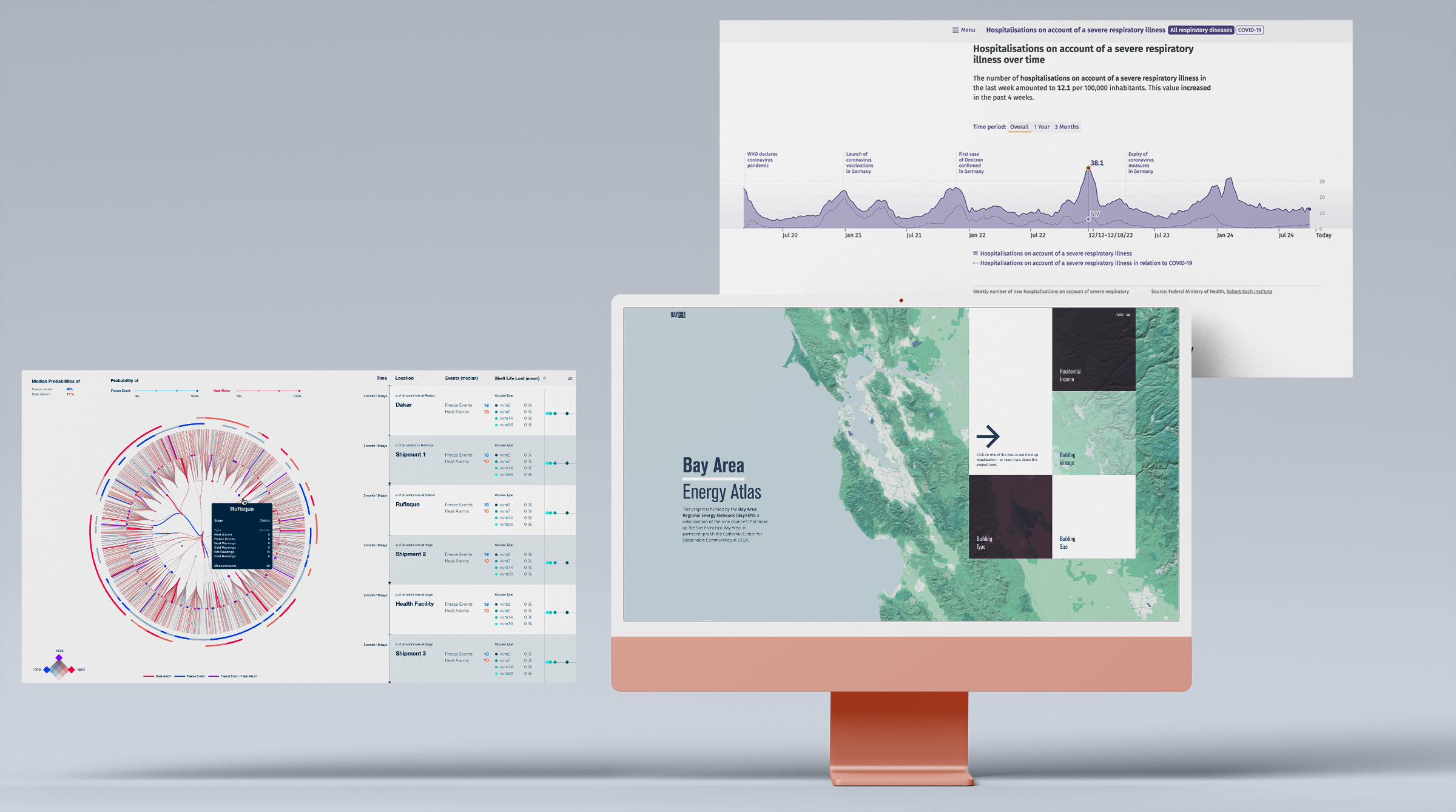
What makes the studio judgeable is its published work. For Germany's Federal Ministry of Health it built Infektionsradar, a public dashboard carrying more than 45 health indicators updated weekly. For the health insurer AOK it built the Gesundheitsatlas, covering KPIs for over twenty diseases across 22 million insured people, and the QCare Qualitatsatlas Pflege, a first attempt to measure care quality nationwide through ten indicators for 370,000 nursing-home residents. For Deutsche Bahn it built Peakspotting, which applies AI-supported prediction to 7.5 million prognosis data points to optimise train capacity, and Spotti, a natural-language search assistant letting non-specialists query booking and forecast data on a network carrying eight million passengers a day. For the German Environment Agency it extracted more than 150 topics from over 10,000 unstructured articles. Other work includes the UCLA Energy Atlas, the Soli interaction prototypes for Google ATAP, an AI-driven storytelling piece with Laokoon that drew 50,000 views in its first month, and a six-month MVP for the fintech startup Blanq. Google, Volkswagen, NIO, Disney Research and the British Museum appear as further named collaborations.
What it does
- Design and build data dashboards, either for the general public or for decision-makers
- Turn datasets of millions of points into legible, interactive interfaces
- Apply machine learning and AI to operational forecasting
- Map data across several geographic scales
- Prototype rapidly and iterate on emerging technologies
- Take a startup from visual identity and product concept through to a shipped MVP
- Develop the resulting applications full-stack
When to use Studio NAND / When not to
A quick filter to help you decide if Studio NAND is the right fit.
When to use Studio NAND
- Public bodies that must turn complex datasets into something citizens can actually read: the Infektionsradar dashboard built for Germany's Federal Ministry of Health carries more than 45 health indicators, refreshed weekly.
- Operators deciding fast on very large datasets, such as Deutsche Bahn, for which the studio built AI-supported capacity forecasts across 7.5 million prognosis data points.
- Health insurers and public-health decision-makers: the AOK atlases cover ten care-quality indicators for 370,000 nursing-home residents, and disease KPIs across 22 million insured people.
- Startups needing a vision turned into something shippable, as with Blanq, which received a crypto wallet app, a physical banking card and a website within six months.
- Research groups prototyping technology that does not exist yet, such as Google ATAP's Soli radar sensor and its sub-millimetre movement data.
When not to use Studio NAND
- Anyone looking for software to try today: there is no product, no account and nothing to sign up for.
- Buyers working to a fixed, modest budget, since no price, plan or order of magnitude is published anywhere on the site.
- Teams wanting an API, a mobile app or a browser extension: none exists, and the site's own sitemap confirms there is no API documentation.
- Organisations that need help within days, because the engagement is a scoped studio project rather than an instant subscription.
- Anyone expecting a scalable platform instead of a single team working out of one Berlin office.
How to use Studio NAND
A typical end-to-end flow, from setup to results.
- Start with the three qualifying questions on the homepage, which ask whether you want to create value from data, are overwhelmed by data volume, or need insights that are fast but durable.
- Browse the four verticals: public health, mobility, sustainable environments and emerging technologies.
- Read the case studies, each of which states the client, the challenge, the result and a headline figure.
- Download the white paper, Making Confident Decisions with Data, Design & AI, from the Design for Decisions page, in exchange for a first name, last name, e-mail address and job title.
- Write to hello@nand.io, the single contact channel published on the site, under the Get in touch banner.
- Do not look for a contact page: the Contact link in the navigation only scrolls to the footer, and the /contact URL returns a 404.
- Expect a scoping conversation rather than a sign-up, since no pricing, plan or trial exists.
- Work then proceeds as a project, with rapid prototyping, iterative development and a team composed around the problem.
- Follow the studio on LinkedIn, Instagram or Bluesky for updates between engagements.
Pros & Cons
Pros
- Verifiable, first-rank references: the Federal Ministry of Health, Deutsche Bahn, AOK, the German Environment Agency, UCLA and Google ATAP
- Ten documented case studies, each with a named client, a challenge, a result and figures, which is rare for a studio
- Full corporate transparency: registration HRB 173837 B, a VAT number, a named managing director and a named data protection officer
- Real longevity, with a domain active since 2011 and more than ten years of collaborations claimed
- A sharp specialism in data-driven decision-making, in sectors where the stakes are public
- End-to-end capability, from ideation through to full-stack development, with no visible subcontracting
- A serious GDPR framework for an organisation of this size, including an appointed DPO and a named supervisory authority
Cons
- No pricing at all, and no budget order of magnitude anywhere on the site
- Nothing to try: the work cannot be evaluated without entering a commercial conversation
- A very sparse site, where the Studio and Case Studies pages amount to a few lines of text and the substance sits inside images
- No terms and conditions page, and no contact page
- No team members are named: the Team section carries no names at all
- An unrevised privacy policy that still invokes the Privacy Shield, invalid since 2020
- Nothing published about where client data is hosted, no formal subprocessor list and no DPA
Pricing & Plans
No price is published. A grep of every page collected, together with the site's own sitemap of fourteen URLs, confirms that there is no pricing page and no amount stated anywhere. There is no free plan, no trial and no paid tier, because the studio does not sell a product: work is quoted per project after contact. The only item obtainable at no cost is the white paper, in exchange for a completed form.
Data, GDPR & hosting
A consolidated view of how Studio NAND handles your data.
GDPR overview
Implementation is explicit and detailed. Studio NAND GmbH is established in Germany, so the GDPR applies directly, and the data protection declaration is built article by article on the DSGVO. A data protection officer is appointed and reachable at data@nand.io. The studio states in its own name that it takes appropriate technical and organisational measures under Article 32, applies data protection by design and by default under Article 25, and informs users of the legal basis for each processing purpose under Article 13. Rights under Articles 15 to 21 are set out one by one, and the right to complain under Article 77 names the competent authority, the Berlin Commissioner for Data Protection and Freedom of Information. No Article 27 representative is designated, which is correct for an EU-established company. One caveat: the text still invokes the Privacy Shield, invalidated in 2020.
Who owns the data?
Two roles apply, and the site separates them. For the website itself, Studio NAND GmbH, Sophienstrasse 18 in Berlin, is the controller, with a data protection officer reachable at data@nand.io. For client work the studio positions itself as a processor: it states that it acts on the customer's instructions under Article 28 GDPR and will not process commissioned data for any purpose beyond the order. Material handed over as part of a commission is deleted according to that order's specifications, in principle once the engagement ends. Internal analyses stay internal, and are shared outside the studio only in anonymous, aggregated form. Ownership of the delivered work itself is not addressed on any public page.
Reuse rights
No terms of use are published, so nothing on the site grants a visitor any right of reuse. The legal notice does the opposite: it places the pages and their contents under German copyright law and requires the rights holder's prior consent for any form of use, reproduction or processing, with individual copies allowed for private purposes only. What the privacy policy does document is the studio's own use of data: running the site, answering enquiries, security, reach measurement and marketing, and agency services. In client engagements it processes inventory, contact, content, contract, payment, usage and metadata under Article 6(1)(a), (b), (c) and (f) GDPR, and carries out internal business analysis and market research on legitimate-interest grounds; personal profiles are anonymised or deleted two years after a contract ends. Training AI models on customer data is never mentioned, in either direction.
Data retention & training
Hosting summary
No hosting country or region is declared. The privacy policy describes the hosting services it relies on, covering infrastructure and platform services, computing capacity, storage, database services, e-mail dispatch, security and technical maintenance, but never names the provider. An order processing contract under Article 28 GDPR is stated to be in place with that host. Transfers to third countries are allowed under the conditions of Articles 44 and following. Access logs are kept for a maximum of seven days. Google Analytics runs with IP anonymisation, so addresses are shortened inside the EU or EEA and transmitted in full to a US server only in exceptional cases. One technical observation should not be mistaken for a declaration: the site's public IP address, 76.76.21.21, resolves to an anycast content delivery node located in the United States, which describes the delivery network and says nothing about where any data is stored.
Things to keep in mind
Risks and trade-offs to weigh before adopting Studio NAND.
- This is not a self-serve AI tool but a services provider: there is no software to use, and expectations set by an AI directory may not match what is actually sold.
- No pricing and no budget range are published, so the cost of an engagement is only discovered inside a sales conversation.
- There is no terms and conditions page, so the contractual frame of an engagement is invisible until a contract is negotiated.
- The privacy policy has aged on one precise point: it still relies on the Privacy Shield for Google and Meta, a framework struck down by the Schrems II ruling in 2020.
- Nothing is published about the country where client data is hosted, no formal subprocessor list exists and no data processing agreement is offered publicly.
- No team member is named on the site, and the Team section carries no names, so the people who would do the work are unknown until you ask.
- Some case studies are old, with Soli, Peakspotting and Spotti dating back to 2018 and 2019, so they may not reflect the studio's current stack.
Setup & Integrations
Technical difficulty
The question barely applies. There is nothing to install, configure or deploy, because the studio does not distribute software. The only technical action asked of a visitor is a four-field form to obtain the white paper. The real effort is commercial and organisational rather than technical: framing the problem, agreeing scope, then working through the studio's own cycle of rapid prototyping and iterative development. Any technical complexity sits with the delivered application, and is carried by the studio, not by the client's team.
Behind Studio NAND
Social
Resources
All the official URLs gathered for verification and reference.
Frequently asked questions
Is Studio NAND an AI tool I can use?
What does it cost?
How do I get in touch?
Who is behind the studio?
Which clients has the studio worked for?
Is the GDPR taken seriously?
Is there an API or a mobile app?
Is anything available free of charge?
Which languages does the studio work in?
Will my data be used to train AI models?
Should you pick Studio NAND?
Studio NAND is unambiguously real, and that matters more than it sounds. The company is registered and checkable, the legal notice and privacy policy are complete, a managing director and a data protection officer are named, the domain has been live since 2011, and ten case studies each name their client, their challenge and their result. Commissioners of that calibre, from Germany's Federal Ministry of Health to Deutsche Bahn, AOK, the German Environment Agency, UCLA and Google ATAP, are not a claim a studio can make casually.
What it is not, however, is a tool. There is nothing to install, nothing to try and nothing to buy online. Anyone arriving here expecting to evaluate features against a price will find neither. The value on offer is judged the way an agency is always judged, on the work it has already shipped, and on that count the evidence is unusually well documented: 45 health indicators refreshed weekly for a national ministry, 7.5 million prognosis data points turned into rail capacity forecasts, care quality measured for 370,000 nursing-home residents.
Two reservations are worth carrying into a first conversation. The documentation has aged in places: the privacy policy still leans on the Privacy Shield, invalidated in 2020, there are no terms and conditions, no published subprocessor list and nothing about where client data is hosted. And the site tells you very little about the people, since no team member is named anywhere. Neither is disqualifying, but both are questions to ask directly. For an organisation sitting on data it cannot act on, this is a credible interlocutor. For someone shopping for software, it is the wrong shelf.
- Choosing a selection results in a full page refresh.
- Opens in a new window.