
PLEQ
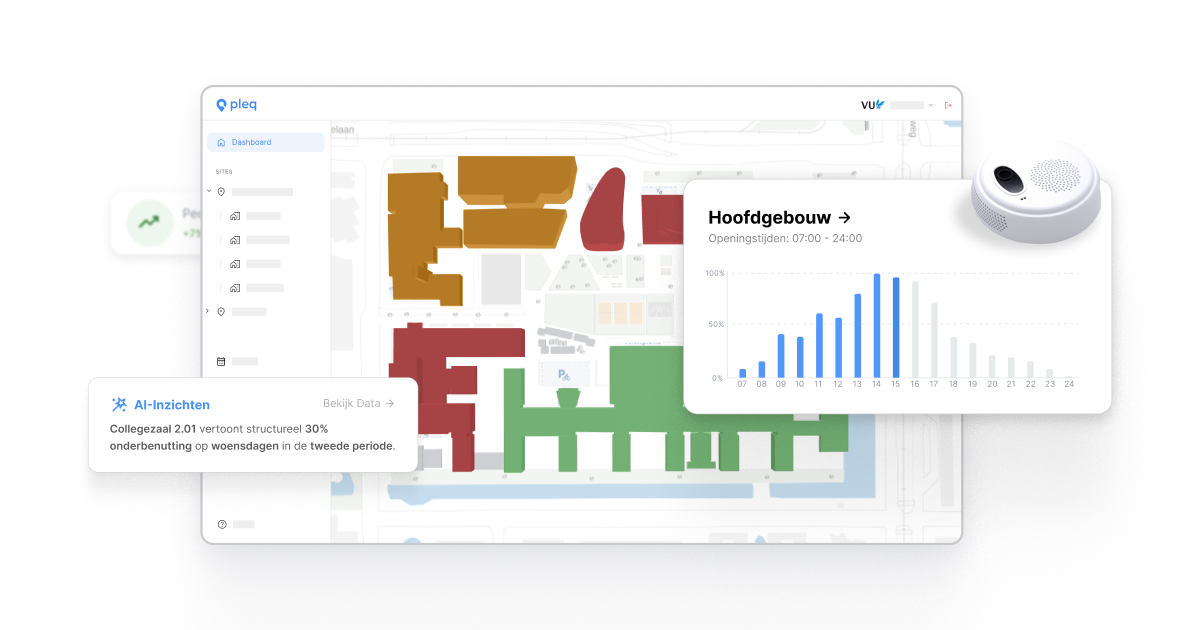
PLEQ is an occupancy and utilisation data platform for campus buildings. Anonymous, camera-free sensors feed a cloud dashboard and an API, so estates and facility teams can see how rooms are actually used, with data hosted in the EU.
What is PLEQ?
PLEQ is an occupancy data platform for campus buildings, published in the Netherlands. It combines its own sensors with a cloud back end, a dashboard and an API, and presents itself as "the #1 occupancy sensor for your smart campus".
Two sensors do the measuring. The Flow Counter uses 3D Time-of-Flight technology to count, in both directions and in real time, how many people pass through a passage, with a claimed accuracy of 98%. The Occupancy Sensor uses thermal technology for static counting in meeting rooms, project rooms and shared offices, covering an area of up to 8 by 8 metres. Installation is described as plug and play: no PoE cabling, just a power supply. The sensors send their readings to the cloud over LoRaWAN, encrypted end to end with AES-128, or over Ethernet. There the raw counts become occupancy and utilisation indicators, which the customer reads in a dashboard or pulls through an API. Going live takes three steps: upload the room register, have the sensors fitted by the customer's own installer, then read the data.
The problem PLEQ describes is a familiar one in estates management: manual counts in spreadsheets, decisions taken on opinion, and reporting scattered across Excel files. Its argument is that campuses are on average only 60% used, and it advertises potential annual savings, although the figure differs between the two language versions of the same page: 30 million euros in English against 16 million in Dutch. An AI layer branded Campus Utilisation Intelligence automates the analysis into immediate action points.
Two things set the publisher apart. It works without cameras and keeps only anonymised counts, claiming full AVG/GDPR compliance, EU manufacturing and EU data storage. And it publishes its measurement method: definitions of Frequency (time in use against availability) and Occupancy (people against capacity), then a Mean Average Error comparison across four institutions giving 92-99% accuracy depending on room size. Named deployments include Vrije Universiteit Amsterdam, Erasmus University Rotterdam on the Woudestein campus, and the University of Warwick's Oculus building, where the UK launch took place. Every accuracy figure remains self-declared.
What it does
- Measure the occupancy and utilisation of rooms in real time
- Set the theoretical timetable against actual presence in the room
- Spot under-used rooms and meeting-room no-shows
- Import the room register from Planon or TOPdesk
- Read usage patterns in a dashboard
- Pull occupancy and utilisation data through an API
- Turn the analysis into action points with the built-in AI
When to use PLEQ / When not to
A quick filter to help you decide if PLEQ is the right fit.
When to use PLEQ
- Universities and higher-education institutions managing a large stock of teaching rooms
- Estates and facility management teams that need to measure how their buildings are really used
- Space planners who want to set the published timetable against actual presence in the rooms
- Organisations under strict privacy requirements, where camera-based counting is not acceptable
- Multi-building campus operators comparable to PLEQ's named references: Vrije Universiteit Amsterdam, Erasmus University Rotterdam and the University of Warwick
When not to use PLEQ
- Buyers who need a published price before opening a conversation: no amount appears anywhere on the site
- Organisations unwilling to sign an initial three-year commitment with tacit renewal and six months' notice
- Teams looking for self-service software: physical sensors have to be fitted on site by an installer the customer provides
- Anyone expecting a permanent free plan or an instant sign-up
- Users wanting analytics beyond built spaces: the scope is rooms and buildings, not a general-purpose measurement tool
How to use PLEQ
A typical end-to-end flow, from setup to results.
- Ask for a quotation through the contact form on the site, or book a slot with the "Plan a demo" call to action, which leads to a third-party Microsoft Bookings page
- Agree the scope with PLEQ: hardware, an implementation project and an annual software subscription are quoted and invoiced separately
- Hand over the room register: PLEQ takes the number of rooms and their naming from your facility management software, Planon and TOPdesk being the two named
- Receive the sensors, preconfigured by PLEQ
- Have your own installation partner fit them following PLEQ's manuals, with no PoE cabling and an ordinary power supply
- Let the sensors transmit over LoRaWAN or Ethernet to PLEQ's cloud, where raw counts become occupancy and utilisation indicators
- Check that measurements are matched automatically to the right room, the room register being the link
- Read utilisation patterns in real time in the dashboard, signing in on the admin panel at admin.pleq.net
- Or pull the same occupancy and utilisation information through the API
- Govern the data flows centrally from the admin panel as the estate grows
Pros & Cons
Pros
- No cameras and anonymised counting only, a decisive argument in a university setting
- Measurement methodology published in the open: definitions, a Mean Average Error method and a four-institution sample giving 92-99%
- EU data storage stated explicitly, with hardware said to be manufactured in the EU
- Data ownership left with the client organisation, and data flows governed from a single admin panel
- Native integration with two widespread facility management packages, Planon and TOPdesk
- Publicly verifiable references in Dutch and UK higher education: VU Amsterdam, Erasmus Rotterdam, University of Warwick
- API delivery alongside the dashboard, and installation without PoE cabling
Cons
- No public price at all: there is no pricing page, probed paths return the site's standard 404 and neither locale's sitemap lists one
- Initial three-year commitment, tacit renewal for the same term and six months' notice
- Entry cost combines hardware, an implementation project and an annual subscription paid in advance, with the sensors physically fitted by an installer the customer supplies
- No public API documentation and no reachable public endpoint, even though an API is advertised
- No about page, no contact page and no legal notice on the site
- No named security certification published (no ISO 27001, no SOC 2, no NEN 7510) and no list of sub-processors
- Privacy policy visibly built from a template, still carrying a leftover link to omniabuildings.com, and a savings figure that differs between the English and Dutch versions of the same page
Pricing & Plans
No price is published. PLEQ works on quotation and has no pricing page at all: paths such as /pricing, /prijzen and /tarieven return the site's standard 404, and neither of the two locale sitemaps lists one. There is no permanent free plan; the only entry route advertised is a "Start your trial period" call to action, which leads to booking an appointment rather than to a self-service sign-up, and neither its duration nor its conditions are published. The terms and conditions set out the structure without naming a single amount. Three items are invoiced separately: the hardware, in full on order; the implementation, half on delivery of the 3D model of the building and half on acceptance; and the software subscription, annually in advance from acceptance of the purchase order, then thirty days before each new contract year. Prices are stated to be in euros, excluding VAT and any other charges. Quotations are valid for a maximum of thirty days, annual indexation on the CBS services price index is possible after the first full year, payment terms are thirty days and late payment carries extrajudicial costs subject to a contractual minimum. The agreement runs for an initial three years and renews tacitly for the same period unless notice is given six months in advance. Because no amount is published anywhere, no lowest price point can be stated here without inventing one.
- the site names no plan
- package or edition
- and carries no pricing page
- sensor hardware
- an implementation project and an annual software subscription
- A separate service level agreement
- expressly accepted in writing
- setting out requirements and response times
- A Statement of Work may be added to the agreement
Data, GDPR & hosting
A consolidated view of how PLEQ handles your data.
GDPR overview
PLEQ makes an explicit claim rather than showing a certificate: "No cameras, fully GDPR-compliant", with hardware said to be produced in the EU to the strictest privacy standards. The site states that all data is stored on servers within the EU and complies with the AVG and the GDPR, and that the sensors store no images and no personal data, only anonymised counts. The terms and conditions commit PLEQ to processing personal data in accordance with the GDPR under technical and organisational measures, and make the PLEQ Data Processing Terms applicable to the agreement. Dutch law governs, before the court in The Hague or the Netherlands Commercial Court in Amsterdam. The data contact is info@pleqcampus.nl. No Article 27 representative is named, consistent with an EU-established publisher. The privacy policy is dated 24 August 2024, the terms 23 January 2025.
Who owns the data?
PLEQ states on its website that the data remains the property of the client organisation, and that all data flows are managed centrally through the admin panel. The terms and conditions leave each party's intellectual property with that party and grant the client a non-exclusive licence. On the sensor side, the publisher says no images and no personal data are stored, only anonymised counting data. What PLEQ allows itself to do with that counting data beyond delivering the service is not spelled out on any public page, and no list of sub-processors is published, so the practical limits rest on the separately applicable PLEQ Data Processing Terms rather than on anything a prospect can read in advance.
Reuse rights
Two different sets of data have to be told apart. Sensor data: raw counts travel to PLEQ's cloud, where they are processed into occupancy and utilisation information and handed back through the dashboard or the API. As the data remains the property of the client organisation, re-use inside that organisation does not depend on the publisher's permission, and the admin panel is presented as the place to govern the flows. Website data: the privacy policy, which reads as an unedited template, covers personal data collected through the site itself, for account, contract, contact, marketing and usage-analysis purposes, and allows sharing with service providers, affiliates, business partners and an acquirer in a merger or sale. No page on the site mentions models being trained on customer data, in either direction.
Data retention & training
Hosting summary
PLEQ states, in the FAQ of both language versions of its site, that all data is stored on servers within the EU and complies with the AVG and the GDPR. Beyond that, nothing is named: no country, no hosting provider, no technical region and no list of sub-processors. The hardware itself is said to be produced in the EU. Transmission from the sensors runs over LoRaWAN with end-to-end AES-128 encryption, or over Ethernet, and the sensors are described as storing no images and no personal data, only anonymised counting data. One distinction matters: the public website is served by Framer, on an anycast node resolving to sites.framer.app, which says where the marketing site is delivered from and nothing about where platform data lives. The publisher is established in the Netherlands, the terms are governed by Dutch law, and disputes go to the court in The Hague or the Netherlands Commercial Court in Amsterdam, so the jurisdiction is clear even where the precise hosting location is not.
Things to keep in mind
Risks and trade-offs to weigh before adopting PLEQ.
- Legal identity in flux: the terms and conditions, last revised on 23 January 2025, name "PLEQ V.O.F.", while the Dutch register shows at the same address "Pleq B.V." (KvK 42147682) and "Pleq Holding B.V." (KvK 42147483), both registered on 24 August 2026, nine days before this review. The terms have not been updated since, and no reachable register dates the V.O.F. itself, hence the sentinel on the company start date.
- The privacy policy is a template that was never fully edited: it still carries a leftover link to omniabuildings.com, and the minimum age of 13 comes from its "Children's Privacy" clause, a clause with no real bearing on a B2B product sold to universities.
- Figures diverge between the two languages of the site: the same page advertises potential savings of 30 million euros a year in English and 16 million in Dutch.
- Every accuracy rate quoted (98%, 92-99%, up to 99% on the timetable comparison) is self-declared, with no third-party audit; GDPR compliance is likewise a claim by the publisher, not a certificate, and no named certification is published, neither ISO 27001 nor SOC 2 nor NEN 7510.
- The API is attested by a single sentence in the site's FAQ: there is no public documentation and no reachable public endpoint, so integration effort cannot be assessed before contact.
- The registered address, De Boelelaan 1085 in Amsterdam, is a building on the Vrije Universiteit Amsterdam campus, and the VU is also one of PLEQ's named customers.
- Contact surface is thin: the only published email, info@pleqcampus.nl, sits on a different domain from the website itself, and the site has no about, contact or legal-notice page. The pleqcampus.nl and pleq.net domains redirect to the main site, so they are aliases rather than separate products.
Setup & Integrations
Technical difficulty
Light on the software side, but this remains a hardware project. The sensors are preconfigured by PLEQ and presented as plug and play, with no PoE cabling and an ordinary power supply, the room register is imported from Planon or TOPdesk, and the site advertises being ready in three steps. The physical installation, however, falls to an installer the customer provides, working from PLEQ's manuals, and the implementation involves delivering a 3D model of the building. A LoRaWAN or Ethernet path to the cloud is required. No timescale is published.
Deployment
Integrations
Supported languages
Behind PLEQ
Social
Resources
All the official URLs gathered for verification and reference.
Frequently asked questions
How does the sensor measure utilisation?
Where is the data stored?
What is LoRaWAN and why does PLEQ use it?
Is there an API?
How much does PLEQ cost?
Who owns the data collected by the sensors?
Which software does PLEQ integrate with?
How accurate are the measurements?
Which institutions use PLEQ?
Is there a mobile app?
Should you pick PLEQ?
PLEQ is a deliberately narrow product: occupancy and utilisation measurement for higher education and building estates, not a general-purpose analytics tool. Within that scope it does several things unusually well for a company of its size. It names its customers, so the references can be checked. It publishes its measurement methodology in the open, with definitions, a Mean Average Error method and a four-institution sample, where a headline percentage would have been enough. And it answers the objection that matters most on a campus by design rather than by policy: no cameras, anonymised counts, storage in the EU.
Set against that, the commercial side is opaque. No price appears anywhere, and there is no pricing page to find; the cost combines hardware, an implementation project and an annual subscription, on quotation, behind an initial three-year commitment with tacit renewal. There is no about page, no contact page and no legal notice, no named security certification, no sub-processor list, and no public API documentation even though an API is advertised.
The publisher is also very small, two employees in the register and 2-10 declared on LinkedIn, and its legal structure looks to be mid-change: the terms still name PLEQ V.O.F. while the Dutch register shows two Pleq B.V. entities registered days before this review. None of that is disqualifying, but it argues for asking direct questions before signing, starting with who exactly the contracting party is and what the annual subscription covers. Buyers who need published pricing or a short commitment should look elsewhere. Estates teams that need defensible room-level data, and can live with a procurement conversation, will find a credible and unusually well-documented specialist.
- Choosing a selection results in a full page refresh.
- Opens in a new window.