
Synature
Synature is a Swiss bioacoustic monitoring platform pairing solar-powered smart microphones, AI species models and the browser-based SynApp dashboard to detect 15,000+ species around the clock, giving conservation, agriculture and ecotourism teams verified biodiversity data without acoustic expertise.
What is Synature?
Synature is a Swiss bioacoustics platform that turns the sound of a landscape into measurable biodiversity data. Built by a company based at the EPFL Innovation Park in Lausanne, it covers the whole chain: hardware in the field, an AI layer that identifies what is calling, and SynApp, a browser-based dashboard where results are explored and verified.
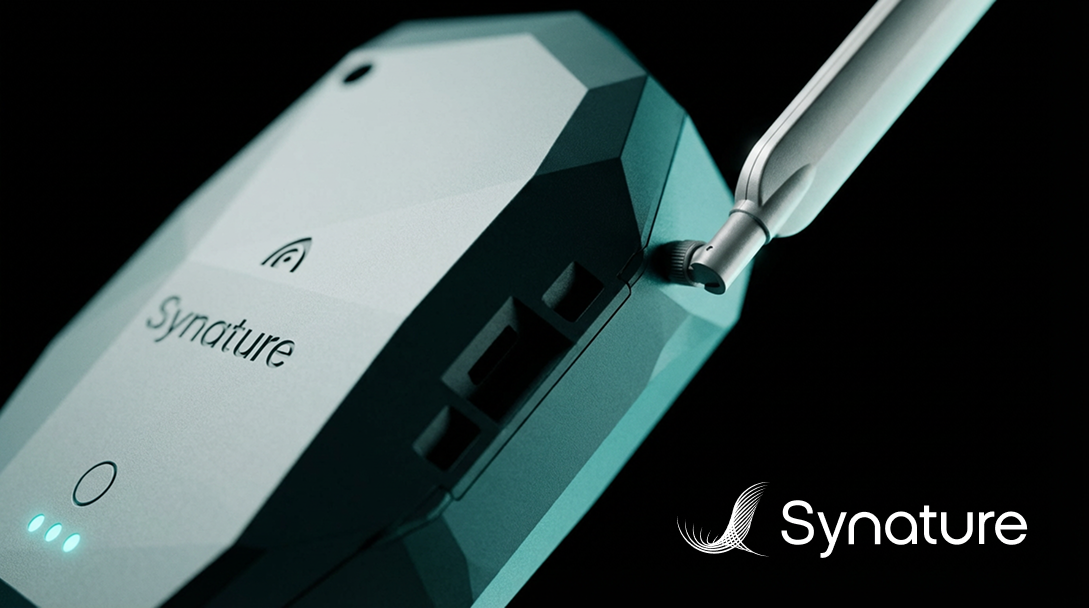
The hardware is a solar-powered smart microphone carrying four MEMS capsules that record up to 250 kHz, so bat ultrasound sits in the same stream as birdsong. It is rated IP66, runs on a LiFePO4 battery stable up to 130 °C, transmits over LTE (4G) or WiFi, and has been through four development iterations. The claim is autonomy: no battery swaps, no SD cards to collect, months of continuous operation. One unit covers roughly a one-kilometre radius in homogeneous landscape.
On top sits a model catalogue spanning more than 15,000 species of birds, bats, frogs, insects and mammals. Eight models are documented publicly: MammalTrace North America (9 species, wolf, cougar, bobcat), MammalTrace Europe (11 species, marten, otter, wild boar), MammalTrace Africa (6 species, lion, leopard, hyena), BatSignal (24 ultrasonic species across Europe and North America), HopperNet (60 Swiss grasshoppers and crickets), AmphSense (9 Western European frogs and toads), Owlset (4 tawny owl call types) and GrouseNet (3 capercaillie call types). Models are trained on years of field audio and fine-tuned on expert-annotated datasets, and the company states that every new deployment feeds fresh data back into the next model generation.
SynApp shows real-time detections, alerts on target species, standardised acoustic indices and comparisons across sites, seasons and restoration phases, plus remote fleet management for battery, connectivity and recording schedules. A verification layer lets regional experts, Synature's network or your own, accept or reject each detection. The company frames results through a "Beacons and Guardians" idea: a kingfisher detection read as a signal of clean water and healthy fish populations.
Buying the hardware is optional, since bring-your-own-recorder uploads are supported. Three service models exist: model-as-a-service and platform-as-a-service, both available, and an end-to-end service announced for 2026. Cited deployments include river restoration in Switzerland, renewable energy in Spain, wolf monitoring, agroforestry in Ecuador, regenerative agriculture in France and coffee growing in Uganda.
What it does
- Detect and classify more than 15,000 species from sound, continuously and around the clock.
- Deploy solar-powered smart microphones that stream data over LTE or WiFi with no field visits.
- Upload existing or historical recordings from third-party recorders straight into SynApp.
- Verify or reject each detection through an expert quality-control layer.
- Track acoustic indices, trends and ecosystem health indicators across sites, seasons and restoration phases.
- Trigger real-time alerts when a target species is heard.
- Generate reports for compliance, ESG disclosure or restoration monitoring.
When to use Synature / When not to
A quick filter to help you decide if Synature is the right fit.
When to use Synature
- Conservation organisations and protected-area managers running large-scale, long-running monitoring programmes.
- Ecological restoration teams that need season-by-season evidence that a river, forest or agroforestry site is recovering.
- ESG, sustainability and compliance officers who must document biodiversity outcomes: ESG reporting and compliance tracking are named on the offering page.
- Research groups and NGOs that already hold expert-annotated acoustic datasets and want custom detection models built for their target species.
- Regenerative agriculture and ecotourism operators, and teams already working with manual recorders, who want existing or historical audio analysed without deploying new hardware.
When not to use Synature
- Buyers who need self-service sign-up and a published price: no rate card exists and every offer goes through a sales conversation, which rules out tightly constrained or unnegotiated budgets.
- Teams that need population abundance figures: the FAQ answers "not yet" and presents abundance measurement as work in progress.
- Anyone hoping to analyse human conversations or speech, which is filtered out and deleted immediately at capture.
- Organisations needing a turnkey deployment today: the end-to-end service that includes deployed microphones is announced as coming in 2026.
- Developers and mobile-first users expecting a documented API or a phone app: SynApp is browser-based only, and no API documentation is published.
How to use Synature
A typical end-to-end flow, from setup to results.
- Get in touch by email or join the waiting list: there is no self-service sign-up.
- Choose a service model: model-as-a-service for custom species models, platform-as-a-service for access to SynApp with your own recordings, or the end-to-end service once it ships.
- Decide your entry point: deploy Synature smart microphones, or bring your own recorders and upload existing audio.
- Plan placement around strategic locations rather than total coverage, allowing roughly a one-kilometre radius per unit.
- Install the units, which are solar powered and presented as plug and play with no expertise required.
- Set recording schedules and let the devices transmit over LTE or WiFi, with no field visit needed to retrieve data.
- Alternatively, upload existing acoustic files of any type manually into SynApp.
- Open the browser dashboard to review detections as they arrive and set alerts on target species.
- Accept or reject detections in the verification layer, using Synature's regional experts or your own.
- Follow acoustic indices and trends over time, then produce reports for compliance, ESG or restoration monitoring.
Pros & Cons
Pros
- Covers the full chain, hardware, AI models and analysis platform, which few vendors on this market do.
- No hardware lock-in: third-party recorders and existing audio files are explicitly accepted.
- Genuine field autonomy, with no battery changes and no SD cards to collect over months of operation.
- Human verification is built into the workflow, giving detections a traceable scientific status.
- The model catalogue is documented publicly, with species counts and geographies for each of the eight models.
- Human speech is filtered out and deleted immediately at capture, a clear privacy stance for monitored sites.
- Solid academic and institutional grounding: EPFL and ETH Zurich roots, six awards and press coverage including SRF, DEGA Akustik and Horizons.
Cons
- No public pricing of any kind: no rate card, no starting price, and every offer routed through a sales contact, which makes upfront budgeting and comparison impossible.
- The end-to-end service, the one that includes deployed hardware, is announced as coming in 2026 and was not available at the time of review.
- Abundance measurement is not supported: the FAQ answers "not yet, but we're working on it".
- Legal documentation is very thin: no terms of service at all (an absence proven by the sitemap), no data processing agreement and no sub-processor list.
- The privacy policy comes from a Swiss template, is written in German on an otherwise English site, and covers the marketing website rather than SynApp.
- Leftovers from the Framer "Landio" template are still online: four off-topic blog posts in the sitemap and a landio@support.com address inside the privacy policy.
- Identity details do not line up across pages: two postal addresses (imprint versus contact page), two company spellings (Synature AG versus Synature SA), no documented API, no mobile app, and no indication of where customer data is hosted.
Pricing & Plans
Synature publishes no price anywhere on its website: no rate card, no starting amount, no currency and no billing unit. No free plan and no free trial are mentioned either. All three service models, model-as-a-service, platform-as-a-service and the end-to-end service, are quoted on request. Pricing is obtained through a commercial contact only, by email to the address published on the site or by joining the mailing list and waitlist form linked from the offering page. Prospective buyers should therefore plan on the basis of a negotiated quotation rather than any published figure.
- Synature builds and trains detection models for the species you care about. Best suited to organisations that already hold annotated acoustic data. No price is published.
- upload
- processing
- analysis and visualisation of existing acoustic recordings. Best suited to projects using manual recorders
- one-off assessments and analysis of historical data. No price is published.
- deployed microphones
- continuous transmission and full SynApp access. Aimed at large-scale programmes
- restoration projects
- ESG reporting and compliance monitoring. No price is published.
Data, GDPR & hosting
A consolidated view of how Synature handles your data.
GDPR overview
Synature never claims GDPR compliance in so many words, but its privacy policy names "Synature SA" as the controller within the meaning of data protection law, in particular the EU General Data Protection Regulation, and grounds each processing operation on Article 6(1)(a) consent or Article 6(1)(f) legitimate interests. Swiss law is invoked alongside it, through the federal data protection act and Article 13 of the Federal Constitution. A cookie consent manager is in place and the consent record is kept for up to two years. No Article 27 EU representative and no data protection officer are designated: questions go to the responsible person listed at the top of the policy. The document carries no effective date and no version number, is written in German on an otherwise English site, and reads as a Swiss template covering the marketing website rather than the SynApp application.
Who owns the data?
Synature publishes no terms of service, so contractual ownership of the recordings you upload, or that its microphones capture, is not addressed anywhere on the site. The only document touching the subject is the German-language privacy policy, built from a Swiss template and written for the marketing website rather than for the SynApp application. It claims copyright over the site's own content, which belongs exclusively to the site operator or to the specifically named rights holders; it states that personal data is treated confidentially and in line with data protection law; and it promises that no data is passed to third parties without your consent. Ownership of product data remains undocumented.
Reuse rights
No terms of service set out what a customer may do with detections, recordings or exports, so reuse rights are simply undocumented. What the site does describe is how Synature itself uses data. On the website side, the privacy policy lists names, email addresses and details volunteered through forms, plus IP address, browser, device and pages viewed, used to run the site, answer enquiries, send the newsletter and measure audience through Google Analytics (with IP anonymisation), Google Ads (30-day conversion cookie), LinkedIn Analytics, Mailchimp and YouTube; transfers to the United States are acknowledged, with an explicit warning that the US is not a safe third country under EU data protection law. On the product side, retraining on customer deployments is advertised as a feature rather than governed by a clause: models are trained on years of field audio, fine-tuned on expert-annotated datasets, and "every new deployment feeds fresh data back into the next model generation", while expert feedback continuously improves the models. No opt-out from that retraining is documented anywhere. The one clearly stated exclusion is human speech, which the FAQ says is filtered out and deleted immediately.
Data retention & training
Hosting summary
No hosting country or region is stated for customer data. The privacy policy only says that data is handled in cooperation with the company's hosting providers, without naming a provider or a jurisdiction, and SynApp is described as cloud-based and browser-based with no location given. The transfers to United States servers acknowledged in the policy concern the marketing website's third-party tools, namely Google Analytics and Ads, LinkedIn, Mailchimp and YouTube, and say nothing about where recordings or detections are stored. The marketing site itself is served from a Framer CDN node (Amazon AS16509, Amsterdam, anycast), which is a content delivery address rather than a hosting jurisdiction, and the application lives on a separate domain, app.synature.ch. In short: the publisher is Swiss, the website's edge is European, and the hosting location of product data is unknown. Organisations with a data residency requirement should obtain it in writing before contracting.
Things to keep in mind
Risks and trade-offs to weigh before adopting Synature.
- Retraining on customer deployments is advertised as a feature, with the site stating that every new deployment feeds fresh data back into the next model generation, and no documented way to opt out.
- There are no terms of service at all, so the contractual relationship, liability and data ownership are never published; the absence is confirmed by the site's own sitemap.
- The privacy policy is a German-language Swiss template covering the marketing website rather than SynApp, and it carries no effective date or version number.
- A landio@support.com address is still present in the privacy policy, a leftover from the Framer "Landio" template, alongside four off-topic blog posts still listed in the sitemap. Do not use that address.
- Company identity is inconsistent across pages: Synature AG on the imprint versus Synature SA in the privacy policy, and two distinct postal addresses, the Lausanne headquarters and a Wallisellen office.
- No hosting country or region is stated for customer data, while transfers to the United States are acknowledged for the website's third-party tools with an explicit warning that the US is not a safe third country.
- Automated detection can create false confidence: the expert verification layer exists precisely because model output is not self-evidently correct, and abundance, which many management decisions actually rest on, is not measured at all.
Setup & Integrations
Technical difficulty
Low on the technical side, slower on the commercial side. Synature advertises plug-and-play operation with no expertise required: the microphones are solar powered, need no battery change or SD card retrieval, and feed a browser dashboard that requires no installation. The friction lies elsewhere. There is no self-service sign-up, so onboarding starts with a sales conversation, and deciding where to place the units is an ecological judgement as much as a technical one. Teams without hardware can skip installation entirely by uploading existing audio files into SynApp.
Deployment
Supported languages
Behind Synature
Social
Resources
All the official URLs gathered for verification and reference.
Frequently asked questions
How many microphones does a site need?
Can I use my own recorders or my own audio files?
How does bioacoustics compare with other survey methods?
Are human conversations recorded?
Can Synature measure species abundance?
How is data transmitted from the field?
Can detections be checked by a human?
How much does Synature cost?
Is there a mobile app or a public API?
Which languages and which models are available?
Should you pick Synature?
Synature is a niche tool, and an unusually complete one. Few vendors in bioacoustics cover the whole chain: a rugged solar microphone, a publicly documented catalogue of species models, and a browser dashboard where every detection can be accepted or rejected by an expert. The engineering claims are specific rather than vague, with 250 kHz capture, an IP66 rating, months without a field visit and roughly one kilometre of coverage per unit. The scientific grounding is equally concrete: EPFL and ETH Zurich roots, six awards, press coverage, and named deployments from Swiss river restoration to Ugandan coffee growing.
Commercial maturity is more uneven. Two service models are usable today, custom model building and access to SynApp with your own recordings, while the end-to-end offer that includes deployed hardware is announced for 2026. Nothing is priced publicly and nothing is self-service: every path leads to an email or a waitlist form. That looks like a deliberate posture rather than an oversight, but it does mean no buyer can size a project without a conversation.
The weakest layer is the paperwork. There are no terms of service at all, no data processing agreement, no sub-processor list, and the privacy policy is a German-language Swiss template describing the marketing website rather than the application. Meanwhile the product page advertises that each new deployment feeds fresh data back into the next model generation, with no documented way to opt out. Add template leftovers still online and two different company spellings across pages, and the legal side clearly lags behind the product.
For a conservation, restoration or ESG team that needs continuous, verifiable species data and is willing to negotiate, Synature is a serious candidate. Ask for the contract terms, the data ownership clause and the hosting location in writing before signing.
- Choosing a selection results in a full page refresh.
- Opens in a new window.