
Fundraisly
Fundraisly is a guided fundraising service for startup founders. It screens a 300,000-strong investor database, maps warm introduction paths from your own network, runs the outreach for you and books qualified investor meetings on your calendar.
What is Fundraisly?
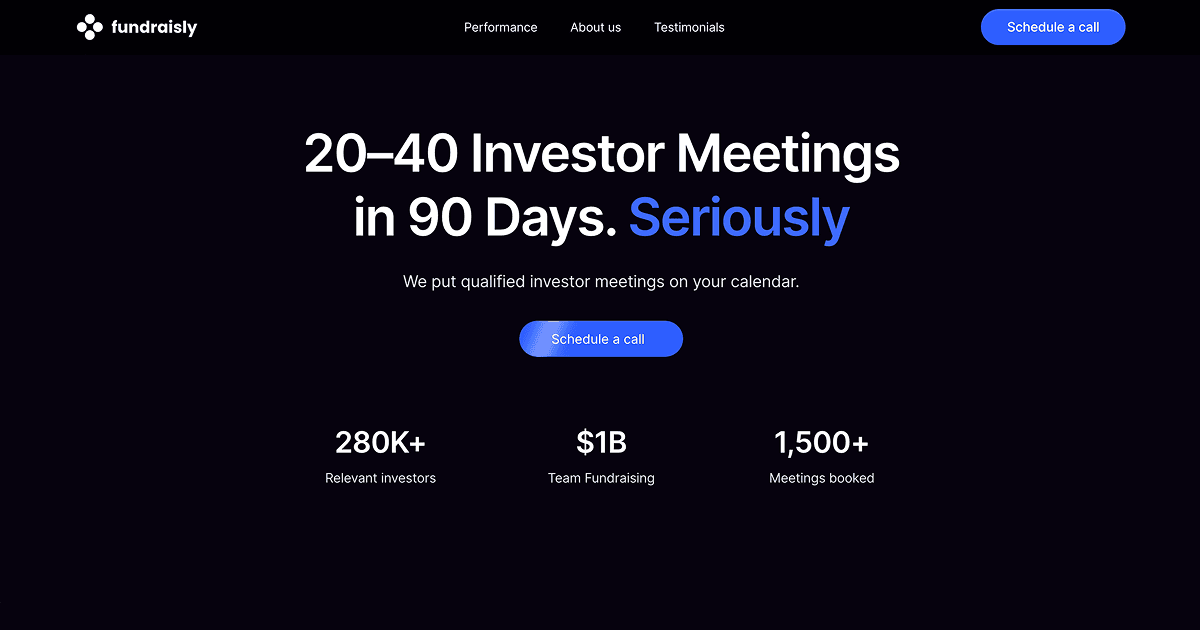
Fundraisly is a fundraising service for founders of private companies, operated by Accumulator Fundraising LLC, a Delaware company based in Coral Gables, Florida. Its promise is blunt and operational: 10 to 50 qualified investor meetings on your calendar within 90 days, instead of the 195-plus hours the homepage says founders burn preparing a raise on their own. The company claims 1.1 billion USD raised across more than 200 startups, over 3,000 investor meetings run, and an 8.7 out of 10 rating from founders.
The product rests on four pillars. First, an investor database of more than 300,000 funds and angels, assembled from Crunchbase, LinkedIn, outreach feedback, public sources and, the site says, thirteen more. Second, investor intelligence: fit is determined by the investments actually sitting in a fund's portfolio rather than the thesis published on its website, with AI matching on stage, market, geography, comparable deals and recent activity, refreshed weekly. Third, warm introductions: paths into a fund are mapped from the founder's own LinkedIn, Gmail and Outlook data, reaching portfolio founders, co-investors on the cap table and members of the investment team. Fourth, targeted outreach for the investors no warm path reaches, sent from a dedicated infrastructure of mailboxes and domains so the startup's primary domain is never exposed.
On top of that sits a human layer that separates Fundraisly from a pure database product: a dedicated ex-VC manager advises on the deck, the data room and the strategy, reviews the pipeline every week, and weighs in on valuation, deal structure and terms.
The boundaries are stated just as clearly. Fundraisly is not a broker-dealer, placement agent, investment adviser or intermediary, takes no transaction-based compensation, gives no investment advice and guarantees no outcome. It is a web product only: an account, a clickwrap service agreement and a CRM, with no mobile app and no public API. A separate Benchmarks section runs a podcast of case studies with the real funnel numbers behind funded rounds.
What it does
- Build a targeted investor list out of a database of more than 300,000 funds and angels
- Qualify each investor on the deals actually in their portfolio rather than the thesis on their website, using stage, market, geography, comparable deals and recent activity, refreshed weekly
- Map warm introduction paths automatically from the founder's LinkedIn, Gmail and Outlook data
- Stand up a dedicated outreach infrastructure of mailboxes and domains so the startup's own domain is never at risk
- Write and optimise the outreach messaging and scripts, then run the email campaign on the founder's behalf
- Put qualified investor meetings on the founder's calendar -- 10 to 50 within 90 days according to the homepage
- Set up a CRM holding the investor funnel, and review the pipeline weekly with a dedicated ex-VC manager
When to use Fundraisly / When not to
A quick filter to help you decide if Fundraisly is the right fit.
When to use Fundraisly
- Founders of private technology companies actively raising a round, from pre-seed through Series B
- Founders with no existing investor network in the United States who need to build one quickly
- Small teams that cannot spare the weeks of list-building, sequencing and follow-up a raise demands
- Founders who want conversation volume rather than a handful of introductions, and who can absorb 20 to 50 calls in a quarter
- Companies that want an ex-VC operator reviewing the deck, the data room, the valuation and the deal terms alongside the outreach
When not to use Fundraisly
- Bootstrapped or very early teams: the cheapest entry point is a 1,000 USD setup fee and the agency plan costs 5,000 USD a month, with a two- to three-month minimum commitment
- Charities, NGOs and anyone raising donations: the service targets private capital markets and venture rounds, not philanthropic fundraising
- Founders looking for investment advice or a placement agent: Fundraisly states it is not a broker-dealer, adviser or intermediary and takes no transaction-based compensation
- Anyone who needs a guaranteed outcome: the terms explicitly disclaim any promise of investment results
- Teams that want a pure self-service tool: access runs through an onboarding flow, a signed service plan and a dedicated manager, with no free tier and no public API
How to use Fundraisly
A typical end-to-end flow, from setup to results.
- Click 'Start my fundraising' on the homepage, which opens the onboarding flow
- Enter your email address to continue and open the account creation path
- Register: name, business title, date of birth, email, company name and postal address
- Complete the company profile -- sector, stage, description, amounts sought or already raised, target investment areas and founder preferences
- Pick a service plan, Agency or Pay-per-Call, and accept the Master Service Agreement and its Service Plan Addendum by clickwrap
- Pay within five business days of the invoice or payment link; fixed and recurring fees are payable in advance
- Connect LinkedIn, Gmail and Outlook so the warm introduction paths inside your own network can be mapped
- Let the team stand up the dedicated outreach infrastructure -- mailboxes and domains -- and the CRM holding the investor funnel
- Validate the target investor list, screened by stage, check size, focus, geography and portfolio
- Work the deck, data room, pitch and strategy with the dedicated ex-VC manager, then run the weekly pipeline review and take the meetings that land on your calendar
Pros & Cons
Pros
- The deliverable is measurable: meetings booked on the calendar, not a list of contacts to work through
- The investor database is the largest in the comparison table the site publishes, at 300,000-plus against 2,000 to 200,000 for the alternatives it names
- Investors are screened on what they have actually funded rather than on the thesis they advertise
- Warm introductions and cold outreach are combined instead of being sold separately
- The outreach runs on dedicated mailboxes and domains, so a burnt sender reputation never touches the startup's own domain
- An ex-VC manager is included in the Agency plan, covering deck, data room, valuation and deal terms
- Prices are published openly, where much of this market answers only with a quote
Cons
- High entry cost and a locked commitment: two months minimum on the Agency plan, three on Pay-per-Call, with no termination for convenience during that period
- All payments are non-refundable unless expressly stated otherwise, and late payment carries 15% annual interest
- No free plan and no free trial anywhere on the site
- No guaranteed result: the terms disclaim any promise on investment outcomes, conversions or marketing success
- The headline numbers -- 1.1 billion USD raised, 8.7 out of 10, the per-client call counts -- come with no published methodology or verifiable source
- Connecting Gmail or Outlook means email metadata, and authorised portions of email content, are analysed by third-party LLM providers, with no documented opt-out from that processing
- Thin public information: no product page, no about page, no contact page, no security page or certification, no screenshots, and a subprocessor list available only on request
Pricing & Plans
Fundraisly offers no free plan and announces no free trial. The lowest paid entry point is the Pay-per-Call plan, which charges a one-time setup fee of 1,000 USD covering the first three months, then 100 USD for each investor call actually conducted. The Agency plan is billed at a recurring 5,000 USD per month, payable in advance. The comparison table on the homepage summarises the range as 1,000 to 5,000 USD per month. All fees are exclusive of applicable taxes, and reasonable pre-approved out-of-pocket expenses may be invoiced separately.
- Agency Plan -- 5
- 000 USD per month
- payable in advance
- minimum fixed term of two months. Covers the outreach infrastructure
- the target investor database and its validation
- the CRM
- the writing and optimisation of outreach messaging
- the scripts and the email campaign sent on the client's behalf
- Pay-per-Call Plan -- a one-time setup fee of 1
- 000 USD covering the first three months
- plus 100 USD per investor call conducted
- minimum fixed term of three months. Covers the outreach infrastructure
- the target investor database and its validation
- the CRM and the mapping of warm introduction paths. It does not include the outreach messaging and scripts
- the campaign sent on the client's behalf
- the deck and data room advisory
- Both plans -- extensions in one-month increments after the initial term
- granted at the vendor's sole discretion
- the outreach infrastructure is permanently disabled and destroyed when the plan ends.
Data, GDPR & hosting
A consolidated view of how Fundraisly handles your data.
GDPR overview
The privacy policy, effective 19 March 2026, devotes a full section to the GDPR. It lists the rights of access, rectification, erasure, objection, restriction, portability, withdrawal of consent and complaint, promises a reply within one month and points to the EDPB directory of supervisory authorities. Legal bases are spelled out: contract performance, legitimate interests, consent and legal obligation. Non-essential cookies are not set for EU, EEA and UK visitors before consent is collected through a cookie consent tool, and Global Privacy Control signals are honoured. Fundraisly is controller for the website and may act as processor under a written DPA; subprocessors are contractually bound and listed on request. Two gaps remain: no Article 27 EU representative and no data protection officer are named, and international transfers are described without naming a transfer mechanism.
Who owns the data?
Accumulator Fundraising LLC keeps ownership of every piece of intellectual property it develops or uses while delivering the service. Once the relevant deliverables are paid for, the client gets a limited, non-exclusive licence to use that IP internally; sublicensing, republishing and distribution are forbidden, and the vendor may reuse non-confidential learnings elsewhere. Confidential information stays with whoever disclosed it. On personal data, Fundraisly is controller for what the website collects and may act as processor for clients under a written DPA. It undertakes never to rent, sell, lease or trade personal information without explicit permission, sharing it only with service providers, authorities and acquirers under the conditions set out in the privacy policy.
Reuse rights
No. The client's rights are deliberately narrow: after payment, the deliverables may be used internally for the company's own business purposes and nothing more. Sublicensing, republishing and distributing the vendor's intellectual property are prohibited, and reselling the content, software, services or products obtained through Fundraisly is prohibited as well. The reverse direction needs permission too: Fundraisly may only use a client's name, logo and a general description of the engagement in its own marketing with prior written approval, which the client should not unreasonably withhold. The vendor reserves the right to reuse general ideas, concepts, know-how and techniques its people retain from the work, provided no confidential information is disclosed. One practical consequence deserves attention: when a plan ends, expires or is not renewed, the outreach infrastructure built for the client -- the mailboxes and the domains -- is permanently disabled and destroyed unless something else is agreed in writing, so the deliverability history built during the campaign does not stay with the client. Unpaid invoices allow the vendor to withhold deliverables and revoke access.
Data retention & training
Hosting summary
Fundraisly publishes no security page, no trust centre and no named hosting country. The only indication comes from the international transfers clause of the privacy policy: personal information may be sent and stored outside the user's country of residence, including to the United States. For users in the EU, EEA or UK, the vendor says it takes appropriate steps to provide an equivalent level of protection, but names no transfer mechanism -- no standard contractual clauses, no adequacy framework. The stated safeguards are generic: firewalls, data encryption, physical access controls to data centres and information access authorisation controls, with an explicit warning that no method of transmission or storage is completely secure. Payment data is handled by a third-party gateway and never stored by Fundraisly. Subprocessors providing infrastructure, hosting, analytics and support are mentioned and contractually bound, but the list is only available on request.
Things to keep in mind
Risks and trade-offs to weigh before adopting Fundraisly.
- Mailbox access is the price of admission: email metadata -- senders, recipients, timestamps, subject lines -- and, where you authorise it, portions of message content are analysed by third-party LLM providers
- That analysis covers relationships and interaction patterns, which means data about third parties who never agreed to anything, including your contacts and their networks
- Your own network is mined as an introduction channel: a badly calibrated approach spends relationship capital you spent years building
- Outreach goes out in the founder's name, so the company's reputation rides on messaging written by an outside provider
- Handing the whole raise to a service means not learning to run one, which matters for the next round and creates a dependency on the provider
- No guaranteed result, combined with a locked minimum term and non-refundable payments -- the financial risk sits entirely with the client
- Investor lists are aggregated from Crunchbase, LinkedIn and public sources: accuracy and freshness should be checked before anything is sent, and compliance with telecom, marketing and consent law remains the client's responsibility
Setup & Integrations
Technical difficulty
Very low on the technical side, higher on the administrative one. Nothing has to be installed, coded or integrated: there is no API and no plugin, and the outreach infrastructure of mailboxes and domains is built by the vendor. The only technical steps a client takes are OAuth connections to Gmail, Outlook and LinkedIn. The real effort is paperwork and attention -- creating the account, filling in the company profile, accepting the service agreement by clickwrap, paying within five business days, supplying deck and data room, then holding a weekly pipeline review and showing up to the meetings booked.
Deployment
Integrations
Behind Fundraisly
Social
Resources
All the official URLs gathered for verification and reference.
Alternatives
Tools that compete with or complement Fundraisly.
Frequently asked questions
What does Fundraisly actually do?
How much does it cost?
Is there a free trial?
How are the investors selected?
Do I have to connect my mailbox?
Will my emails be used to train AI models?
Does Fundraisly guarantee that I will raise?
Is there a mobile app or an API?
Who operates the service and under which law?
How do I exercise my GDPR rights, and how long is my data kept?
Should you pick Fundraisly?
Fundraisly sits in an unusual spot: neither a raw investor database nor a traditional fundraising agency, but a managed campaign sold at a published price. What it commits to is refreshingly concrete -- meetings booked, not contacts delivered -- and the mechanics behind that promise hold together: a large database screened on real portfolio activity, warm paths mined from the founder's own inbox and LinkedIn, cold outreach for the rest, all run from mailboxes and domains that keep the startup's own domain out of harm's way. The ex-VC manager included in the Agency plan is what makes the offer more than tooling, and the testimonials describe volumes -- 43 calls, 49 pitches in two months, 110 fund connections -- that a founder working alone would struggle to reach.
The reservations are equally clear. There is no free plan and no trial, the minimum commitment runs two to three months, payments are non-refundable and the outreach infrastructure is destroyed when the engagement ends. The headline results carry no published methodology. And the product only works if you hand over access to your mailbox and your professional network, where metadata and authorised content are processed by third-party language models with no documented opt-out. Outside its three legal pages, the site says remarkably little: no product page, no security page, no certifications, no subprocessor list beyond one available on request.
For a founder about to spend a quarter on a raise, the arithmetic is straightforward: compare the plan fee to the value of the weeks it buys back, and be sure you are comfortable with what you connect.
- Choosing a selection results in a full page refresh.
- Opens in a new window.