
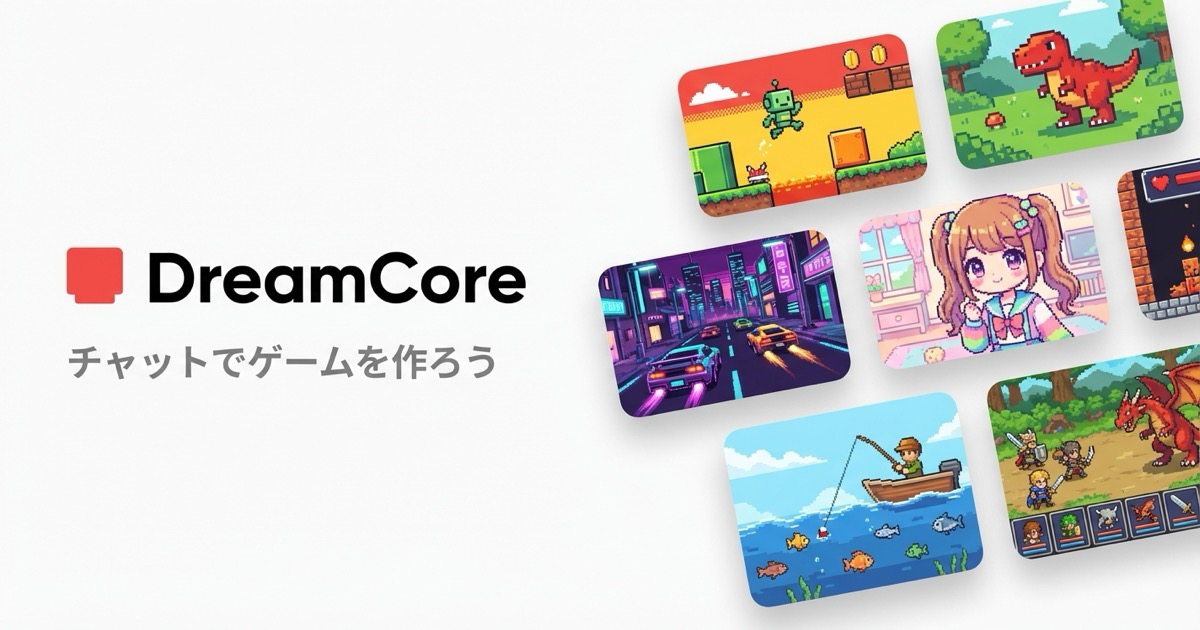
DreamCore
DreamCore turns a written idea into a playable browser game in minutes, with no coding, shared through a single link. Built for beginners, children and teachers. The site publishes no terms of service and no privacy policy.
What is DreamCore?
DreamCore is a browser-based game creation platform published by the Japanese company NEIGHBOR Inc. Its own definition: “an AI-powered game creation platform” where anyone can build an original browser game just by chatting with an AI, with no programming knowledge, and share it instantly. The stated mission is to democratize game development so that making a game becomes as casual and social as taking photos with friends. The publisher says many users are not developers, a good number of them elementary school kids.
The loop is short. You write what you want in the home-page box, optionally choosing image, 2D, 3D, a random Surprise me, or a blank Studio. A workspace called Studio opens, builds for a few minutes, then returns the finished game in the chat thread with a note on what was made and a Play button. If something feels wrong you say so in the same box, through pre-written buttons — easier, harder, better pacing, clearer goal, clearer controls — or in your own words, and the game is rebuilt. Publishing produces a link: whoever opens it plays straight away, with no app and no account. Three entry points lead to the same Studio: the free-text box, a five-question wizard, and a photo route called SnapCade, which swaps an existing game's hero for your own picture in one of five styles.
The engineering blog describes what happens underneath. Every generation starts a disposable E2B sandbox where a coding agent writes the files, before the machine is destroyed. The house library holds 95 3D skeletons and 202 2D skeletons; generation is split into a design turn and a build turn, with the host injecting the skeleton in between; and the agent is given three executable tools: image generation, a checker for the finished game, and level validation — is the jump makeable, is the goal reachable.
It runs in a modern browser on iOS, Android, Windows, macOS and Linux, touch on mobile, keyboard on desktop. You can write prompts in any language; the interface exists in six. Around the games sits a social layer: public timeline, guestbook, play and reaction counters, @username profiles. The limits are real — one game in production at a time, a daily quota, 1 MB per uploaded file, no documented source-code export — and no terms of service or privacy policy is published anywhere on the site.
What it does
- Describe a game in one sentence and get it back playable.
- Turn a photo into the hero of the game.
- Fix the game by writing what feels wrong.
- Publish it and share it through a single link.
- Upload your own images and sounds to use as assets.
- Remix a game published by someone else.
When to use DreamCore / When not to
A quick filter to help you decide if DreamCore is the right fit.
When to use DreamCore
- Complete beginners with no coding and no drawing skills: one written sentence is enough to get something playable back.
- Children and teenagers, an audience the publisher claims openly, writing on its own blog that a good number of its users are elementary school kids.
- Teachers and instructional designers who need a playable artefact inside a single lesson rather than at the end of a term.
- Friends and social creators making quick, disposable games to pass around, where the point is the sharing rather than the craft.
- Mobile-first users: the platform is designed to be played with a thumb in the browser, on iOS or Android, with nothing to install.
When not to use DreamCore
- Studios and developers who need the source code: no code export is documented anywhere on the site.
- Commercial or long-running game projects: only one game is built at a time, under a daily generation limit.
- Organisations that put tools through a legal review: there are no terms of service, no privacy policy, no data processing agreement and no contact channel.
- Teams that need a guarantee on where their data sits or on their content not being used for model training: nothing is published on either point.
- Projects with heavy assets: uploads are capped at 1 MB per file, and at 300 KB for GIF and WebP.
How to use DreamCore
A typical end-to-end flow, from setup to results.
- Create an account with Continue with Google, Continue with Apple or Continue with Email, and remember which one you chose: signing in another way creates a separate account that does not hold your games.
- Type your idea in one line in the home-page box, or pick Image to start from a photo, or 2D or 3D to steer the result.
- Send it: Studio opens and starts building, which takes a few minutes.
- Leave the screen if you want — generation is not interrupted, and a notification tells you when it is done.
- Open the card that comes back in the chat: it carries a note of what was built and a Play game button.
- Play from the Play button at the top, then use Back to chat to return to the thread.
- Write what bothers you in the same box, one thing at a time rather than a long list, and let the game be rebuilt.
- Add your own material with the + button next to the box: Choose assets, Upload tab, tags and description, then Insert drops the asset into the chat as 【1】 so you can write “make 【1】 the main character”.
- Take a shortcut if the blank box is intimidating: the five-question wizard, which opens with “Add a photo?”, or SnapCade, where you add an image, choose one of five styles, name the hero and hit Create.
- Publish, pick the visibility, and hand over the link — the person receiving it plays with no app and no account.
Pros & Cons
Pros
- Almost no learning curve: a single sentence is enough to get a playable game.
- The result is immediately playable and shareable, with nothing to install on either side.
- Play, fix and replay happen in the same screen, so iteration is fast and stays in natural language.
- Substantial help documentation: 29 step-by-step articles, translated into six languages, with consistent operational figures.
- A detailed and checkable engineering blog on the architecture: one disposable E2B sandbox per job, no API keys inside it, outbound traffic denied by default.
- Fine-grained visibility control: link only, public or private for each game, plus a private account with manual approval of followers.
- Published games are free to play for everyone, and creating is covered by a permanent free plan.
Cons
- No legal page of any kind: no terms of service, no privacy policy, no legal notice. Fifteen usual paths were tested and all returned 404, and the complete sitemap contains no legal page.
- No published way to reach anyone: not a single e-mail address across the 31 collected files, no contact page, no form.
- Nothing published on model training, data retention, hosting location, sub-processors or the GDPR: a dedicated search returned zero occurrences.
- No minimum age is published, although the publisher's own blog describes users as young as elementary school age.
- Prices are not public: the /plan page is linked from the home page but the site's own robots.txt classifies it under private, authenticated pages, so it was not collected.
- Production is deliberately capped: one game being built at a time, a daily generation limit, and tight upload quotas of 1 MB per file and 300 KB for GIF and WebP.
- No public API and no native mobile application; and the site itself warns that a link-only game can spread, since anyone who receives the link can pass it on.
Pricing & Plans
A permanent free plan is available. Published games are free to play for anyone, and creating costs nothing within a daily generation limit — reaching it shows a Daily limit reached message and a View Plans link. Paid plans therefore exist, but no amount is reported here: the /plan page is linked from the home page and answers, yet the site's own robots.txt classifies it under private, authenticated pages and disallows it, so it was deliberately not retrieved. This is a compliance choice on our side, not a gap in the product: no price, currency or billing period appears anywhere else on the site either. A Redeem Coupon mechanism unlocks wider limits, again with no published figure. No time-limited free trial is announced, the model resting instead on a free tier with a daily quota.
- creating games costs nothing
- within a daily generation limit
- published games are free to play for anyone
- with or without an account.
- their existence is confirmed by the /plan link on the home page and by the Daily limit reached screen
- but their names and prices are not reported — the site's robots.txt disallows that page
- so it was not retrieved.
- a Redeem Coupon field activates wider limits (“Your special limits are now active”)
- with no published value attached.
Data, GDPR & hosting
A consolidated view of how DreamCore handles your data.
GDPR overview
The site never mentions the GDPR: not one occurrence across the 31 files collected. There is no privacy policy, no legal notice, no Article 27 EU representative, no data protection officer and no contact address of any kind. This is a complete silence rather than a refusal: NEIGHBOR Inc., a Japanese publisher based outside the EU, takes no published position on European data protection at all, neither claiming compliance nor declining it, and says nothing about transfers or data location. The /help/privacy-guide page is not a privacy policy — it explains how to set the visibility of an account and of individual games. gdprCompliance is therefore recorded as N by application of the rule that silence counts as N, and not because anything was refused.
Who owns the data?
No terms of service and no privacy policy are published, so ownership of the games, images and sounds created through DreamCore is defined nowhere: nothing in writing says who holds the rights, what the publisher may do with user content, or with whom it may be shared. Only behaviour is observable. Games are attached to the account rather than the device — “Your games live on your account, not on your phone.” — and stay reachable from any device once you sign in. A deleted project remains restorable for at least 30 days. The author sets each game's visibility and can make the account private. Beyond that, there is no contractual answer.
Reuse rights
Nothing on the site describes how user data may be used or reused: with no terms and conditions and no privacy policy, no licence, permission or restriction is stated in either direction. A dedicated search across the 31 collected files, text and HTML alike, found no mention of model training, opt-out or training data. The only explicit limit found anywhere concerns photographs, on the SnapCade help page: “Your image is only used to make the hero of your game.” The engineering blog documents the technical path instead of the legal one: each prompt drives a coding agent inside a disposable E2B sandbox, where “there are no API keys in the sandbox. The agent gets a proxy URL and a short-lived signed token, minted per job.” Outbound traffic is denied by default. Sign-in relies on Google or Apple.
Data retention & training
Hosting summary
No hosting country or region is published. The site says nothing about where user data is stored, and there is no privacy policy or legal notice in which such a commitment could appear. Two technical clues exist, and they are clues only. The domain resolves to 172.67.202.237, an anycast address in Cloudflare's AS13335 network, which describes the edge sitting in front of the site and says nothing about where the data itself lives. And the publisher's engineering blog states that each generation runs in a sandbox provided by E2B (e2b.dev), which points to a third-party compute provider without naming a region. Neither element is a commitment on data localisation, and neither should be relied on for a compliance assessment. The publisher, NEIGHBOR Inc., is Japanese and therefore outside the EU; no sub-processor list, no data processing agreement and no transfer mechanism is published.
Where DreamCore works
Country-level availability.
Not available in
Things to keep in mind
Risks and trade-offs to weigh before adopting DreamCore.
- No published legal framework at all. Fifteen usual paths — terms, terms-of-service, privacy, privacy-policy, legal, tokushoho, contact and others — all returned 404, and the complete sitemap contains no legal page. Nothing in writing commits the publisher on the ownership of the games you create, on how long they are kept, or on the reuse of the images you upload.
- No way to reach anyone. No e-mail address appears anywhere on the site: the check covered the 31 collected files, text and HTML, including Cloudflare obfuscation and [at] / [dot] spellings, and returned nothing. There is no contact page and no form, so no documented channel exists if an account or a piece of content goes wrong.
- Children are part of the audience with nothing published to protect them. The publisher's engineering blog describes users of elementary school age, yet no minimum age, no parental consent flow and no moderation policy is published — while the public timeline, guestbook and play and reaction counters put young creators in front of an audience.
- Photographs of other people. The site warns about this itself: “Using someone else's photo — once it's public, whoever plays it sees that hero. Ask them first.” With no terms of service, the entire responsibility sits with whoever uploads the picture.
- A link-only game is not a secret. Again in the site's own words: “A game set to Only people with the link can still spread: whoever got the link can pass it on, and that person can play too.” Treat link-only as semi-public rather than private.
- Prices cannot be checked before you commit. The /plan page is disallowed by the site's own robots.txt, so no amount was retrieved; the daily generation limit is discovered in use, and a paid plan is the advertised way past it.
- For proportion, the counterweight. The publisher is identified, funded and documented (NEIGHBOR Inc., Tokyo), and the product is demonstrably real: thousands of published games in the sitemap, 29 help articles in six languages, a detailed engineering blog. What is missing is the legal layer, not the tool.
Setup & Integrations
Technical difficulty
Very low. There is nothing to install and nothing to configure: everything happens in the browser, on mobile or desktop. The only prerequisite is an account, opened with Google, Apple or an e-mail address. No technical skill is required, and the site explicitly addresses non-developers and children. Playing a game someone sends you needs neither an app nor an account. The one real trap is the sign-in method: always come back through the same one, because a different route creates a separate account, and the games made under the first will not be there.
Deployment
Integrations
Supported languages
Behind DreamCore
Fundraising
Resources
All the official URLs gathered for verification and reference.
Frequently asked questions
Do I need to know how to code?
How long does it take to get a playable game?
Do I need an account, or an app?
Can I start from a photo?
How many games can I make at once?
Who can play the game I make?
What does DreamCore cost?
Which languages does it support?
What happens to my data?
Is there a minimum age?
Should you pick DreamCore?
DreamCore does what it says. You write a sentence, and a few minutes later you have a browser game you can play and hand to someone through a link. The evidence that this is a real, working product is unusually strong: the sitemap lists thousands of user-published games, the help centre carries 29 step-by-step articles in six languages with figures consistent across pages, the engineering blog explains the architecture in verifiable detail, and the publisher, NEIGHBOR Inc., is identified, funded and named in public records.
It suits beginners with no coding or drawing background, children and teenagers, teachers and instructional designers who need a playable result inside a lesson rather than at the end of a term, and anyone wanting a quick, disposable game to pass around. It suits less well studios needing the source code, long-running or commercial projects — one game is built at a time, under a daily quota — and anything involving heavy assets.
The reservation is straightforward, and it matters. The site publishes no legal layer at all: no terms of service, no privacy policy, no legal notice, no contact page, no e-mail address, no minimum age. Fifteen usual paths were tested and every one returned 404; the complete sitemap holds no legal page. Nothing in writing commits the publisher on who owns the games you create, on how long anything is kept, or on whether your content feeds model training — while its own blog describes users of elementary school age. Prices could not be checked either, the site's robots.txt disallowing the /plan page.
The product is there and shows itself; what is missing is the paperwork. For a personal or classroom experiment, that is a workable trade-off. For anything facing a legal review, it is not.
- Choosing a selection results in a full page refresh.
- Opens in a new window.