
Mindwell
Mindwell is a journaling and mood-tracking app for mental well-being, available on iOS, Android and web with 10,000+ guided prompts and a permanent free plan. Its AI companion, Mel, is currently disconnected by the publisher.
What is Mindwell?
Mindwell is a journaling and mood-tracking app for mental well-being, published by Mindwell World LLC. It runs on iOS, Android and the web, works offline on mobile, and can be used on a phone without creating an account at all; on the web, an account is required before you can write. The publisher describes its ambition as building human-first tools that help people build agency, understand themselves and others, and develop self-awareness, emotional intelligence and mindfulness.
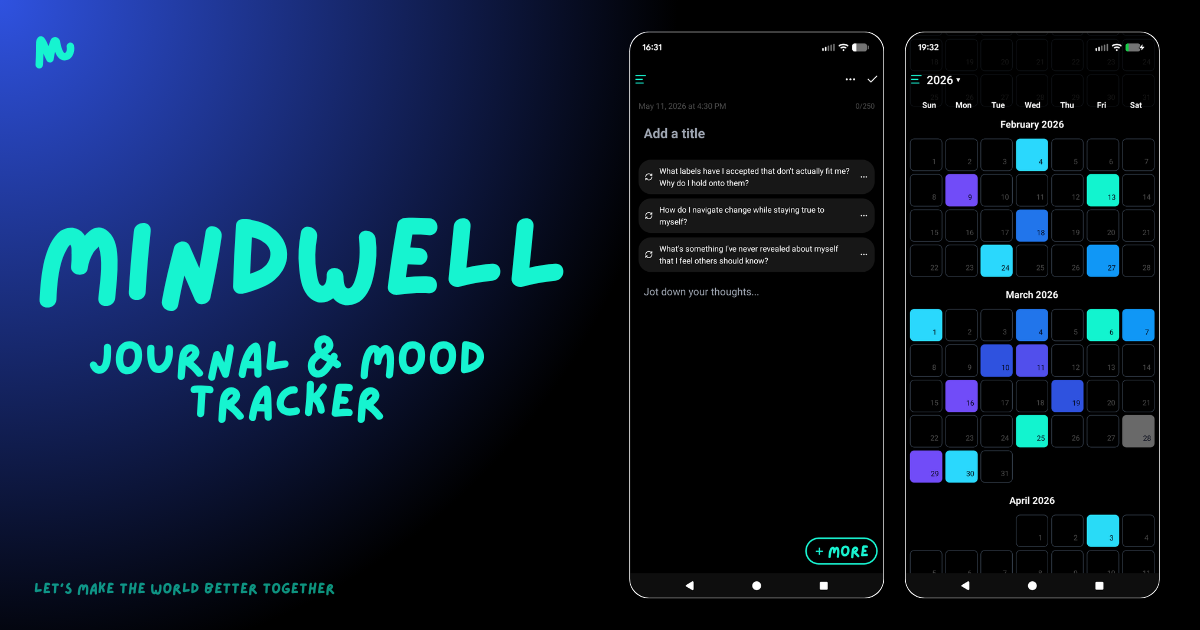
The core product is unglamorous and quite complete. An entry can combine free text, a mood, identity words, photos and voice memos, and moods feed a calendar showing a daily average. When the blank page wins, a library of more than 10,000 prompts across 30+ topics is available, sorted into three types: Action, Self-Reflection and Social. Entries can be shared two ways: as an image through the native mobile sheet, or as a public link whose lifetime you choose and which you can revoke, with 30 links a month on a registered account. A Firebase-backed cloud sync carries entries, moods and media between devices, within storage caps that depend on the plan. A separate learn section collects editorial material on psychological frameworks such as CBT, DBT, ACT, metacognition, meta-emotions and self-compassion, with academic citations.
The AI layer is called Mel, and this is where expectations must be adjusted. Mel is announced for chats, personalized prompts, memories and insights, but the site states plainly that AI is currently disconnected and is planned to return later as an optional feature; OpenAI and Google Gemini are named as the providers for that return. Two of the four plans, AI and AI Pro, are nevertheless sold around that layer, and the AI plan is itself declared to be in beta.
Maturity should be read the same way. Many features are marked coming soon, including themes, layout customization, external backup and the Mel chat itself, and a site banner warns that major updates are rolling out and that some features may be temporarily unstable. The public version log runs from 2.0.06 to 2.2.03, with Mel in beta on the web.
What it does
- Write full journal entries combining text, moods, identity words, photos and voice memos
- Track moods and emotions over time, on a calendar showing an average mood per day
- Draw on more than 10,000 prompts across 30+ topics and three types: Action, Self-Reflection and Social
- Capture a thought in seconds with the Quick Action button when there is no time for a full entry
- Sync entries, moods and media between mobile and web through a Mindwell account
- Share an entry as an image, or as a public link whose lifetime you choose and can revoke at any time
- Export the whole journal as a PDF or a text file, and schedule reminder and prompt notifications
When to use Mindwell / When not to
A quick filter to help you decide if Mindwell is the right fit.
When to use Mindwell
- Beginners in journaling or digital mental well-being, who need a free, guided starting point rather than a blank page
- People who journal regularly and want a long history kept in sync across phone, tablet and computer
- Prompt-driven writers who prefer a very large library of themes to open-ended free writing
- Users who are comfortable keeping their entries mainly on the device, and who like being able to write on mobile without an account
- People who occasionally want to share a reflection with someone close to them in order to open a conversation
When not to use Mindwell
- Anyone looking for care rather than a notebook: the publisher states its guidance is informational only and does not replace professional medical advice, diagnosis or treatment
- Users who require end-to-end encryption, which the service explicitly does not provide, or local app-level encryption, which it says it does not have to date
- Buyers who want working AI today: Mel is declared disconnected, and its chat, insights and memories are still marked coming soon
- Developers and teams with integration or compliance needs: there is no public API or developer documentation, no DPA and no subprocessor list
- People under 13, who are excluded by the terms of service, and non-English speakers, since no other interface language is announced
How to use Mindwell
A typical end-to-end flow, from setup to results.
- Download Mindwell from the App Store or Google Play, or open the web version in a browser
- On mobile, start writing straight away: no account is needed to create your first entries
- On the web, create an account first, since journaling there requires one
- Sign in through Google or Apple if you would rather not manage another password
- Write a full entry when you have time, or tap Quick Action to capture a short note
- Pick a prompt by topic and by type (Action, Self-Reflection or Social) when you do not know where to start
- Turn on notifications in two stages: allow them in your phone settings, then open Settings, Custom Notifications in Mindwell and use the master switch before the individual ones
- Create a share link from the settings, choose when it should expire, and revoke it whenever you want
- Manage your account, security, connected services and deletion at account.mindwell.ai
- Manage or cancel a subscription where you bought it: the App Store, Google Play or Stripe
Pros & Cons
Pros
- A permanent free plan, usable offline and, on mobile, without any account at all
- An unusually deep prompt library: more than 10,000 prompts across 30+ topics and three types
- Three platforms covered from a single account: iOS, Android and the web
- Content ownership left entirely to the user, with an explicit commitment not to sell data
- Unusual candour about the product's real state: AI declared disconnected, absence of end-to-end encryption acknowledged, unreleased features labelled coming soon
- A low paid entry point at 4.99 USD per month, an annual discount at 49.99 USD per year, and self-service account deletion from inside the app
- An editorial learn library on psychological frameworks documented with academic citations, and AI providers named explicitly in the terms
Cons
- The .ai domain and two of the four plans are sold around AI, while the site itself declares AI disconnected
- Many central features are marked coming soon (themes, Mel chat, insights, external backup), and a banner warns of temporary instability while major updates roll out
- No end-to-end encryption, and no local app-level encryption to date
- No published DPA, no subprocessor list, no EU representative under Article 27, and no documented way to exclude your data from model training
- No postal address and no legal notices page anywhere, and no hosting country or region disclosed
- No public API or developer documentation, and no interface language other than English announced
- Billing is delegated to Apple, Google and Stripe, so neither cancellation nor refunds go through the publisher, and a single email address serves support, legal and data protection requests
Pricing & Plans
Mindwell is offered on a freemium basis. A permanent free plan is available at no cost, and the lowest paid entry point is the Cloud plan at 4.99 USD per month, or 49.99 USD per year. The AI plan is priced at 12.99 USD per month or 129.99 USD per year, and AI Pro at 24.99 USD per month or 249.99 USD per year; AI credits may also be purchased as one-off packs at 0.99, 3.99 and 10.99 USD. No time-limited free trial is mentioned anywhere on the site. Payments are processed by the App Store, Google Play and Stripe rather than billed directly by the publisher, who warns that exact pricing, storage limits and sync behaviour may change before and shortly after launch.
- unlimited entries
- mood tracking
- basic cloud backup
- starter prompts and a preview of Mel
- everything in Free
- plus extended backup and sync
- access to thousands of prompts
- all colour modes
- up to 10 custom notifications
- and up to 6 images and 3 voice memos per entry
- everything in Cloud
- plus extended conversations with Mel
- AI insights and more to come
- everything in AI
- plus higher usage caps
- priority processing and more to come
- 1 credit for 0.99 USD
- 5 credits for 3.99 USD
- 15 credits for 10.99 USD
- According to the pricing FAQ
- coming-soon features included in a paid plan are delivered automatically when they ship
Data, GDPR & hosting
A consolidated view of how Mindwell handles your data.
GDPR overview
Mindwell never claims GDPR compliance: the word GDPR appears only in the meta keywords of the privacy page. The policy does list rights of clear GDPR inspiration (access and an electronic copy, rectification, erasure, restriction of processing, objection and portability), but introduces them conditionally, as rights you may have depending on applicable data protection legislation and in certain circumstances. Requests go by email to support@mindwell.ai, and identity verification may be required; deletion is also self-service in the app, under Settings, Account Actions, Delete Account, with some data retained for legal, security or operational reasons. Beyond that, the formal machinery is missing: no EU representative under Article 27, no data processing agreement, no published subprocessor list. The terms are governed by the law of Delaware and impose individual AAA arbitration, with a class action waiver and a 30-day opt-out.
Who owns the data?
Mindwell's terms leave ownership of user content with the user: journal entries, mood logs, voice memos and images remain yours, and Mindwell World LLC states that it claims no ownership of them. In exchange, you grant the publisher a non-exclusive, worldwide, royalty-free, transferable and sublicensable license to operate, improve and enrich the service and to support the company's operations. That license is revocable: deleting your account and requesting deletion of your data ends it, subject to retention obligations. Deletion is self-service in the app, under Settings, then Account Actions, then Delete Account. The publisher states that it does not sell your data.
Reuse rights
Because ownership stays with you, you are free to reuse your own entries as you wish, and the app lets you export the whole journal as a PDF or a text file. On Mindwell's side, entries, moods, media and messages sent to the chatbot are used to deliver insights, prompts and recommendations, alongside behavioral analytics, anonymized reporting, security and legal compliance. AI processing is handled by named third parties: the terms designate OpenAI and Google Gemini, with no stated intention of adding others, while PhotoDNA and Google Cloud Vision are used to detect and prevent illegal content. The terms also state that content may be used, in anonymized or aggregated form, to improve proprietary AI models, under safeguards meant to limit exposure of personally identifiable information. The privacy policy tempers this by saying Mindwell favours test data, demo data, automated evaluations and user feedback to improve prompts and personalization, and that personal journal content is not used for personalized AI-powered features unless you choose to enable or use them. Human review is limited to exceptional cases: support, abuse, fraud, security and legal obligations. Data is shared with service providers under confidentiality obligations and, the publisher says, is not sold. No mechanism for opting out of model training is documented anywhere.
Data retention & training
Hosting summary
Mindwell does not say where its data is hosted. No hosting country or region is declared anywhere on the site, and the domain's IP address resolves to a Cloudflare anycast node, which indicates nothing about where data actually rests. What the publisher does describe is the chain. Entries are stored locally on the device through the app's storage, with no dedicated app-level encryption to date, so local protection rests on the security of the device's operating system. Transmission is encrypted over HTTPS/TLS. In the cloud, data sits with third-party providers, and Mindwell states that it relies on those providers' built-in security features, including encryption in transit and encryption at rest where those services provide it. Sync is built on Firebase, and the site serves its media from mindwell-world.firebasestorage.app. Above all, the service is explicitly not end-to-end encrypted: authorised systems can access data in clear form. No subprocessor list is published, hosting, payment, analytics and security providers being named only by category. The terms are governed by the law of Delaware, in the United States.
Things to keep in mind
Risks and trade-offs to weigh before adopting Mindwell.
- AI is declared disconnected while the .ai domain and two of the four plans are sold around it; the AI plan is itself in beta, and features you pay for may still be marked coming soon at the moment of purchase
- The service is not end-to-end encrypted and has no local app-level encryption, so an intimate diary ends up in infrastructure that authorised systems can read in clear
- A share link is accessible to anyone who holds it, with no authentication; it can be revoked, but a link already forwarded cannot be unsent
- After a cancellation, media above the free plan's cap remain for 90 days and may then be deleted, so exporting before leaving is the safe move
- A banner on the site warns of temporary instability while major updates are being rolled out
- Mindwell is not a medical device and does not replace a health professional; scoring your mood every day can also feed self-diagnosis, or a habit of measuring life rather than living it
- The minimum age is 13, and cancellations and refunds go through Apple, Google or Stripe rather than the publisher
Setup & Integrations
Technical difficulty
Very easy, and deliberately so. On mobile you download the app and start writing, with no account, no API key and no server configuration; signing in through Google or Apple is optional. On the web, the only prerequisite is creating an account before you can journal. The one setting that takes two steps is notifications: you have to allow them in your phone's settings first, then enable them inside Mindwell under Settings, Custom Notifications, using the master switch before the individual ones. No technical integration is involved at any point.
Deployment
Apps stores
Integrations
Behind Mindwell
Social
Resources
All the official URLs gathered for verification and reference.
Frequently asked questions
Is Mindwell free?
Which platforms does Mindwell run on?
Do I need an account to use it?
How is AI used in Mindwell?
Does Mindwell work without an internet connection?
How do I pay, and how do I cancel?
What happens to my data if I cancel a paid plan?
Is a share link private?
What is the minimum age?
How do I delete my account?
Should you pick Mindwell?
Mindwell is a real, shipping product: applications published on both stores, a tracked version log and a working web version. On plain journaling, its proposition is solid. Entries are rich, combining text, moods, photos and voice memos, mood tracking builds up over time, the prompt library is unusually deep, sharing is controlled and revocable, and the journal can be exported. The free plan is genuinely usable, mobile writing works offline and without an account, and the paid entry point is low at 4.99 USD per month.
The gap that matters is between the AI promise and the AI reality. The domain ends in .ai, two of the four plans are sold around AI, and the site nonetheless states that AI is currently disconnected, with Mel's chats and insights marked coming soon and the AI plan itself declared in beta. Subscribing to those tiers today means paying for something announced rather than delivered.
Legal maturity is partial in the same way. There is no postal address, no data processing agreement, no subprocessor list and no EU representative under Article 27; no hosting country is disclosed; and the service is explicitly not end-to-end encrypted. The rights set out in the privacy policy read like GDPR rights, but they are introduced conditionally, and compliance is never claimed.
What redeems the picture is the publisher's candour. Mindwell says its AI is off, says its service is not end-to-end encrypted, labels its unreleased features as unreleased, and leaves content ownership to the user while stating that it does not sell data. For someone who wants a well-stocked, prompt-driven journal on three platforms, free or cheap, it is a reasonable choice. For anyone buying it for the AI, the honest advice is to wait until Mel is reconnected.
- Choosing a selection results in a full page refresh.
- Opens in a new window.