
Olvy
Olvy centralises user feedback from surveys, interviews, support tickets, reviews and sales calls into one workspace, then uses AI to sort, translate, summarise and theme it. It also publishes branded changelogs and embeddable feedback widgets.
What is Olvy?
Olvy is a user feedback platform for product teams, built around two halves that feed each other. The first is a unified repository: feedback arriving through Slack, Discord, Telegram, X, the Google Play Store, Zendesk, Intercom, Crisp, HubSpot, email, bulk upload, a Chrome extension, video capture and more than a thousand applications through Zapier all lands in one workspace instead of scattering across inboxes and channels. An automated component the vendor calls the AI Auto Listener Agent watches those integrations, identifies what is genuine feedback and discards the rest.
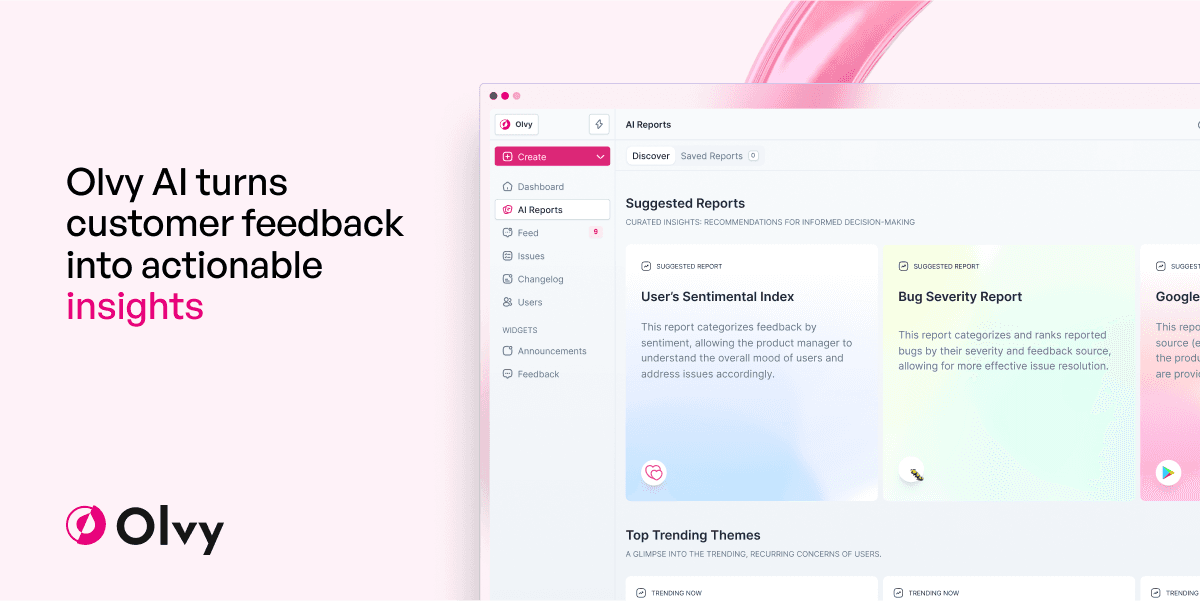
Once collected, each item is enriched automatically. Olvy classifies feedback type so bug reports separate from feature requests, scores sentiment and reports the positive, neutral and negative split, groups recurring concerns into themes with the number and percentage of users affected, fills custom properties through a feature called AutoFills, surfaces repeating keywords, and translates non-English feedback so an international user base stays readable. On top of that sit generative functions: one-click summaries across thousands of items, AI-generated reports, and Ask Olvy, which answers plain-language questions about the qualitative corpus. Reviewers can identify who said what, segment by team or product area, and filter by sentiment, source, type, rating or user. From any item they can create a ticket in Jira, Linear, ClickUp or GitHub.
The second half is changelog and release-note publishing. Olvy hosts an announcement page that can be aligned to a customer's brand, served on a custom domain with SEO settings, scheduled ahead of time, sent to email subscribers, and embedded inside the product through an announcement widget. A separate feedback widget collects input in-app. REST API keys and webhooks unlock from the Business tier.
Olvy was founded by Nishant Arora and Arnob Mukherjee, announced its own shutdown in late 2024, and was instead acquired by Amoeboids in February 2025. It now runs as a standalone product under that Pune-based publisher, a long-standing Atlassian Marketplace vendor.
What it does
- Pull user feedback from Slack, Discord, Telegram, X, Google Play, Zendesk, Intercom, Crisp, HubSpot, email and 1,000+ apps via Zapier into a single repository
- Let an auto-listening agent import genuine feedback automatically and filter out the noise
- Tag each item by type and sentiment, and group recurring concerns into themes with user counts
- Summarise thousands of feedback items in one click and generate reports from them
- Ask questions of your qualitative data in plain language
- Translate incoming feedback written in any language
- Publish a branded changelog on your own domain and embed it in your product
When to use Olvy / When not to
A quick filter to help you decide if Olvy is the right fit.
When to use Olvy
- Product managers drowning in feedback that arrives through five or six different channels at once
- SaaS teams running a public Slack or Discord community alongside Zendesk, Intercom or Crisp support
- Product and UX researchers who need user interviews and survey exports themed and summarised rather than read one by one
- Teams that also have to publish release notes under their own brand, on their own domain, and inside their app
- Small product teams starting from zero, since the free plan carries unlimited release notes and a working feedback widget
When not to use Olvy
- Organisations with a data residency requirement, since no hosting country or region is published anywhere on the site
- Buyers who need a security certification on file: none is claimed for Olvy itself
- Developers who want to evaluate the API before purchase, as no public documentation exists even though REST access is sold with the Business tier
- Teams needing a mobile app for their reviewers, since Olvy ships no iOS or Android application
- High-volume operations on a small budget, because analysis is capped at 25 items on the free plan and 100 on Essentials
How to use Olvy
A typical end-to-end flow, from setup to results.
- Create a workspace at app.olvy.co, starting on the permanent free plan
- Connect the channels your users already talk on, such as Slack, Discord, X, Zendesk, Intercom, Crisp or HubSpot
- Route anything else in through Zapier, email, bulk upload of survey responses, or the Chrome extension
- Drop the feedback widget into your product so users can report directly from where they are
- Let the auto-listener import genuine feedback and discard the noise
- Review the automatic enrichment: feedback type, sentiment, themes and custom properties
- Filter and segment by team, product area, rating or user, then read the themes rather than the raw items
- Run a summary or a report across the corpus, or ask a question in plain language with Ask Olvy
- Push the items worth acting on into Jira, Linear, ClickUp or GitHub as tickets
- Publish the resulting release notes on your branded changelog and push them to subscribers and the in-app widget
Pros & Cons
Pros
- One workspace for feedback that would otherwise sit in twenty different places, with the integrations named individually rather than promised in bulk
- Enrichment happens without manual triage: type, sentiment, themes and custom properties are applied automatically
- Customer results are published with names and numbers attached, including a 65% productivity gain at LottieFiles and eight-fold faster feedback handling at Casablanca
- The free plan is permanent rather than a countdown, and already carries unlimited release notes and a working widget
- Branded changelog on a custom domain with an in-app widget, which few feedback tools bundle in
- Feedback translation makes a non-English user base usable rather than ignorable
- A signed DPA is downloadable directly, and the GDPR framework is documented in concrete terms rather than asserted
Cons
- A /sunset page announcing the product's shutdown on 15 February 2025 is still live and listed in the sitemap, with nothing on it saying it has been superseded
- The site's own privacy and terms pages are empty shells that redirect to another domain, and the GDPR page still names a company that announced its own liquidation
- Nothing is published about where data is hosted, and no subprocessor list exists beyond Stripe being named as payment provider
- No security certification is claimed for Olvy, and no public API documentation exists even though API access is sold with the Business tier
- Annual prices are behind a Monthly/Yearly toggle that never renders in the page source, so the advertised discount cannot be verified before signing up
- Analysis quotas are low outside the Business tier, at 25 items on Free and 100 on Essentials, and Essentials bills each integration separately
- Support runs Indian business hours with a two-working-day response target, and the terms disclaim any uptime warranty
Pricing & Plans
A permanent free plan is available and is not time-limited. The lowest paid entry point is the Essentials plan at USD 60 per month, followed by Business at USD 240 per month and an Enterprise tier priced on request. Additional seats, described as builders, cost USD 25 per month each, and Essentials bills each integration at USD 20 per month. A Monthly/Yearly toggle and a 20% discount badge suggest cheaper annual rates, but those amounts are not rendered in the page and cannot be confirmed.
- 1 builder
- unlimited release notes
- SEO settings
- up to 25 feedback items analysed
- announcement and feedback widgets
- 1
- 000 unique visitors per month
- feedback by email
- everything in Free
- 1 builder
- extra builders at USD 25 per month
- USD 20 per month per integration
- up to 100 feedback items analysed
- advanced customisation
- 2 widgets
- no Olvy branding on widgets
- everything in Essentials
- 5 builders
- unlimited viewers
- up to 10
- 000 feedback items analysed
- feedback summarisation
- unlimited widgets and integrations
- changelog email subscriptions
- everything in Business
- customised limits
- bulk user import
- single sign-on and SAML
- audit logs
- custom contract and invoicing
- priority support
- custom integrations
Data, GDPR & hosting
A consolidated view of how Olvy handles your data.
GDPR overview
GDPR compliance is claimed explicitly and backed by concrete instruments. A dedicated page describes an Article 28 data processing addendum incorporating the EU Standard Contractual Clauses and the UK International Data Transfer Addendum, a record of processing activities kept under Article 30(1) and 30(2), a company-wide data discovery exercise, a formal retention schedule invoking minimisation and storage limitation, and a breach notification procedure covering both customers and supervisory authorities. The privacy policy separately enumerates the rights of access, rectification, erasure, portability, objection and restriction, and a signed DPA is downloadable without having to ask. Two gaps remain: no representative is designated under Article 27 even though the publisher is established outside the EU, and the GDPR page is still written in the name of Olvy Inc. rather than the current operator.
Who owns the data?
The publisher describes a split role: it acts as data controller for information submitted through the website, and as data processor for the customer data handled inside the platform. Customer content therefore remains the customer's. The applicable privacy policy lists what is collected on the vendor's own account, namely names, email addresses, usage data and IP addresses, and states that no payment information is collected or stored, all transactions being handled by Stripe. The publisher commits not to sell, trade or otherwise transfer user data to third parties for marketing or advertising purposes. Account deletion can be requested at any time, and analytics, marketing and cloud hosting providers are mentioned generically without being named.
Reuse rights
Stated purposes are limited and enumerated: operating and improving the service, analysing usage trends and system performance, enforcing security and preventing fraud, and communicating with users about the service, support and legal obligations. Third-party providers may be engaged for analytics, marketing and cloud hosting, bound by contract and applicable data protection law, but none is named beyond Stripe. Data is explicitly not sold or transferred for marketing or advertising. Customers exporting their own workspace content face no stated restriction on reuse. Nothing in the applicable terms or privacy policy addresses whether customer data is used to train AI models, in either direction, and no exclusion option is documented.
Data retention & training
Hosting summary
Hosting is the least documented part of Olvy's paperwork. No country, region, cloud provider or data centre is named anywhere on the site or in the applicable privacy policy, which refers only generically to third-party providers supporting analytics, marketing and cloud hosting functions. The domain resolves to a Cloudflare anycast address, which reflects the CDN edge and says nothing about where data actually rests. What is stated concerns jurisdiction and safeguards rather than location: both the applicable terms and the privacy policy are governed by the laws of India, with exclusive jurisdiction in Indian courts, and the publisher and its team are established in Pune. Transfers out of the EU and the UK are covered by an Article 28 processing addendum incorporating the EU Standard Contractual Clauses and the UK International Data Transfer Addendum. Security measures are described as encryption of stored data, strict access controls and regular audits, but no certification is claimed for Olvy. Buyers with a residency requirement will need to ask directly.
Things to keep in mind
Risks and trade-offs to weigh before adopting Olvy.
- A page at /sunset, still live and listed in the sitemap, announces that Olvy shut down on 15 February 2025 and that the company was liquidated. It was superseded by the February 2025 acquisition, but nothing on the page says so, and a visitor arriving there could reasonably believe the product is dead
- The support address support@olvy.co appears only on that outdated page and is obfuscated in the page source. Whether it is still monitored is not established; the applicable terms route support to the publisher's Atlassian service desk instead
- The site's privacy and terms pages contain no text and redirect to another domain, while the GDPR page is still written in the name of Olvy Inc., an entity that announced its own liquidation. Establishing which document actually binds you takes more effort than it should
- No hosting country, region or provider is published, and no subprocessor list exists beyond Stripe as payment provider. Organisations with data residency obligations cannot answer that question from the site alone
- Nothing in the applicable terms or privacy policy addresses whether customer feedback is used to train AI models, and no exclusion option is documented. Feedback often carries names, emails and complaints about real people
- Automatic sentiment scoring and theming are convenient enough to be taken at face value. Treating an AI-assigned theme or percentage as a measured fact, rather than a summary worth spot-checking against the raw items, is an easy habit to fall into
- The terms disclaim any warranty on uptime or availability, and support runs Indian business hours with a two-working-day response target, which is worth knowing before making the tool part of a critical workflow
Setup & Integrations
Technical difficulty
Low to moderate, depending on how far you go. Signing up and connecting the prebuilt integrations is self-service, and Zapier covers anything not natively supported. Two steps need real access: embedding the announcement or feedback widget requires putting code into your product, and hosting the changelog on a custom domain requires a DNS change. One published customer describes doing both in a few hours. API keys and webhooks unlock at the Business tier, though the absence of public documentation makes advance planning harder. SSO, migration from another tool and guided onboarding are Enterprise-only.
Deployment
Integrations
Supported languages
Behind Olvy
Fundraising
Social
Resources
All the official URLs gathered for verification and reference.
Alternatives
Tools that compete with or complement Olvy.
Frequently asked questions
What exactly is a builder in Olvy's pricing?
Is the free plan permanent or a trial?
Which channels can Olvy pull feedback from?
Does Olvy have an API, and is it documented?
Is Olvy still running? There is a shutdown page on the site.
Who operates Olvy today?
How long is my data kept if I close my account?
Where is the data hosted, and is a DPA available?
Is my feedback data used to train AI models?
Should you pick Olvy?
Olvy is a real, working product with an unusually messy paper trail. On the product side the evidence is solid: four priced tiers detailed in full, a live application, an active changelog, around twenty individually named integrations, twenty published competitor comparisons, and three named customers with attributed numbers rather than anonymous testimonials. The combination it offers is genuinely uncommon, since most feedback tools stop at analysis and leave the release-note side to someone else. For a product team fielding input across Slack, support tickets, app store reviews and interviews, the automatic classification, theming and summarisation address a real and tedious problem, and the permanent free plan makes it cheap to test the claim.
The reservations are almost entirely about what happened after the ownership change. A page announcing the product's shutdown is still online and indexed, with nothing marking it as superseded, and a visitor who lands on it first would reasonably conclude the tool is dead. The site's own privacy and terms pages are empty redirects, and the GDPR page still speaks in the name of a company that announced its own liquidation. Separately, nothing is published about hosting location, subprocessors or security certification, no API documentation exists despite API access being sold, and the applicable documents are silent on whether customer data trains AI models.
None of this makes the tool untrustworthy, but it does shift work onto the buyer. Anyone with procurement, residency or security requirements should get written answers before committing, and should treat support@olvy.co with caution since it appears only on the outdated shutdown page. For teams without those constraints, the free plan is a low-risk way to judge the analysis quality first-hand.
- Choosing a selection results in a full page refresh.
- Opens in a new window.