
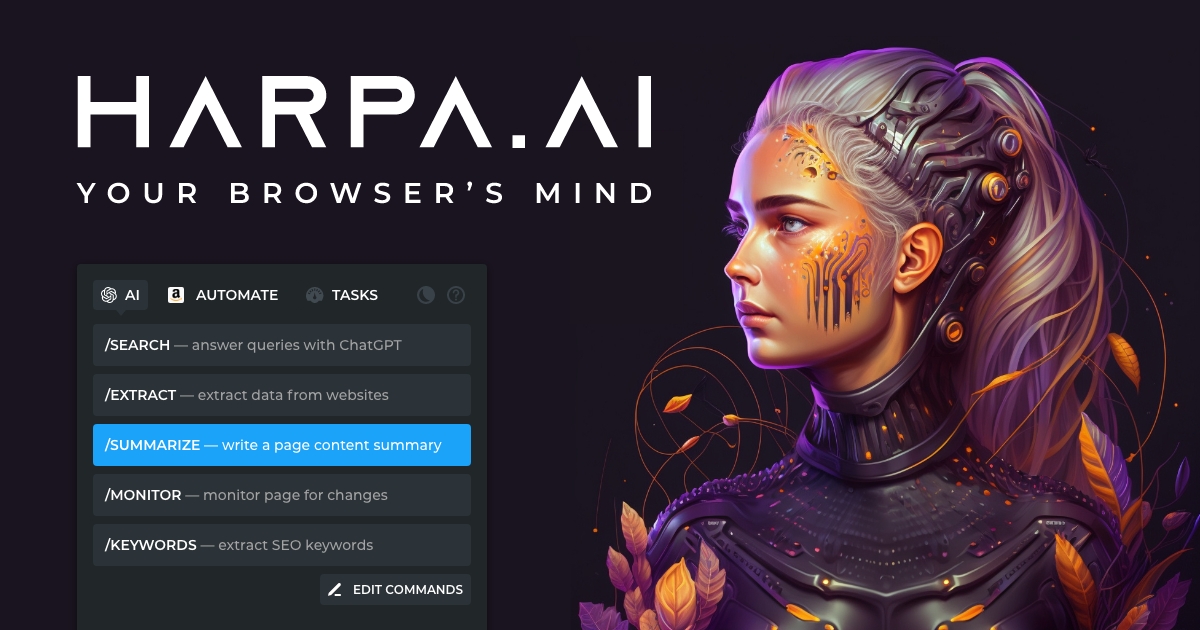
HARPA AI
HARPA AI is a Chrome-family browser extension that puts GPT, Claude, Gemini, Perplexity, DeepSeek and Grok on any web page, then adds a web automation engine able to scrape data, monitor sites and act on them.
What is HARPA AI?
HARPA AI is a browser extension for Chrome, Brave, Opera, Edge and Chromium that turns the browser into an AI agent. The name stands for High Availability Robotic Process Automation, and the product is built on a hybrid engine: a conversational assistant that can read the page you are on, coupled with an automation layer that can navigate, click, fill forms and extract data on its own. It opens on any site with Alt+A, or ^+A on a Mac.
Rather than tying the user to one provider, HARPA aggregates several. Its CloudGPT connection gives access to GPT-5.4, Claude Sonnet 4.6, Gemini 3.1 Pro, DeepSeek V3, Perplexity Pro, Grok 4.1 and Llama 4. Alternatively, users can plug in their own web sessions with ChatGPT, Claude or Gemini, subject to those providers' rate limits, or their own API keys, including OpenRouter, Straico and Azure. MCP connections are also supported, letting the assistant route a request to whichever connected server advertises the right tool.
Day to day, the extension ships with more than a hundred page-aware commands, reachable by typing a slash in the chat, plus a quick-access bar with one-letter shortcuts to finish a draft, fix grammar, rephrase, translate, search or explain. It summarises pages, PDFs and YouTube transcripts, answers alongside Google search results with citations, writes long-form articles across twenty-five writing frameworks, generates and edits images in the chat, and handles vision tasks. Long inputs are cut into chunks automatically so they fit a model's context window.
The automation side is what separates it from a simple chat overlay. Each browser running the extension becomes a Node with its own identifier, capable of executing scheduled recipes: monitor a page, track a competitor, watch a price, scrape a listing, then send the result to Google Sheets, a CRM or an IFTTT chain. The GRID REST API exposes the same capabilities to Zapier, Make.com, n8n, Microsoft Power Automate, Workato and UiPath, with a key issued per team space.
The publisher is HARPA AI TECHNOLOGIES LLC, based in Espoo, Finland. The homepage claims 500,000 professional users and an average rating of 4.7.
What it does
- Summarise web pages, blog posts, PDFs and long YouTube videos, with jumps to timestamps
- Chat with any page using GPT, Claude, Gemini, Perplexity, DeepSeek, Grok or Llama
- Draft, finish, rephrase, proofread and translate text directly on the site you are viewing
- Extract data from any website and push it to Google Sheets, CSV, JSON or a CRM
- Monitor pages, competitors and prices, and get alerted when something changes
- Triage a Gmail inbox: categorise, summarise threads and draft replies in your own tone
- Run browser automations remotely from Zapier, Make.com or n8n through the GRID REST API
When to use HARPA AI / When not to
A quick filter to help you decide if HARPA AI is the right fit.
When to use HARPA AI
- Marketing, SEO and content professionals who research, write and publish inside the browser all day
- Sales and lead generation teams that source, enrich and contact prospects from web pages and LinkedIn
- Support and operations staff who triage inboxes, summarise long threads and draft replies at volume
- Analysts, researchers and journalists who need long pages, PDFs and hour-long videos condensed with sources
- No-code automation builders who want a browser wired into Zapier, Make.com or n8n through the GRID API
When not to use HARPA AI
- Firefox and Safari users: the extension only covers Chrome, Brave, Opera, Edge and Chromium
- Anyone who needs a mobile app: there is no iOS or Android version
- Teams looking for a server-side API, since GRID drives a browser that has to stay open
- Buyers who want a refund guarantee: the vendor states plainly that it offers none
- Organisations whose procurement requires an audited certification, a DPA or a formal subprocessor list
How to use HARPA AI
A typical end-to-end flow, from setup to results.
- Install the extension from the Chrome Web Store through the vendor's install link, then pin it to the browser toolbar
- Create a HARPA account on the website and stay signed in, since the plan status is read from that session
- Open the assistant on any page with the toolbar icon, Alt+A, or ^+A on a Mac
- Pick an AI connection at the bottom left: CloudGPT on a paid plan, your own API key, or a web session with ChatGPT, Claude or Gemini
- Click DEFAULT next to the chosen connection so every new chat opens with it
- Switch to the AI tab, ask a question, and turn on page-aware mode when you want the assistant to read the current page
- Type a slash in the chat to list the built-in commands, or a keyword such as /article or /rewrite to filter them
- Create custom commands as a sequence of steps: navigate, click, extract, run through a model, then send the result somewhere
- Use the AUTOMATE tab to set up page monitors or schedule commands, keeping in mind that the browser must stay open
- For team or external use, have a space admin generate a GRID API key in the extension and connect it to Make.com, Zapier or n8n
Pros & Cons
Pros
- One subscription replaces several separate AI subscriptions, which is the vendor's central pricing argument
- Model freedom: CloudGPT, your own API keys or plain web sessions, switchable at any time
- Real browser automation rather than chat alone, including clicks, forms, scraping and scheduling
- Page content is extracted and processed locally, and the vendor states it keeps no logs or data on its servers
- REST API and no-code connectors make the browser usable as a step inside existing workflows
- A one-off lifetime plan exists and is kept on the account even after moving to a subscription
- The publisher is established in the European Union, under Finnish law and the GDPR
Cons
- No refunds and no discounts, stated as firm policy including on the lifetime plan
- No Firefox version, no mobile app, and no server-side API: automations need an open browser
- Pricing on the site is geolocated, so the amount and currency a visitor sees depend on where they are
- The homepage FAQ still quotes a lower entry price than the live plan catalogue, an inconsistency inside the site
- Token consumption varies with the model and with page-aware context, which makes budgeting hard to anticipate
- The ISO 27001 badge on the homepage links to a Wikipedia article, not to a certificate: no audited certification is published
- No DPA, no formal subprocessor list, no about page and no named executive
Pricing & Plans
A permanent free plan is available. The DEMO tier allows web session connections to ChatGPT, Claude and Gemini limited to ten messages per day, up to one hundred AI command runs in total, and access to predefined and custom commands as well as web monitors; a demo period also covers the premium features. The cheapest paid entry point observed is the S1 plan at 15.13 CHF per month, or 181.61 CHF per year. Prices are displayed in the visitor's local currency, so the figure above corresponds to a Swiss reading of the pricing page and will differ elsewhere. Billing is handled by FastSpring, and the vendor states that it offers no refunds.
- free
- limited to ten web session messages a day and one hundred AI command runs in total
- with predefined and custom commands and web monitors
- 15.13 CHF per month or 181.61 CHF per year
- 75 megatokens a year on annual billing
- cloud models
- web sessions
- API connections
- vision
- PDF summaries
- cross-device chat history
- 20.54 CHF per month or 246.47 CHF per year
- 225 megatokens a year
- everything in S1 plus command scheduling and advanced automation
- with an extra seat at ten percent off
- 57.29 CHF per month or 562.12 CHF per year
- 259.44 CHF once
- single user
- 30 non-renewing megatokens
- own API keys or unlimited web session connections for life
- with an automatic forty percent discount on token purchases
- 20 megatokens for 21 CHF
- advertised as a twenty-five percent discount
- with a unit megatoken at 1.41 CHF
Data, GDPR & hosting
A consolidated view of how HARPA AI handles your data.
GDPR overview
GDPR compliance is claimed explicitly and in several places. The security page states that HARPA is fully compliant with GDPR and CCPA, and the terms place the agreement under Finnish law and applicable European Union legislation, the GDPR included. The privacy policy, effective 26 December 2021, carries a dedicated GDPR section: the company identifies itself as data controller and lists the rights of access, rectification, erasure, objection, restriction, portability and withdrawal of consent, plus the right to complain to an EEA supervisory authority. Requests go to a single generic support address, and identity may be verified first. Marketing consent is opt-in and revocable from account settings. No Article 27 representative is named, which is consistent with a company established in Finland, and no data protection officer is designated.
Who owns the data?
The terms are explicit that users keep ownership of what they produce. HARPA AI TECHNOLOGIES states that it has no access to and does not store the content generated with the software, and therefore does not act as its custodian; users retain all rights to the content they submit or process, and remain responsible for its legality and for the rights of third parties. For personal data, the picture is different: the company declares itself a data controller under the GDPR for the account, usage and cookie data it collects. Page content read by the extension is processed locally in the browser before being sent to the language model provider the user has chosen.
Reuse rights
Users may reuse whatever they generate without asking permission: the terms confirm they retain all rights over that content and are solely responsible for storing and distributing it. The vendor does not claim a licence over generated output, only over feedback voluntarily sent to it, which becomes the company's property. The counterpart is that users must hold the licences and permissions for any third-party material they process, must respect copyright and privacy rights, and may have their account terminated for infringement. Personal data collected by the company is used for delivering and improving the service, support, billing, analytics and similar-product marketing, with an unsubscribe route; the company states it does not sell data or show ads.
Data retention & training
Hosting summary
The publisher states that its servers sit in the United States and in Germany, described as jurisdictions with strict privacy laws, and that it keeps no logs or user data on them. Users located outside the European Union are told that their data is transferred into the EU and processed there. Most page content never reaches those servers at all: the extension extracts and processes browsing data locally, before sending only what is needed to the language model provider the user has selected. The declared security measures are encryption of client-to-server and server-to-server traffic, encryption of the database, salted hashes for account passwords, access control limited to DevOps and database administrators, minimisation of stored personal data, and automatic deletion once data is no longer needed. No audited certification such as SOC 2 or ISO 27001 is published; the homepage carries an ISO badge that links to a general reference rather than to a certificate.
Things to keep in mind
Risks and trade-offs to weigh before adopting HARPA AI.
- The extension needs permission to read and change data on all sites, and its automations can reach content behind a login and run custom JavaScript
- Prompts leave for OpenAI, Google or Anthropic depending on the connection chosen, so their policies also govern what happens to that text
- The ISO 27001 badge on the homepage is not backed by a published certificate, auditor or reference number and should not be read as proof of certification
- No data processing agreement and no formal subprocessor list are published, which will block adoption in regulated environments
- No opt-out from model training is documented; the vendor's position rests on the claim that no training takes place at all
- Delegating summarising, writing and reading to an always-present assistant can quietly erode the habit of reading sources in full and checking them
- Automated scraping, monitoring and outreach can breach the terms of the sites being targeted, and responsibility for that sits with the user
Setup & Integrations
Technical difficulty
Basic use requires no technical skill: install the extension, sign in, press Alt+A. The one real decision is the AI connection, since a provider account, an API key or a paid CloudGPT plan is needed before anything works. Custom commands are built as a sequence of steps and stay accessible without code. The GRID API is a step up: an admin issues a key, a node is configured per browser profile, and calls go through REST or through Make.com, Zapier or n8n. Scheduled runs require the browser to stay open.
Deployment
Integrations
Supported languages
Behind HARPA AI
Social
Resources
All the official URLs gathered for verification and reference.
Alternatives
Tools that compete with or complement HARPA AI.
Frequently asked questions
What is HARPA AI?
Which browsers does it support?
Which AI models can I use with it?
Is there a free version?
How much does the cheapest paid plan cost?
What is a megatoken?
Is there an API?
Is my data used to train AI models?
Where is the data hosted?
Who publishes HARPA AI, and is there an age limit?
Should you pick HARPA AI?
HARPA AI is a mature, actively maintained product rather than an experiment. The domain was registered in January 2021, the earliest archived capture dates from April 2022, and the publisher, HARPA AI TECHNOLOGIES LLC, operates from Espoo in Finland under Finnish law and the GDPR. Its proposition is straightforward: pool several AI subscriptions into one, then add something those subscriptions do not offer, namely a browser that can act on its own. For people who spend their working day inside a browser tab, that combination is genuinely useful, and the GRID API extends it to teams that already run Zapier, Make.com or n8n.
The reservations are practical rather than fundamental. Refunds do not exist, discounts are refused on principle, and the lifetime plan is sold as is. Pricing is geolocated, so the figure a visitor sees depends on where they stand, and the homepage FAQ still quotes an entry price that the live catalogue contradicts. Consumption is billed in megatokens, which is transparent per request but hard to forecast for heavy page-aware automation. On the compliance side, the privacy commitments are clearly written and the local-processing design is a real argument, but the ISO 27001 badge on the homepage links to an encyclopaedia entry rather than to a certificate, no data processing agreement is published, and third-party processors are named only inside the body of the privacy policy.
Recommended for individuals and small teams who want one browser assistant that also automates. Organisations with formal procurement requirements should ask the vendor directly for the documentation the site does not publish.
- Choosing a selection results in a full page refresh.
- Opens in a new window.