
Mentara
Mentara is an AI coaching platform for startup founders. It runs ten-minute voice interview simulations modelled on Y Combinator, analyses pitch decks, and rehearses term sheet negotiations, returning a score and written feedback after every session.
What is Mentara?
Mentara is an AI coaching service for startup founders, published by Mentara Inc. Its privacy notice calls the product Mentara Founder Coach and describes it as an AI founder support system around coaching, training and mentoring. The pitch is explicit: founders perform under pressure like elite athletes, human coaching is expensive and limited to one person's perspective, so the company offers practice on demand instead.
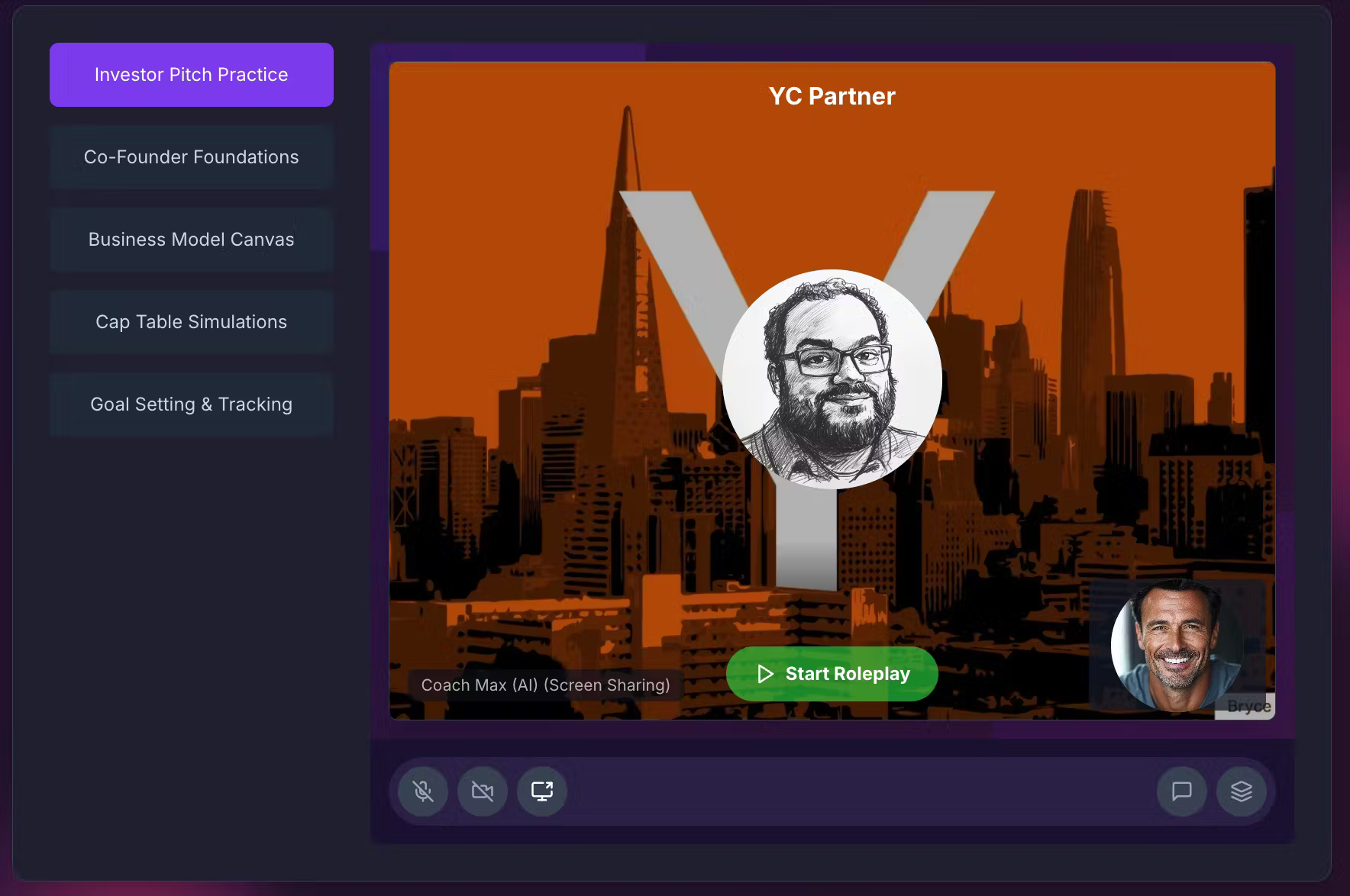
The first module shipped is a Y Combinator interview simulator. Sessions last ten minutes, run as a spoken conversation in the browser, and are designed to push on metrics and challenge vague answers, returning feedback straight away. A second pack covers the TechStars interview. Around that core the platform advertises five themes: investor pitch practice, co-founder foundations, business model canvas, cap table simulations, and goal setting and tracking.
Sessions are spoken rather than typed. The site loads a voice activity detection library and the browser runtime it needs, and the interface offers camera controls and face login alongside the microphone. While you talk, the AI generates interactive cards. Separately, you can upload a pitch deck as a PDF and receive an assessment of clarity, data-backed reasoning and narrative depth, downloadable as a report.
What comes back afterwards is the substance of the product: a YC interview score with ranking tiers, strengths, areas to improve, an investment-readiness indicator, a conversation summary and progress against goals. The agent keeps memory between sessions, recalls the previous session's summary, can search the web and can query a coaching knowledge base. A roleplay generator builds a complete counterpart for a business meeting, with name, title, company, sector, organisation size, decision style and buying authority, plus governance rules such as who holds a budget veto.
Technically it is a React single-page application hosted on Vercel, with Supabase for data and accounts, Groq for inference and Stripe for payment; sign-in is through Google only. The interface is English-only, with no API, no mobile app and no third-party integrations. The homepage claims more than a thousand founders, a 4.6 satisfaction rating and an NPS above 94, self-declared figures that sit awkwardly beside a 500+ founder count shown on the same page.
What it does
- Run a ten-minute Y Combinator interview simulation that presses you on metrics and challenges vague answers
- Upload a pitch deck as a PDF and receive a written analysis of its clarity, data and narrative depth
- Rehearse the investor Q&A of the kind asked at Demo Day
- Negotiate a term sheet in simulation
- Work through a capitalisation table in a dedicated simulator
- Roleplay a business meeting against a generated counterpart with a defined role, company and buying authority
- Set goals and track progress across sessions, with a score and written strengths and weaknesses each time
When to use Mentara / When not to
A quick filter to help you decide if Mentara is the right fit.
When to use Mentara
- Founders preparing for a Y Combinator or TechStars interview, who need to rehearse the format many times before the real thing
- Startup teams in the middle of a fundraise, working on investor Q&A, Demo Day questions and term sheet negotiation
- Technical founders who need to turn a technical story into a business narrative investors will follow
- Co-founder pairs wanting to rehearse the difficult conversations about roles, equity and decision-making before they matter
- Anyone who wants unlimited on-demand practice at a fraction of the cost of a human coach, with a written score after each attempt
When not to use Mentara
- Anyone looking for a substitute for a human coach, therapist or licensed adviser, which the terms of service rule out explicitly
- Founders needing regulated legal, financial or medical advice, which the terms forbid the AI from providing
- Teams wanting to work on confidential company material, since the terms prohibit submitting confidential business information
- Users under 18, who are excluded from the service
- Anyone needing an API, a mobile app, third-party integrations or a language other than English
How to use Mentara
A typical end-to-end flow, from setup to results.
- Sign in with a Google account, the only sign-in method offered
- Complete the conversational onboarding, in which the AI collects your occupation, your main goal and your first milestones
- Claim the two free practice sessions credited on sign-up
- Choose a session bundle, or spend the free credits you already hold
- Pick an interview partner or coach from the list
- Select the focus areas you want the session to cover
- Add any free-text notes so the coach can prepare
- Allow microphone access and begin the session immediately, or schedule it for later
- Optionally upload a pitch deck as a PDF for separate analysis
- Read the session report, covering score, strengths, areas to improve and conversation summary, then track progress in your dashboard
Pros & Cons
Pros
- A genuinely narrow focus on the YC interview and the fundraise, where most AI coaches stay generic
- Real-time voice sessions come far closer to an actual interview than a text exchange
- Immediate, quantified feedback: a score, ranking tiers, strengths and weaknesses in writing
- Unlimited repetition without booking a human, one published testimonial mentioning more than thirty sessions
- Cross-session memory and goal tracking mean progress accumulates instead of restarting each time
- A real trial without a card: two free sessions, plus ten more for booking a ten-minute call
- Unusually complete legal documentation for a company this size, including a published DPA and a documented training opt-out
Cons
- No usable postal address: the privacy notice leaves TBD placeholders where the registered office should be
- The trust portal cited in the data processing addendum does not resolve at all, and the business terms URL it references does not exist
- The terms describe recurring subscriptions and a pricing page that bear no relation to what is actually sold
- No public pricing page, so you must enter the application to discover what anything costs
- AI outputs belong to Mentara, payments are non-refundable, and confidential business information is contractually unwelcome
- No API, no mobile app, no integrations and English only
- A very young and opaque company: domain registered in November 2024, no named team, no documented funding, and site content largely frozen since
Pricing & Plans
Mentara offers free credits on entry rather than a permanent free plan: two practice sessions are granted on sign-up, and a further ten for booking a ten-minute call with the team. Beyond that, the service is sold as one-off bundles of sessions rather than as a subscription. The lowest paid entry point is USD 12.00 for three sessions. There is no public pricing page, the prices being shown only inside the application. Payments are processed by Stripe and are stated to be non-refundable unless the law requires otherwise.
- 2+1 YC Interviews — 3 sessions — USD 12
- 4+2 YC Interviews — 6 sessions — USD 20
- TechStars Interview Mastery — 3 sessions — USD 49.99
- Free credits on entry — 2 sessions on sign-up
- plus 10 sessions for booking a ten-minute call with the team
- Enterprise — Mentara Coach Enterprise
- referenced in the interface and in the data processing addendum
- with no published price
Data, GDPR & hosting
A consolidated view of how Mentara handles your data.
GDPR overview
GDPR implementation is concrete rather than merely declaratory. The privacy notice, effective 3 November 2024, sets out the legal bases relied on, namely consent, performance of a contract, legitimate interests, legal obligations and vital interests, and lists the rights of access, rectification, erasure, restriction, portability, objection and non-subjection to automated decision-making, together with the right to complain to a supervisory authority. A Data Protection Officer is named under Article 37. Transfers rely on the European Commission's Standard Contractual Clauses with a UK addendum, and a Data Processing Addendum is published, under which Mentara Ltd. handles EEA and Swiss data, with the ICO as competent supervisory authority. Two gaps stand out: no Article 27 EU representative is designated, and the controller's postal address is left as a TBD placeholder.
Who owns the data?
Under the terms of service, ownership is split. Your inputs remain your property, and you keep your rights in any content you submit, but you grant Mentara Inc. a worldwide, non-exclusive, royalty-free licence to use, copy, modify, create derivative works from, distribute and publicly display that content in order to operate the service. The AI's outputs, by contrast, are owned by Mentara rather than by you. Usage licences are described as non-exclusive and training-data rights as limited. The platform itself, with all its intellectual property, remains the exclusive property of Mentara and its licensors, and any feedback you offer may be reused freely and without compensation.
Reuse rights
Your sessions are recorded and stored, and Mentara analyses conversation patterns to improve the AI's coaching. Individual conversations may be read by staff for quality assurance, and anonymised conversation data may be used for research and development. Inputs, outputs and personal data are passed to named third-party AI providers: Anthropic, OpenAI, Google Cloud AI, Microsoft Azure AI, Amazon Web Services AI and NVIDIA AI. You can opt out of having your data used for AI training, either through your account controls or by contacting the company, and you can request deletion of your conversation history. Mentara states that it has not sold or shared personal information with third parties for commercial purposes in the preceding twelve months.
Data retention & training
Hosting summary
Mentara states plainly that its servers are located in the United States, and its terms add that the service is controlled and operated from facilities there. No choice of hosting region is offered to the user. Transfers out of the United States are covered by the European Commission's Standard Contractual Clauses, supplemented by a UK addendum, and the published data processing addendum allocates EEA and Swiss data to an entity called Mentara Ltd. and United Kingdom data to Mentara Inc., naming the Information Commissioner's Office as competent supervisory authority. The visible infrastructure is Vercel for hosting, Supabase for the database, accounts and stored media, and Groq for model inference, with Anthropic, OpenAI, Google Cloud AI, Microsoft Azure AI, Amazon Web Services AI and NVIDIA AI named as AI providers. Two caveats matter. No security certification such as SOC 2 or ISO 27001 is claimed, the addendum describing only generic industry best practices. And the trust portal meant to document those measures in detail cannot be reached, because its subdomain does not resolve.
Things to keep in mind
Risks and trade-offs to weigh before adopting Mentara.
- Ownership runs the opposite way to what users expect: the AI's outputs belong to Mentara, not to the founder who produced them in session
- The terms forbid submitting confidential business information, yet the natural use of a pitch rehearsal tool is to discuss exactly that, so read the boundary carefully before uploading a deck
- Sessions are recorded, may be read by staff for quality assurance and are sent to third-party AI providers, and the declared data categories include voiceprints and other biometric information
- Rehearsing against an AI can breed false confidence, since a simulated investor concedes where a real one would press harder
- Leaning on generated narratives can erode a founder's own ability to reason about the business, and the score is a proxy for investor judgement rather than the thing itself
- The company is hard to hold accountable: no postal address, no named officers, dead links inside its own contractual documents and non-refundable payments
- European users have no Article 27 representative to turn to, and the site has barely changed since November 2024, so check the service is still maintained before committing
Setup & Integrations
Technical difficulty
Very low. There is nothing to install, since Mentara runs entirely in the browser, with no API key, no configuration and no integration to wire up. You sign in with a Google account, the only method offered, and a conversational onboarding collects your role, your main goal and your first milestones. The only real requirements are a working microphone, because sessions are spoken, and a browser able to run the voice-detection component. The two genuine points of friction are the dependence on a Google account and the absence of any alternative sign-in.
Deployment
Supported languages
Behind Mentara
Social
Resources
All the official URLs gathered for verification and reference.
Frequently asked questions
What exactly does Mentara do?
What is the YC interview simulator?
How much does Mentara cost?
Is there a free trial?
Are my conversations used to train the AI?
Where is my data hosted?
Is there a mobile app or an API?
Can it replace a human coach?
Should you pick Mentara?
Mentara is a deliberately narrow product, and that is its strength. Rather than another general-purpose AI coach, it targets one expensive, high-stakes exercise, the Y Combinator interview and the fundraising conversations around it, and lets founders repeat it at will. The ten-minute voice format, the scored report and the memory carried between sessions make that repetition genuinely cumulative, and the entry cost is close to nothing: two free sessions on sign-up, ten more for a short call, and USD 12 for three sessions after that.
The counterweight is the company behind it. Mentara Inc. registered its domain in November 2024 and remains largely anonymous: no postal address beyond a placeholder, no named team, no documented funding and no identifiable beneficial owner. Its own contractual documents point at resources that do not exist: a trust portal whose subdomain does not resolve, business terms at a dead URL. The terms of service describe recurring subscriptions and a pricing page that bear no relation to the session bundles actually sold, suggesting boilerplate rather than a drafted agreement.
Against that, the legal documentation is more serious than the company's size would predict: a published data processing addendum with Standard Contractual Clauses, a named data protection officer, and a training opt-out that most tools of this kind never offer.
The practical advice follows from the terms themselves. Treat it as a rehearsal room rather than a confidant: the agreement forbids submitting confidential business information, AI outputs belong to Mentara rather than to you, and sessions may be read by staff for quality assurance. Used that way it is inexpensive and well aimed. Check that the service is still actively maintained before paying, since the site has barely changed since November 2024.
- Choosing a selection results in a full page refresh.
- Opens in a new window.