
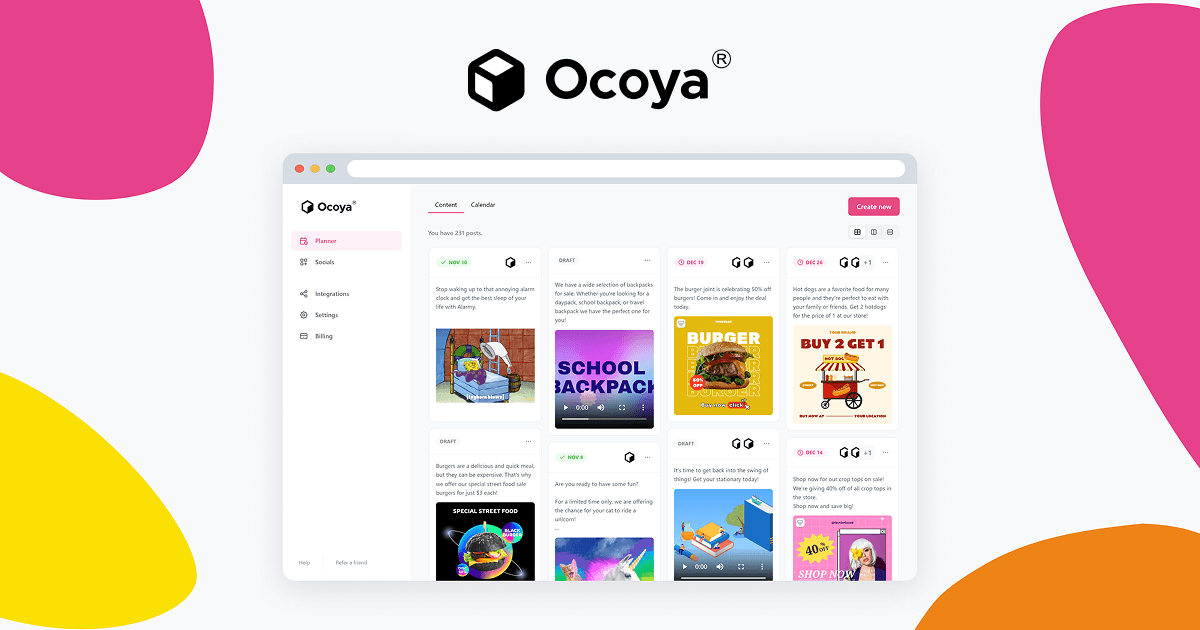
Ocoya
Ocoya is an AI-powered social media management platform that combines bulk content creation, a drag-and-drop scheduling calendar and trigger-based automation agents across twelve networks. Built by Lithuanian company UAB Ocoya, it targets freelancers, brands and marketing agencies.
What is Ocoya?
Ocoya is a browser-based social media management platform published by UAB Ocoya, a Lithuanian company. Its pitch is blunt and repeated across every page: don't hire a social media agency. The product sets out to replace what an agency does — producing content, scheduling it and keeping engagement going — with AI tools that one person can operate.
The platform rests on three layers. The first is creation: an AI assistant that writes, rewrites, expands, summarises and translates copy, generates images, removes backgrounds and suggests hashtags, alongside an in-house editor stocked with per-network templates, over a million royalty-free assets, stock video and music. Canva, Unsplash and Giphy are wired in, so designing rarely means leaving the tab.
The second layer is publishing. A drag-and-drop calendar organises the queue, Ocoya claims throughput of up to a thousand posts per minute, and a 'publish like a human' toggle inserts a natural delay so a feed does not read as machine-timed. A prediction engine, described as trained on more than twenty million data points, proposes the best hours to post. Approvals run on three levels — internal team, client, and a shareable public link — the feature that most clearly targets agencies.
The third layer is automation, and it is where Ocoya separates itself from a plain scheduler. Ready-made AI agents cover multi-channel posting, DM support chatbots and keyword-triggered comment-to-DM promotions, and customers can train their own domain-specific agent. Workflows fire on a schedule, on a new RSS item, or when a product is added to a connected WooCommerce or Shopify store, chaining steps such as write caption, create image, publish post.
Twelve social networks are supported, though seven are openly labelled beta: Threads, TikTok, Google Business, YouTube Shorts, Discord, Telegram and Slack. Usage is metered in credits, a single unit consumed by automation runs and by every AI text or media action, replenished each month. Four public tiers run from Bronze to Diamond, plus an Enterprise plan on request. There is no free plan, only a seven-day trial.
What it does
- Schedule and publish posts to twelve social networks from a single drag-and-drop calendar
- Generate captions, hashtags, images and translations with built-in AI tools
- Run ready-made AI agents for multi-channel posting, DM replies and comment-to-DM promotions
- Automate content production with schedule, RSS feed or new-product triggers
- Design visuals and short videos in the built-in editor or through Canva
- Route posts through internal, client and public-link approval before they go out
- Shorten and UTM-tag campaign links, then track how they perform
When to use Ocoya / When not to
A quick filter to help you decide if Ocoya is the right fit.
When to use Ocoya
- Marketing agencies juggling several client accounts, who need the three-level approval flow — internal team, client, then a shareable public link — and the unlimited workspaces of the top tier
- Solo freelancers and creators who want AI captions, images and ready-made templates without paying for a separate design tool alongside their scheduler
- Brand and social media managers running a consistent organic calendar across Facebook, Instagram, X, LinkedIn and Pinterest
- E-commerce operators on Shopify or WooCommerce who want a newly added product to trigger a social post automatically
- Publishers and content teams with an RSS feed, who want each new article turned into a scheduled post without rewriting it by hand
When not to use Ocoya
- Anyone who needs a permanently free plan: Ocoya offers only a seven-day trial, and billing starts automatically if it is not cancelled in time
- Teams whose primary channel is TikTok, Threads, YouTube Shorts, Discord, Telegram or Google Business — seven of the twelve integrations are still flagged as beta
- Developers planning a custom integration, since the homepage advertises an API but no documentation page exists anywhere on the site
- Mobile-first users, as there is no iOS or Android app, no desktop client and no browser extension: everything runs in the browser
- Organisations with a strict vendor-security checklist, given the absence of a published sub-processor list, of SOC 2 or ISO 27001 certification, and of any postal address for the company
How to use Ocoya
A typical end-to-end flow, from setup to results.
- Start the seven-day trial from the website and create an account on the Ocoya web app
- Connect your social accounts, bearing in mind that Facebook and Instagram must be Business pages or profiles
- Set up the workspace: brand kit, theme colour, hashtag presets, email presets and labels
- Upload your own assets to the media library, or draw on the built-in royalty-free library
- Write a post with the AI assistant, or start from a per-network template in the editor
- Generate or edit the visual using AI image generation, background removal, video templates and royalty-free music
- Drop the post onto the calendar, or let the best-times engine suggest a slot
- Send it through the approval chain: internal team, client, or a shareable public link
- For recurring output, build a workflow on a schedule, RSS or new-product trigger, or deploy one of the ready-made AI agents
- Cancel before day seven if you do not want to be billed: the subscription starts automatically and no refunds are given
Pros & Cons
Pros
- Fully public pricing with explicit quotas at every tier: workspaces, users, social profiles and credits are all stated up front
- Low entry point at USD 15 per month on annual billing, well under most established social media suites
- Real automation depth — AI agents plus schedule, RSS and e-commerce triggers, rather than a scheduler with an AI writing box bolted on
- The three-level approval flow makes the tool genuinely workable for agencies handling client sign-off
- Editor and asset library are built in, removing the constant switch to a separate design tool
- EU-established company under Lithuanian law, with a substantive addendum covering the Standard Contractual Clauses, the UK Addendum and Swiss rules
- The beta status of seven integrations is displayed honestly rather than hidden behind the headline count
Cons
- No permanent free plan, and the terms exclude refunds outright: billing starts automatically at the end of the seven-day trial
- Seven of the twelve integrations are still in beta, so the advertised network coverage is not the stable coverage
- An API is advertised on the homepage but no documentation exists anywhere on the site
- No postal address, no legal notice page and no contact page; one support mailbox handles support, legal and GDPR requests alike
- The legal pages are visibly unfinished: leftover template blocks, a truncated sub-processor clause, missing annexes and contradictory effective dates
- No published sub-processor list, no SOC 2 or ISO 27001 certification, and no data residency option
- No mobile application, and no interface or processing languages are documented anywhere
Pricing & Plans
There is no permanently free plan. Ocoya offers a seven-day free trial giving access to all features, after which billing begins automatically unless the subscription is cancelled. The cheapest paid entry point is the Bronze plan at USD 15.00 per month on annual billing, or USD 19.00 per month on monthly billing, the annual commitment being advertised as a 20% saving. The terms of service state that sales are final and that no money-back guarantee is offered.
- 1 workspace
- 1 user
- 5 social profiles
- 100 credits
- 5 workspaces
- 5 users
- 20 social profiles
- 500 credits
- 20 workspaces
- 20 users
- 50 social profiles
- 1
- 500 credits
- unlimited workspaces
- 50 users
- 150 social profiles
- unlimited credits
- Enterprise — custom pricing on request
- though the 'Let's talk' button points to an unrelated third-party domain
- Every tier includes the seven-day free trial
- credits are consumed by automation runs and by AI text and media tools
- and reset each month
Data, GDPR & hosting
A consolidated view of how Ocoya handles your data.
GDPR overview
GDPR compliance is claimed explicitly, not merely implied. Section 1 of the privacy policy is headed 'General data protection regulation (GDPR)', names UAB Ocoya as data controller, lists the four legal bases it relies on and enumerates the EEA rights of access, rectification, erasure, objection, restriction, portability and withdrawal of consent. A separate page carries a full Data Processing Addendum: Ocoya acts as processor, the Standard Contractual Clauses are incorporated for transfers outside the EEA, and the UK Addendum and Swiss data protection act are covered. Security incidents are notified within 48 hours where feasible. As a company established in Lithuania, Ocoya requires no Article 27 representative and names none. The drafting is imperfect — the Clauses are cited as Decision 2021/91 instead of 2021/914 — but the framework is published and substantive.
Who owns the data?
Ocoya's position depends on which data is at stake. Under the Data Processing Addendum the customer is the controller and Ocoya acts only as a processor, handling Customer Data on the customer's documented instructions, with the customer remaining solely responsible for its accuracy, quality and legality. For visitors and account holders on the website itself the privacy policy says the opposite, declaring Ocoya a data controller of that information. Ocoya may appoint sub-processors but never publishes which ones. On termination the customer chooses whether data is deleted or returned, and self-service tools allow retrieval, correction, deletion and restriction at any time.
Reuse rights
The terms grant the user no explicit licence over content produced with Ocoya, and impose no restriction on reusing it either: the intellectual-property clause covers only Ocoya's own graphics, icons, logos and service names, which remain its trademarks and may not be reused. Everything a customer uploads or generates stays Customer Data under the addendum, processed solely to deliver the service, and can be exported or deleted at will. Nothing in the published pages requires permission before publishing, selling or repurposing a generated caption, image or video. Ocoya separately states that it does not sell Google user data, nor disclose it to advertising platforms, data brokers or information resellers.
Data retention & training
Hosting summary
Ocoya publishes no guaranteed hosting location. The data processing addendum states that customer data may be transferred to and processed in the United States and anywhere else in the world where Ocoya, its affiliates or its sub-processors operate. That is a permission rather than a commitment, and the United States is the only country named anywhere on the site. No European region is guaranteed, no data residency option is offered, and the list of sub-processors is never published, so there is no way to verify which providers hold the data or where. Transfers outside the European Economic Area are covered contractually by the Standard Contractual Clauses, with the UK Addendum and Swiss rules applied where relevant. For reference, the marketing site itself resolves to an anycast address in Amsterdam on Amazon infrastructure, but that describes the brochure site rather than the application or the customer data behind it.
Things to keep in mind
Risks and trade-offs to weigh before adopting Ocoya.
- Every mailto link on the legal pages points to support@ocoya.net, a domain with no mail server at all; only the address shown as plain text, on the ocoya.com domain, actually receives mail. A GDPR deletion request sent by clicking one of those links will simply bounce.
- The legal pages are unfinished in ways that matter: a leftover 'Purchase Now' button for an unrelated web development kit closes all four of them, the sub-processor clause of the addendum breaks off exactly where the list should appear, two referenced annexes are missing, and the terms of service state two different effective dates.
- The site never says whether customer content is used to train AI models. There is no commitment either way and no opt-out, so anyone pushing client material through the platform is doing so without an answer on that point.
- Nothing is published about data residency: the addendum permits transfers to the United States and anywhere else in the world, with no guaranteed region and no sub-processor list to check the claim against.
- The Enterprise and custom-integration buttons lead to an unrelated third-party domain, so a prospect following the paid-tier path leaves Ocoya's site without necessarily noticing.
- Automating tone and timing is the point of the product and also its trap: agents replying in direct messages and workflows turning every RSS item into a post can publish in your brand's name faster than anyone reviews them. The approval flow exists, but nothing obliges you to use it.
- Billing starts automatically after seven days and the terms exclude refunds under any circumstances, so a trial forgotten over a weekend becomes a charge that cannot be reversed.
Setup & Integrations
Technical difficulty
Very low. Ocoya is entirely browser-based: there is nothing to install, no desktop client and no extension. Setup means creating an account, connecting your social accounts — Facebook and Instagram must be Business pages or profiles — and publishing. The visual editor, drag-and-drop calendar and pre-configured AI agents need no technical skill, and even trigger-based workflows stay no-code, built from a fixed set of triggers. The one exception is integration work: with no API documentation published, anything beyond the twelve supported networks cannot be built independently. Support runs through a help centre and live chat.
Deployment
Integrations
Behind Ocoya
Social
Resources
All the official URLs gathered for verification and reference.
Frequently asked questions
Is there a free plan?
What are credits and how quickly do they run out?
Which social networks does Ocoya support?
Is there a mobile app?
Does Ocoya provide an API?
Is my data used to train AI models?
Who runs Ocoya, and from where?
Is a Data Processing Agreement available?
What is the minimum age to use Ocoya?
How do I have my data deleted?
Should you pick Ocoya?
Ocoya is a real, working product, and a well-featured one for its price. The three layers it is built on — AI content creation, a fast drag-and-drop scheduler, and trigger-based automation with reusable agents — go meaningfully further than the AI writing box bolted onto most social suites, and the three-level approval flow shows the agency use case was designed rather than merely claimed. At USD 15 per month on annual billing, the entry tier undercuts most established competitors while stating its quotas openly.
The reservation concerns not the product but everything written around it. The four legal pages are visibly assembled from templates that were never cleaned up: a leftover button inviting you to buy a web development kit closes the privacy policy, the sub-processor clause of the data processing addendum stops mid-sentence exactly where the list should be, two annexes are referenced but never delivered, and the terms of service carry two mutually exclusive effective dates. Every mailto link on those pages resolves to a domain with no mail server. Two Enterprise buttons lead to an unrelated third-party site.
None of this makes the tool fictitious: a working application, a status page, a public roadmap and a mature affiliate programme all argue the opposite. It does mean the published documentation cannot carry the weight a procurement review would place on it. No postal address, no sub-processor list, no SOC 2 or ISO 27001, no stated position on whether customer data trains AI models, and an API advertised without a page of documentation. For an individual or a small agency, that is likely an acceptable trade. For a formal security review, it is not yet answerable.
- Choosing a selection results in a full page refresh.
- Opens in a new window.