
Drizz
Drizz is a Vision AI testing agent for mobile apps: manual QA teams describe end-to-end flows in plain English, and the agent runs them on real iOS and Android devices, repairing tests by itself when the interface changes.
What is Drizz?
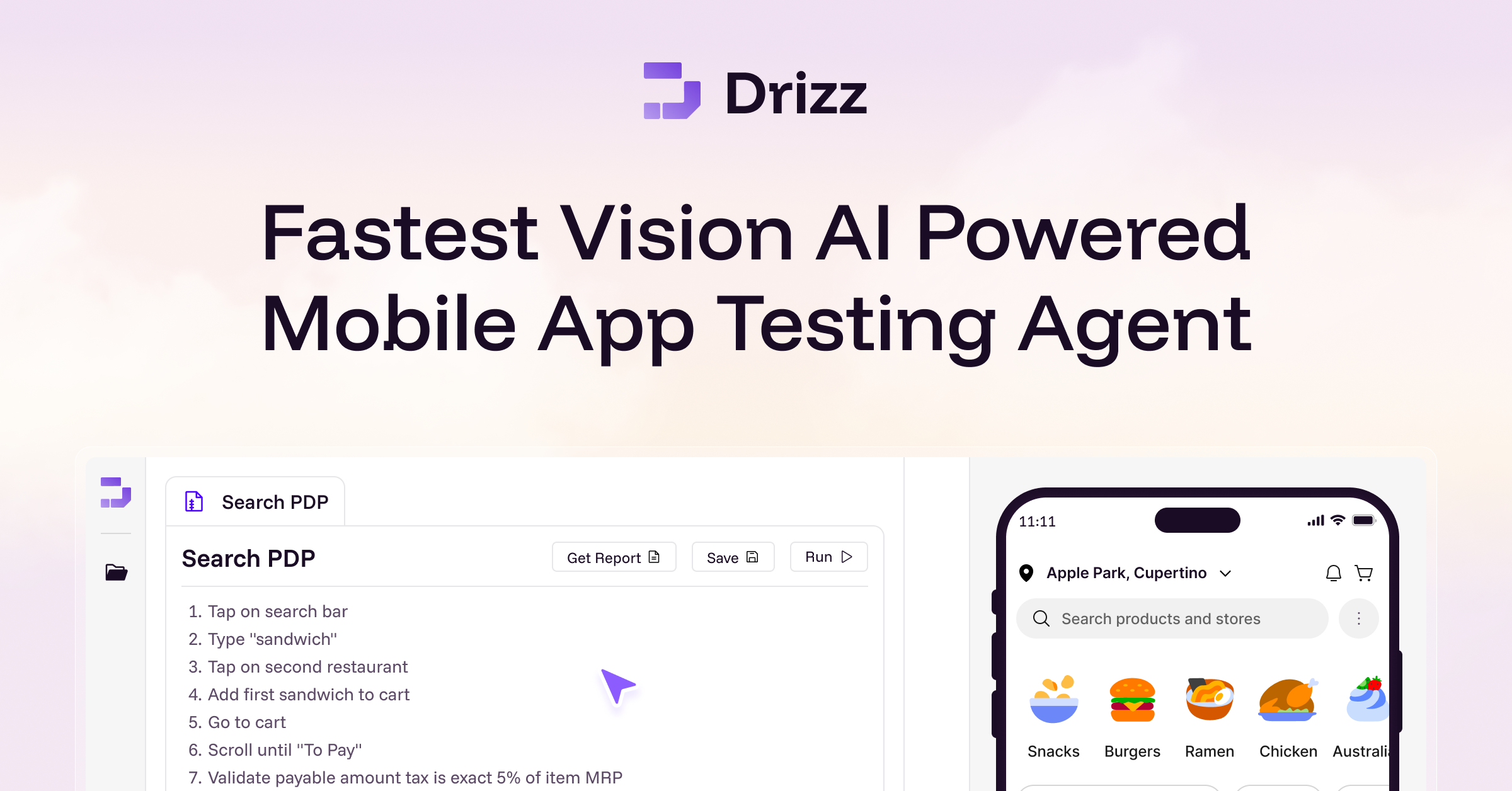
Drizz is a mobile application testing agent built on Vision AI. Instead of binding a test to selectors or XPath expressions, the agent reads the screen the way a person does, which is what allows a manual tester to describe a flow in plain English and have it executed without a line of code. The publisher's own summary is direct: Your manual QAs describe the flow in plain English. Drizz's agents run it on real devices, fix it when your UI moves, and hand back the failure already debugged.
The product comes in two components. Drizz Desktop is where tests are created, edited and validated locally against a connected physical device, an Android emulator or an iOS simulator; its editor structures a test as a sequence of commands with conditional logic and reusable modules. Drizz Cloud handles execution at scale, reporting, device fleet management and CI/CD integration, so the same test logic can be replayed without re-authoring. Android, iOS and mobile web are all covered, on emulators, simulators and physical devices alike. The documentation describes a component named Fathom for script generation and editing, publishes a command reference, and details an integration API covering authentication, build upload, run triggering, error codes and CI/CD wiring.
Technically, the differentiator is state detection rather than static timers: adaptive waiting, real-time awareness of list boundaries, scroll positions and element visibility, and targeting by visual and semantic cues instead of positional indexes. Deep links, background-to-foreground transitions, cold starts, push notifications and state-based branching are supported.
The gains advertised are the publisher's own figures, given without any published methodology: 200 tests a month per manual tester against 15 on Appium, 5% flakiness against 15%, 1.0x effort for iOS plus Android against 2x, zero selectors to maintain, a claimed execution success rate above 97% and five times more bugs found. One measurement is open: Drizz published UI-TapBench, a benchmark reporting 94.51% tap accuracy over 570 screenshots and 20 applications. Tata 1mg, Porter and NikahForever are named as customers. The company was founded by Asad Abrar, Yash Varyani and Partha Sarathi Mohanty.
What it does
- Write end-to-end mobile tests in plain English, with no code and no selectors
- Run them on real iOS and Android devices, and on mobile web
- Repair tests automatically when the interface moves or elements are renamed
- Execute runs in parallel inside CI/CD pipelines
- Hand back each failure already debugged, with screenshots, logs, screen state and before/after context
- Check the accessibility of every flow
- Upload builds and trigger runs through a documented integration API
When to use Drizz / When not to
A quick filter to help you decide if Drizz is the right fit.
When to use Drizz
- Manual QA teams that want automated coverage without writing code or hiring an automation engineer
- Mobile teams on weekly or bi-weekly release cycles, in the industries Drizz cites: e-commerce, fintech, streaming, mapping and healthcare
- Teams whose selector-based scripts keep breaking on dynamic screens such as login, payment and checkout
- Product teams covering both iOS and Android from a single set of tests, which the publisher rates at 1.0x effort instead of 2x
- Regulated or security-conscious organizations that need on-premise or VPC deployment, SSO/SAML, RBAC and audit logs
When not to use Drizz
- Individuals and hobbyists: the terms restrict eligibility to a body corporate, so there is no personal use
- Teams testing desktop web applications, since the product covers native, hybrid and mobile-web apps only
- Buyers who need a published price before speaking to a salesperson, as no amount appears anywhere on the site
- Windows or Linux users who want the desktop application: only a macOS arm64 .dmg installer is offered
- European organizations that require a documented GDPR framework, the privacy policy being built on Indian law
How to use Drizz
A typical end-to-end flow, from setup to results.
- Request access through the site's form (Schedule a demo, Start free or Talk to Sales), as there is no self-serve sign-up
- Download Drizz Desktop from the website, a macOS arm64 .dmg installer, and install it
- Connect a real device, an Android emulator or an iOS simulator to the desktop application
- Upload your APK or connect the build you want to test
- Describe the test in plain English, the way you would use the app yourself; the publisher claims a first end-to-end test in under two minutes
- Structure the flow in the test editor: ordered command sequences, conditional logic and reusable modules
- Run the test with Vision AI on a real device and let the agent adapt to the interface in real time
- Review the failures, each returned with screenshots, logs, screen state and before/after context
- Replay the same test logic in Drizz Cloud to scale up, without re-authoring anything
- Wire runs into your pipeline through the documented API and the integrations with GitHub, Jenkins, Jira, Slack, Xcode and Android Studio
Pros & Cons
Pros
- No coding skills required, since tests are written in plain English
- No selectors to maintain, which removes the main maintenance cost of mobile test suites
- A single test set for both iOS and Android, rated by the publisher at 1.0x effort
- Execution on real devices, not only on emulators and simulators
- Failures are handed back already debugged, with screenshots, logs and screen state
- Genuine enterprise options: on-premise or VPC deployment, SSO/SAML, RBAC and audit logs
- Documented API and CI/CD integrations, an openly published benchmark (UI-TapBench) and a desktop application that can be downloaded without going through a salesperson
Cons
- No price is published anywhere: the four tiers carry no amount and every call to action leads to the same form
- No GDPR framework at all: the privacy policy rests on Indian law, with no Article 27 representative and no data protection officer
- No data processing agreement is published and no sub-processor list exists
- Complete silence on any use of customer data for model training, and on any opt-out
- No hosting country is named: region-locked storage is mentioned but never specified
- No support email address is published, support going through a form, and the desktop application is offered for macOS arm64 only
- A very young publisher, seed-funded in July 2025, a documentation set last updated six months ago, and a SOC 2 compliance badge on the demo page that no trust page, report or named auditor backs up
Pricing & Plans
Drizz publishes no price. No amount, and therefore no currency, appears on any page of the site, and there is no pricing page: /pricing redirects to the demo form. Four tiers are named, Free Trial, Pay As You Go, Team Plan and Enterprise, but they are described by their features only, and every call to action (Start free, Get Started, Talk to Sales, Contact Us) leads to the same form. There is no permanent free plan: the free entry point is a Free Trial limited to 50 test runs. The desktop application itself can be downloaded at no cost, as a macOS arm64 .dmg installer. The terms indicate that billing is set out in an Order Form, with payment due within 30 days, a late penalty of 1.5% per month and non-refundable fees, one-off payments excepted, which are refunded on a pro rata basis. Any figure therefore has to be obtained from the sales team.
- 50 test runs
- APK upload
- plain-English authoring
- basic visual detection and email support. No price published
- runs bought on demand
- unlimited authoring
- Vision AI execution
- visual regression testing
- CI/CD integration and a 7-day history. No price published
- shared workspace
- collaboration features
- priority email support
- visual regression testing and CI/CD integration. No price published
- on-premise or VPC deployment
- unlimited runs
- a dedicated account manager
- a custom SLA
- SSO/SAML
- advanced security and bespoke workflows and integrations. No price published
Data, GDPR & hosting
A consolidated view of how Drizz handles your data.
GDPR overview
Drizz never claims GDPR compliance: the term appears on the site only in blog titles, never as a statement about the product. The published framework is Indian, not European. The privacy policy is written under the Information Technology Act, 2000 and its associated rules, and the terms are governed by Indian law with arbitration seated in Bangalore. Rights of access, rectification, deletion and withdrawal of consent are offered, exercised through a named grievance officer, Mr. Partha Sarathi Mohanty, at grievances@drizz.dev, which is an Indian grievance route rather than a data protection officer. No EU Article 27 representative is designated, no DPO appointed, no data processing agreement published or announced, and no sub-processor list exists. The privacy policy took effect on 1 July 2025 and the terms were updated in July 2025. This is a silence, not an explicit refusal.
Who owns the data?
Under the terms and conditions, the customer keeps ownership of its data: You retain ownership and intellectual property rights in and to its Customer Content. Drizz receives a licence limited to delivering the service, covering copying, storing, displaying and transmitting that content. A separate licence lets the publisher use the customer's name and logo for marketing, and can be revoked on thirty days' notice. Drizz itself owns the platform, the services, the documentation and any improvements derived from them. The privacy policy adds a clear statement on personal data: We do not sell or rent your personal information. Sharing is presented as limited to service providers and legal authorities.
Reuse rights
Because the customer keeps ownership of its Customer Content, it can export, reuse and redistribute its own test data, logs and reports without asking Drizz for permission; the licence granted to the publisher runs the other way and is confined to operating the service. On the website side, the privacy policy describes the collection of names, email addresses, phone numbers, IP addresses, browser and operating system details and browsing behavior, used to answer inquiries, provide support, handle recruitment, send newsletters, improve the site and meet legal obligations, on the basis of legitimate interest, contract performance, legal obligation or consent. Sharing is limited to service providers and legal authorities. Test artifacts such as logs, videos, screenshots and device metadata are described as stored encrypted under a unique run identifier, and APK binaries in isolated encrypted buckets that can be purged automatically once a run finishes. No document on the site says whether customer data is ever used to train models, and no opt-out is offered.
Data retention & training
Hosting summary
The site names no hosting country and no region. What it does state is that test data, logs and screenshots are encrypted in transit and at rest, that storage can be region-locked and retention customized for customers with strict policies, and that test artifacts are kept under a unique run identifier while APK binaries sit in isolated, encrypted buckets which can be deleted automatically once a run finishes. For customers who need data to stay inside their own network, Drizz offers on-premise and VPC deployments, in which case test data never leaves the customer's infrastructure. Everything else is undocumented: no data center location, no cloud provider named for customer data, no sub-processor list and no data processing agreement. The website itself resolves to an Amazon anycast address, which describes where the marketing site is served from and says nothing about where customer test data actually lives. Buyers with a data residency requirement should obtain the hosting region in writing before signing.
Where Drizz works
Country-level availability.
Not available in
Things to keep in mind
Risks and trade-offs to weigh before adopting Drizz.
- No price is published: the four tiers carry no amount and every call to action funnels into the same form, which makes any independent budget comparison impossible before a sales conversation
- The SOC 2 compliance badge shown on the demo page is backed by no trust or security page, no published report and no named auditor: it is a publisher claim, not an established certification
- The entire legal framework is Indian, built on the IT Act 2000 with Indian governing law and arbitration in Bangalore, with no GDPR mention, no data processing agreement, no sub-processor list and no EU Article 27 representative, which matters if you handle European users' data
- Nothing is published about a possible use of customer data for model training, or about any opt-out, and no hosting country is named, region-locked storage being mentioned without further detail
- The efficiency figures advertised, such as 200 tests a month, more than 97%, 35% or three times faster, come from the publisher with no published methodology, and several homepage testimonials give only a first name and a job title, with no identifiable company
- Handing test design over to an agent can quietly erode a team's own testing judgement: if nobody reviews what the agent actually covers, blind spots go unnoticed and false confidence builds behind a green dashboard
- The terms designate three sites as the same platform, testzeus.com, drizz.dev and drizz.ai, which deserves clarification, and small site defects such as a navigation link pointing to /indusries or /pricing redirecting to the demo form point to a young product
Setup & Integrations
Technical difficulty
Low for the intended user, higher for the integration work. Writing tests requires no coding: steps are typed in plain English, and the publisher claims a first end-to-end test in under two minutes and a setup completed in minutes. Local installation means downloading a macOS arm64 .dmg installer and connecting a device, an Android emulator or an iOS simulator. Two things raise the bar: full access goes through a sales conversation rather than a self-serve sign-up, and wiring runs into CI/CD through the documented API, with authentication, build upload, run triggering and error codes, needs an engineering profile.
Deployment
Integrations
Supported languages
Behind Drizz
Fundraising
Social
Resources
All the official URLs gathered for verification and reference.
Alternatives
Tools that compete with or complement Drizz.
Frequently asked questions
What does Drizz actually do?
Do I need to know how to code?
Does it work on both iOS and Android?
How much does Drizz cost?
Is there a free trial or a free plan?
Can I run Drizz inside my CI pipeline?
How is my data handled?
Is Drizz suitable for a high-security environment?
Is Drizz GDPR compliant?
What happens to my data if I cancel?
Should you pick Drizz?
Drizz is a real, documented product rather than a landing page: public documentation, a documented API, two distinct components, named customers such as Tata 1mg, Porter and NikahForever, and an open benchmark it published itself. Its positioning is easy to state, namely replacing the selector maintenance that weighs on Appium suites with a Vision AI agent that reads the screen and repairs its own tests, so that manual QA teams can automate without writing code. For a mobile team on a fast release cycle, that trade deserves a serious look.
Two reservations should shape the conversation. The first is commercial: no price exists in public. The four tiers are described without a single amount and every button leads to the same form, so any budgeting exercise begins with a sales call. The second is legal: the published documentation is thin for a European buyer. There is no GDPR framework, no data processing agreement, no sub-processor list, no named hosting country, and no statement whatsoever about whether customer data may be used to train models. The SOC 2 compliance badge shown on the demo page is a publisher claim, unsupported by any trust page, report or named auditor. The company is also very young, with a USD 2.7 million seed round raised in July 2025.
The tool suits mobile QA teams ready to go through a salesperson and able to negotiate their own contractual guarantees. Before committing, ask for the pricing in writing, for the SOC 2 report and the name of its auditor, for a data processing agreement, for the exact hosting region, and for an explicit written position on model training. If Windows or Linux workstations, or a purely self-serve purchase, are requirements, this is not the right fit today.
- Choosing a selection results in a full page refresh.
- Opens in a new window.