
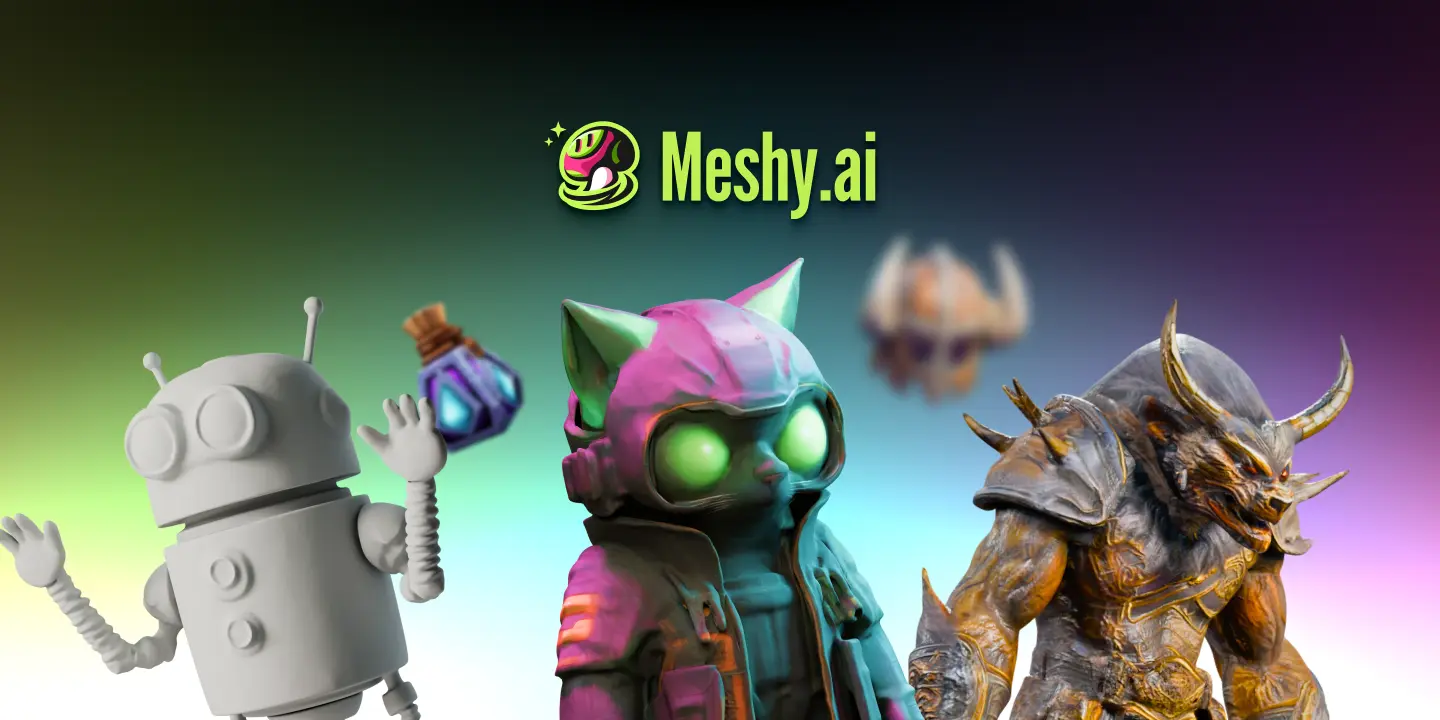
Meshy
Meshy is an AI 3D model generator that turns a text prompt, a photo or a rough sketch into a textured, rigged and export-ready 3D asset in about a minute, for game engines, 3D printers, product design and AR/VR pipelines.
What is Meshy?
Meshy is an AI-powered 3D content creation platform published by Meshy LLC, a company based in Sunnyvale, California. It gathers six tools inside a single browser workspace: a conversational 3D Agent, Image to 3D, Text to 3D, AI Texturing, an AI Image Generator and an Animation module. The starting point is deliberately loose — a sentence, a photograph, a concept sketch or simply a conversation — and the output is a previewable, editable, exportable mesh.
Text to 3D returns a textured model in roughly forty-five seconds on the Meshy 5 engine and around two minutes on Meshy 6, in styles ranging from photoreal to cartoon to low poly, with the topology under your control. Image to 3D works from one photograph or from two to eight views, and can hold a custom pose for characters. AI Texturing repaints an existing OBJ, FBX or GLB file, or a Meshy model, generating a complete PBR set at up to 8K. The Animation module auto-rigs humanoid and quadruped characters and draws on a library of more than six hundred motion presets covering walk cycles, idles, jumps, attacks and gestures.
What separates Meshy from a general image-to-mesh service is how far it pushes toward two specific destinations. For 3D printing it claims watertight, manifold geometry, runs a printability check on every export, auto-repairs edge cases, supports multi-colour filament mapping and can split an over-complex model into printable parts pre-arranged on the build plate. Exports go directly to eight slicers and publish to MakerWorld, Printables and Thingiverse. For real-time work it ships native plugins for Unity, Unreal Engine, Godot, Roblox Studio, Blender, Maya, 3ds Max, ZBrush and Omniverse, plus a native ComfyUI node.
Developers get a documented REST API with a playground, a monitoring console, webhooks and a 99.9% uptime SLA, and an open-source MCP server lets AI coding assistants generate models on request. The company reports more than 100 million models generated for over 12 million users, holds 4.8/5 on both G2 and Trustpilot, and lists Microsoft, Google DeepMind, DNEG, Nexon, Supercell and Square Enix among its customers.
What it does
- Generate a textured 3D model from a written prompt
- Convert a single photo, a sketch or two to eight views into a 3D model
- Apply full PBR textures — albedo, normal, metallic, roughness — up to 8K
- Auto-rig and animate humanoid or quadruped characters from 600+ motion presets
- Export to FBX, OBJ, GLB, STL, USDZ, 3MF or .blend
- Send a finished model straight to a slicer or a game engine
- Drive generation programmatically through the REST API or an MCP-connected AI assistant
When to use Meshy / When not to
A quick filter to help you decide if Meshy is the right fit.
When to use Meshy
- Indie and studio game developers who need textured, rigged assets dropped straight into Unity, Unreal Engine, Godot or Roblox Studio
- 3D printing hobbyists and makers who want watertight, manifold models sent in one click to Bambu Studio, OrcaSlicer, Creality Print or Cura
- Product and industrial designers turning a concept or a reference photo into a prototype mesh before touching CAD
- Teachers, lecturers and students running 3D printing, game or XR courses, who can apply for the discounted Education plan
- Film, VFX and previsualisation teams that need rough but usable 3D stand-ins early in look development
When not to use Meshy
- Engineers who need parametric CAD: Meshy generates meshes, and its own guidance is to refine the result in Blender or Roblox Studio
- Anyone publishing commercially on the free plan, since free outputs carry a CC BY 4.0 licence and require attribution to Meshy
- Teams handling strictly confidential concept work without an Enterprise contract, because non-Enterprise inputs and outputs may be used to train the models
- API users who cannot download quickly: assets generated through the API are deleted three days after creation outside the Enterprise plan
- Under-14s, who are excluded by the Terms of Use, and 14-to-17-year-olds without a parent or guardian's permission
How to use Meshy
A typical end-to-end flow, from setup to results.
- Create a free account — no credit card is requested
- Open the online workspace at meshy.ai/workspace
- Pick a starting point: write a text prompt, upload a photo or sketch, or simply describe your idea to the 3D Agent
- Generate, then review the preview; paid plans allow unlimited retries
- Optionally repaint the mesh with AI Texturing to get a full PBR set up to 8K
- Optionally auto-rig the character and apply one of the 600+ motion presets
- Switch on Low Poly Mode and set your own polygon budget if the asset is destined for real-time use
- Export to FBX, OBJ, GLB, STL, USDZ, 3MF or .blend, or send the model in one click to a slicer such as Bambu Studio or OrcaSlicer
- For engine work, install the native plugin for Unity, Unreal Engine, Godot, Roblox Studio, Blender, Maya or 3ds Max
- For automation, generate an API key, test the endpoints in the Playground, then integrate — or install the MCP server with a single npx command
Pros & Cons
Pros
- A permanent free plan with 100 credits a month and no credit card required
- End-to-end coverage — generation, texturing, rigging, animation, export and printing — rather than a single step
- Genuine 3D printing focus: watertight and manifold output, printability checks, auto-repair and direct slicer hand-off
- An unusually broad integration ecosystem, from Blender and Unreal to ComfyUI and an MCP server for AI assistants
- Full commercial rights on every paid plan, with a 20 USD monthly entry point
- ISO/IEC 27001 and SOC 2 Type II certification with a publicly accessible trust centre
- Interface available in roughly twenty languages, with 4.8/5 ratings on both G2 and Trustpilot
Cons
- Free-plan output is licensed CC BY 4.0, so attribution to Meshy is required even when you sell the model
- Inputs and outputs from non-Enterprise customers may be used to train the models, and no self-service opt-out is documented
- The Terms and the pricing FAQ contradict each other on training: one permits it, the other promises it will not happen without consent
- Assets generated through the API are deleted after three days unless you are on the Enterprise plan
- No general refund policy — exceptions are decided case by case
- No named list of subprocessors is published, only broad categories of service providers
- Monthly credits reset on the first of the month and do not roll over, and the free plan cannot buy top-ups
Pricing & Plans
Meshy operates a freemium model. A permanent free plan is available at no cost and without a credit card, providing 100 credits per month, with outputs licensed under CC BY 4.0. The lowest paid entry point is the Pro plan at 20.00 USD per month, or 240.00 USD when billed annually. Additional credits can be purchased on the paid plans only.
- 100 credits per month
- no credit card
- CC BY 4.0 licence on outputs
- low queue priority
- no credit top-ups
- 1
- 000 credits per month
- private commercial licence
- roughly 60% faster generation
- API access
- 10 concurrent tasks
- unlimited retries and downloads
- 4
- 000 credits per month
- highest queue priority
- unlimited retries
- additional team seats and API Console access
- everything in Studio plus 100+ concurrent tasks
- exclusive API endpoints
- indefinite retention of API-generated assets
- a 99.9% uptime SLA and wire transfer payment
Data, GDPR & hosting
A consolidated view of how Meshy handles your data.
GDPR overview
GDPR handling is documented rather than merely claimed. The privacy policy names Meshy as data controller, cites Article 6(1)(b) as the legal basis for European users, and designates an Article 27 representative: Instant EU GDPR Representative Ltd. in Lucan, Ireland, with a separate UK representative in Brighton. Access, rectification, erasure, objection and the right to complain to a supervisory authority are all set out, with a stated response window of up to thirty days. Transfers outside Europe rely on standard contractual clauses or binding corporate rules where no adequacy decision applies. The API page advertises ISO/IEC 27001 and SOC 2 Type II certification alongside a public Drata trust centre. Note that its wording, GDPR certified, is marketing shorthand: GDPR is a regulation, not a certification scheme.
Who owns the data?
Meshy's Terms of Use assign ownership of generated assets to the user, but the licence depends on the plan. Paid subscribers own every model they create and hold full commercial rights, including distribution and resale. Free-plan outputs are instead granted under a CC BY 4.0 licence: they may still be sold, but Meshy asks for attribution on the commercial listing. Ownership is conditional in both cases, since the Terms require that the materials used during generation do not infringe anyone else's copyright. Separately, Aggregated Statistics — anonymised, aggregated usage data — and the intellectual property rights attached to them remain the exclusive property of Meshy LLC, which may publish them.
Reuse rights
On a paid plan the answer is straightforward: the models are yours, you need no further permission, and you may use them in commercial games, products, films, 3D prints and client work, or sell them on third-party marketplaces. On the free plan reuse is still permitted, including resale, but the CC BY 4.0 licence means Meshy must be credited. One restriction cuts the other way: the Terms forbid using generated assets to train, develop or improve AI models that compete with Meshy. In the opposite direction, Meshy reserves the right to use inputs and outputs from non-Enterprise customers to train, validate, test or improve its own services, unless a signed Order says otherwise.
Data retention & training
Hosting summary
Meshy states that web app data is stored with Amazon Web Services in the United States. That claim is consistent with the technical evidence: the domain resolves to 44.250.101.71, an address operated by Amazon (AS16509) and geolocated in Boardman, Oregon. Users in mainland China are told explicitly that their information is stored overseas in the US, with Meshy LLC named as recipient and support@meshy.ai as the contact point. No European or Asian hosting region is offered as an alternative. For European users, transfers outside the EEA are covered by appropriate safeguards where no adequacy decision applies — the privacy policy names EU standard contractual clauses and third-party binding corporate rules. The company holds ISO/IEC 27001 and SOC 2 Type II certification and publishes a trust centre hosted on Drata. No list of named subprocessors is published, only broad categories of service providers, so anyone needing a full data map will have to request one.
Things to keep in mind
Risks and trade-offs to weigh before adopting Meshy.
- Free-plan output carries a CC BY 4.0 licence: selling a model without crediting Meshy breaches the licence, and it is easy to forget once the file leaves the workspace
- The Terms of Use allow Meshy to train on inputs and outputs from non-Enterprise customers unless an Order says otherwise, which is a real exposure for client or pre-release concept work
- The Terms and the pricing FAQ openly contradict each other on training, so neither can be relied on as a settled answer without asking Meshy directly
- API-generated assets vanish three days after creation outside the Enterprise plan — build the download step into your pipeline rather than trusting the platform as storage
- Speed can erode craft: generating in forty-five seconds discourages the observation, topology work and iteration that make a modeller improve, and newcomers may skip fundamentals entirely
- Monthly credits reset on the first of the month and never roll over, which quietly encourages generating for the sake of not wasting the allowance
- Governing law is California with an arbitration clause and Santa Clara County jurisdiction, a meaningful obstacle for a European or Asian user contemplating a dispute
Setup & Integrations
Technical difficulty
Very low for the web workspace: sign up free, open the browser, describe or upload something, and a first model arrives in under a minute with no installation and no 3D modelling experience required. Slicer hand-off is a single click. Slightly more involved if you want a native plugin for Blender, Unity, Unreal Engine, Godot, Roblox Studio, Maya, 3ds Max or ZBrush, though ComfyUI needs no install at all. The API tier is for developers: generate a key, test endpoints in the Playground, then wire up webhooks. The MCP server installs with one npx command.
Deployment
Integrations
Supported languages
Behind Meshy
Fundraising
Social
Resources
All the official URLs gathered for verification and reference.
Alternatives
Tools that compete with or complement Meshy.
Frequently asked questions
Is Meshy free to use?
How much does the cheapest paid plan cost?
Who owns the 3D models I generate?
Which file formats can Meshy import and export?
Does Meshy have an API?
How long are my generated assets kept?
Is my content used to train Meshy's models?
Where is my data hosted?
What tools does Meshy plug into?
Is there a minimum age to use Meshy?
Should you pick Meshy?
Meshy is one of the most complete generative 3D platforms available to individuals and small studios, and its breadth is what justifies the attention. Rather than stopping at mesh generation, it carries an idea through texturing, rigging, animation, polygon budgeting and export, then hands the result to a game engine or a 3D printer without an intermediate cleanup pass. The printing focus is the clearest differentiator: watertight and manifold geometry, a printability check on every export, automatic repair, multi-colour mapping and one-click transfer to eight slicers are concrete engineering choices, not slogans.
The commercial proposition is unusually accessible. A permanent free plan with 100 monthly credits lets anyone test the output quality on their own prompts, and the paid entry point at 20 USD a month buys private commercial rights, API access and faster queues. Certification against ISO/IEC 27001 and SOC 2 Type II, plus a public trust centre, gives the platform more compliance ground than most tools in this category.
Two reservations deserve weight before committing. Free-plan output is CC BY 4.0, so attribution follows the asset even into commercial use — a detail easily missed by someone who assumes a free tier means unencumbered output. More significantly, the Terms of Use permit Meshy to train on inputs and outputs from non-Enterprise customers unless a signed Order says otherwise, while the pricing FAQ promises no training without consent. That contradiction is unresolved on the site and matters for anyone handling client or pre-release concept work. Add the three-day deletion window on API assets outside Enterprise, and the picture is a strong, fast, well-integrated tool whose fine print rewards reading.
- Choosing a selection results in a full page refresh.
- Opens in a new window.