
OpenAssistantGPT
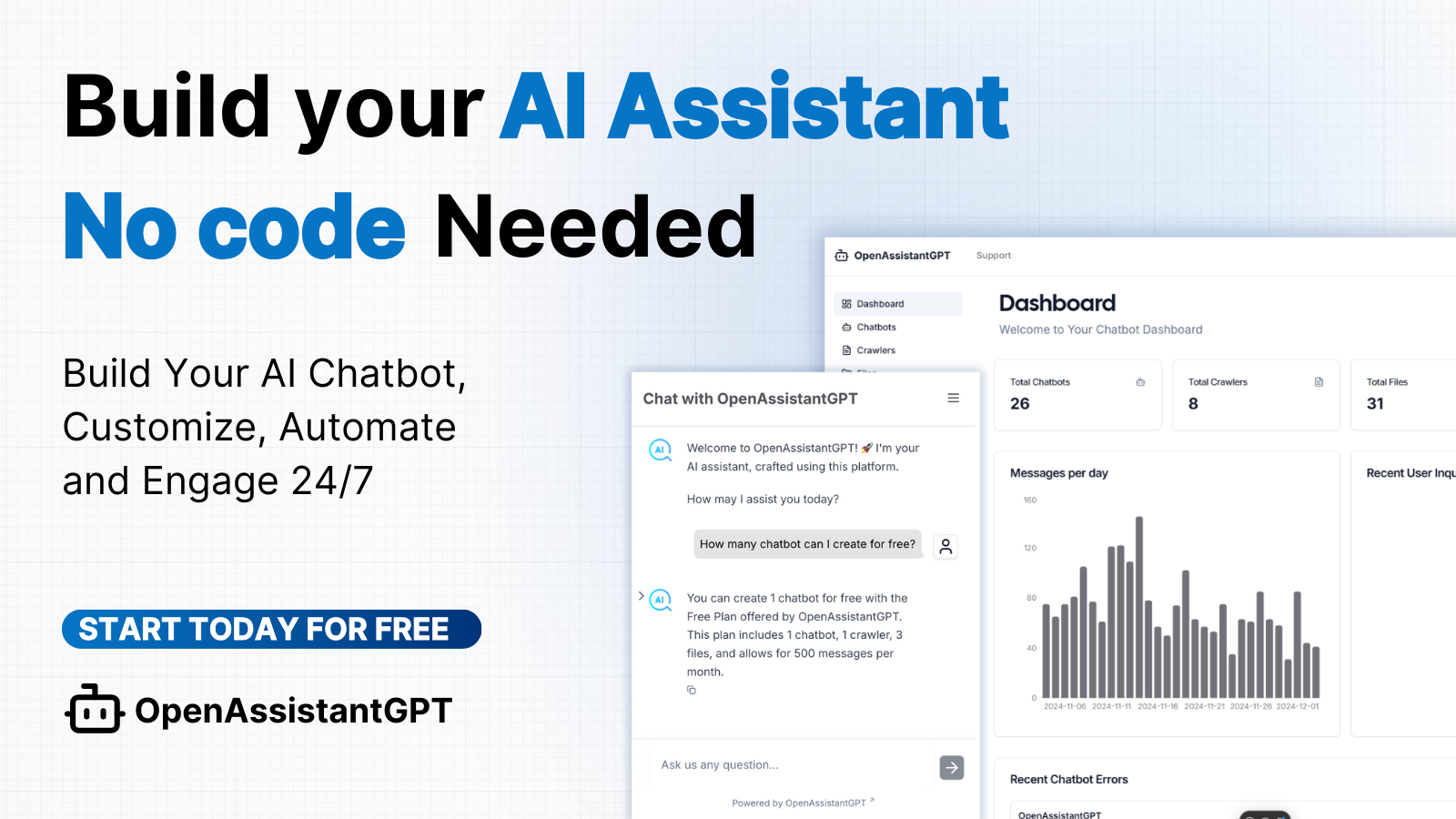
OpenAssistantGPT is a no-code platform for building AI chatbots and agents powered by the OpenAI API. It crawls your website, ingests your files and embeds anywhere with a snippet. The code is open source and a permanent free plan exists.
What is OpenAssistantGPT?
OpenAssistantGPT is a hosted platform for building chatbots and AI agents that sit on a website and answer visitors' questions. The pitch on the homepage is "Build your own AI agent with no code", and the workflow follows it: you point a crawler at a URL, the platform indexes the pages, you optionally add files, and you get a widget to paste into your site.
Everything runs on the OpenAI API. The homepage advertises GPT-4, GPT-3.5 and GPT-4o; the changelog records newer additions through 2026, including gpt-5-mini, gpt-5.3, o3 and o4-mini. The product is mid-way through a rename: what were "chatbots" built on the Assistants API are becoming "AI agents" built on the newer Responses API, and a migration path is documented. One consequence matters commercially — you supply your own OpenAI API key, so model consumption is billed to you by OpenAI on top of the subscription.
Six capabilities carry the homepage: OpenAI Assistants, SAML/SSO authentication, a User Inquiry form that collects leads, AI Agent Actions that call external API endpoints with URL parameters, live web search, and in-chat file attachments. Later additions include a Code Interpreter that analyses XLSX, CSV, DOCX and PPTX files in a Python sandbox, webhooks, custom domains and message exports. A public REST API is documented, authenticated with a bearer key and rate-limited to 60 requests per minute.
The project is open source under AGPL-3.0. The repository shows 1,071 commits, 426 stars and 140 forks, and a separate SDK repository exists for self-deployment on Vercel. Two dedicated offers extend the core product: an enterprise page built around SSO with Azure Entra, Okta and Google Workspace, and an agency page offering a multi-client dashboard with per-client branding and usage caps.
What the site does not show is who is behind it. No company form, no registration number and no postal address appear anywhere, and the published contact is a free Gmail address.
What it does
- Build an AI chatbot or agent without writing a line of code
- Crawl a website so the agent answers from its actual content
- Embed the chatbot on any page with a single snippet
- Upload CSV, XLSX, XML, DOCX and PPTX files as knowledge sources
- Capture leads through an in-chat inquiry form and receive them by email
- Call external API endpoints from the agent using AI Agent Actions
- Turn on live web search so answers reflect current information
When to use OpenAssistantGPT / When not to
A quick filter to help you decide if OpenAssistantGPT is the right fit.
When to use OpenAssistantGPT
- Small support teams that want to deflect repetitive questions without hiring a developer
- Digital agencies running chatbots for several clients from one dashboard, with white-label branding and per-client usage limits
- Companies that need an internal knowledge assistant restricted to employees through SSO/SAML
- Developers who would rather self-host: the codebase is published on GitHub under AGPL-3.0
- Owners of no-code sites built on WordPress, Webflow, Wix, Bubble or Framer, who only want to paste a snippet
When not to use OpenAssistantGPT
- Organisations whose procurement requires a signed Data Processing Agreement, since none is published or offered
- Buyers who need a named legal entity, a company number and a registered address before they can sign anything
- Teams contractually bound to a hosting jurisdiction, because the site names no country and no region
- Anyone who needs a native mobile application: the product is web-only, with no App Store or Google Play listing
- Users under 18, whom the privacy policy explicitly excludes
How to use OpenAssistantGPT
A typical end-to-end flow, from setup to results.
- Create an account from the login page using GitHub, Google or a magic link — no card is requested
- Generate an OpenAI API key and add it to the platform, as documented in the API keys guide
- Create a crawler pointed at the website you want the agent to learn from, and let it index the pages
- Optionally upload CSV, XLSX, XML, DOCX or PPTX files as additional knowledge-base sources
- Create the chatbot or agent and pick the OpenAI model it should run on
- Write the system prompt, using the published guide on building a good prompt
- Customise colours, texts and the chat disclaimer if you are on a paid plan
- Enable the extras you need: web search, file attachments, the User Inquiry lead form, or AI Agent Actions pointing at your APIs
- Copy the embedding snippet and paste it into your site, or attach a custom domain on the Pro plan
- Review conversation threads from the dashboard, or read them programmatically through the REST API
Pros & Cons
Pros
- A permanent free plan with no card required, so the product can be tested end to end
- Open source under AGPL-3.0, with 140 forks and an SDK repository, which leaves self-hosting on the table
- Public, legible pricing with hard quotas per plan and unlimited messages from USD 18 per month
- A documented public REST API with a stated rate limit, which is rare at this price point
- A dated, detailed changelog running to April 2026, plus around fourteen documentation pages and ten guides
- SSO/SAML available for internal deployments, and per-client branding for agencies
- The marketing site is served in English, French, Spanish and German
Cons
- No identifiable legal entity: no company form, no registration number and no postal address anywhere on the site
- The main published contact is a free Gmail address rather than a domain mailbox
- The terms and the privacy policy have not been updated since 5 April 2024, while the product has changed a great deal
- The privacy policy still contains an unfilled template blank where a contact address should be
- No data processing agreement, no named subprocessors and no stated hosting country or region
- Nothing is published about whether customer data is used to train AI models, in either direction
- You must supply your own OpenAI API key, so model costs sit outside the advertised subscription price
Pricing & Plans
A permanent free plan is available at no cost and requires no payment card, though it is capped at one chatbot, one crawler, three files and ten messages per month. The lowest paid entry point is the Basic plan at USD 18.00 per month, which lifts the message limit and adds customisation and lead capture. Pricing is quoted monthly only; no annual billing option is displayed. Model consumption is billed separately by OpenAI, since the customer supplies their own API key.
- 1 chatbot
- 1 crawler
- 3 files
- 1 action
- 10 messages per month
- 9 chatbots
- 9 crawlers
- 27 files
- 9 actions
- unlimited messages
- customisation
- lead capture
- 27 chatbots
- 27 crawlers
- 81 files
- 27 actions
- 5 custom domains
- branding removal
- client file attachments
- all features
- SAML/SSO authentication and an SLA guarantee
Data, GDPR & hosting
A consolidated view of how OpenAssistantGPT handles your data.
GDPR overview
OpenAssistantGPT never states that it is GDPR compliant, and that silence is worth recording as such. Its privacy policy does engage with the regulation: it sets out the legal bases relied on for EU and UK users — consent, legal obligations and vital interests — and lists the rights available in the EEA, the United Kingdom, Switzerland and Canada, including access, rectification, erasure, restriction, portability and objection, with a right to complain to a supervisory authority and a stated 30-day response time. Beyond that the framework is thin: no Article 27 EU representative, no data protection officer, no data processing agreement, no named subprocessors and no hosting location. The policy is dated 5 April 2024 and still carries an unfilled template blank where a contact address for children's data should appear.
Who owns the data?
The published documents say remarkably little about ownership. The terms of service, last updated on 5 April 2024, claim the platform itself — its content, features and functionality — as the exclusive property of OpenAssistantGPT and its licensors, but they contain no clause assigning or licensing the material customers upload. Users merely warrant that any content they post is theirs or that they hold the rights to it. The privacy policy covers personal data only: names, email addresses, usernames and billing addresses, with payment details held by Stripe. Ownership of chatbot transcripts, crawled pages and knowledge-base files is never addressed, in either direction.
Reuse rights
Nothing in the terms limits what a customer may do with the material they load into the platform or with the conversations their chatbot produces: no licence is granted to the vendor, and no re-use restriction is placed on the customer. On the vendor's side, the privacy policy lists the purposes it relies on for personal data — creating and authenticating accounts, providing and improving the service, communicating with users, security and fraud prevention, and legal compliance. Stripe is named for payments and Google Analytics for measurement, alongside unnamed categories of cloud computing, data storage and website hosting providers. The policy states that no information is received from third parties. Whether customer content is ever used to train AI models is not addressed anywhere on the site.
Data retention & training
Hosting summary
The site says nothing about where data is hosted. No country and no region is named in the privacy policy, in the terms or anywhere else, and there is no trust, security or compliance page — an absence confirmed by walking the 987 URLs the sitemap declares. The privacy policy describes the recipients of personal data only by category: cloud computing services, data storage service providers and website hosting service providers. Two third parties are named in passing, Stripe for payment data and Google Analytics for usage measurement, but neither is presented as part of a subprocessor list, and no such list exists. No jurisdiction is designated for processing, no transfer mechanism is described for data leaving the EEA, and no standard contractual clauses are mentioned. For a buyer with a hosting requirement, the honest summary is that the information needed to assess it has not been published and would have to be requested directly.
Things to keep in mind
Risks and trade-offs to weigh before adopting OpenAssistantGPT.
- No legal entity is identifiable: the terms name only "OpenAssistantGPT", with no company form, no registration number and no postal address, which leaves you without a named counterparty
- The published contact for privacy questions and enterprise sales is a free Gmail address, not a mailbox on the company domain
- The terms and privacy policy are dated 5 April 2024 and unchanged, while the changelog runs to April 2026 — the documents no longer describe the product they govern
- The privacy policy still shows an unfilled template blank, reading "please contact us at __________", in the section on children's data
- No data processing agreement, no named subprocessors, no stated hosting country and nothing published about whether customer data trains AI models
- The integrations page publishes an Open Graph URL pointing at a lookalike .com domain that is parked and listed for sale, which is a brand and search exposure the publisher may not be aware of
- The headline business figures on the homepage — 35% fewer tickets, 60% faster resolution, USD 25,000 saved per year — come with no published methodology and should be read as vendor claims
Setup & Integrations
Technical difficulty
Low for the intended path. You sign in with GitHub, Google or a magic link, point a crawler at a URL, and paste a snippet into your site; integration guides exist for WordPress, Webflow, Wix, Bubble, Framer and others. One prerequisite is easy to miss: you must obtain and supply your own OpenAI API key before anything works. The advanced surface is a different matter — webhooks, AI Agent Actions pointing at your own API endpoints, SAML/SSO configuration and custom domains all assume someone comfortable with web infrastructure.
Deployment
Integrations
Supported languages
Behind OpenAssistantGPT
Resources
All the official URLs gathered for verification and reference.
Frequently asked questions
What is OpenAssistantGPT?
Is there a free plan?
How much does the first paid plan cost?
Do I need my own OpenAI API key?
Is there an API?
Is the project really open source?
Is there a mobile app?
Is a Data Processing Agreement available?
Where is my data hosted?
Does the site claim GDPR compliance?
Should you pick OpenAssistantGPT?
OpenAssistantGPT is a real, actively maintained product, and the evidence for that is easy to check: fourteen documentation pages, ten how-to guides, a public REST API with a stated rate limit, a changelog dated through April 2026, and an AGPL-3.0 repository carrying more than a thousand commits and 140 forks. For a small support team or an agency, the value is straightforward — point a crawler at a website, paste a snippet, and get a chatbot that answers from real content, starting free and rising to USD 18 per month for unlimited messages.
The reservation is not about the software but about the publisher. No company form, no registration number and no postal address appear anywhere on the site; the operator is named only as "OpenAssistantGPT" in terms that have not been touched since April 2024, and the contact address published for privacy questions and enterprise sales is a free Gmail account. The same documents leave a template blank unfilled, offer no data processing agreement, name no subprocessors, state no hosting jurisdiction, and say nothing at all about whether customer data feeds model training. A stale Open Graph tag on the integrations page even points at a lookalike domain that is parked and for sale.
None of that makes the tool unusable, and for a low-stakes marketing chatbot it may not matter. It does make the product hard to recommend where procurement, a regulator or a data protection officer will ask who the counterparty is and where the data sits. Anyone considering it beyond the free plan should ask those questions directly before committing.
- Choosing a selection results in a full page refresh.
- Opens in a new window.