
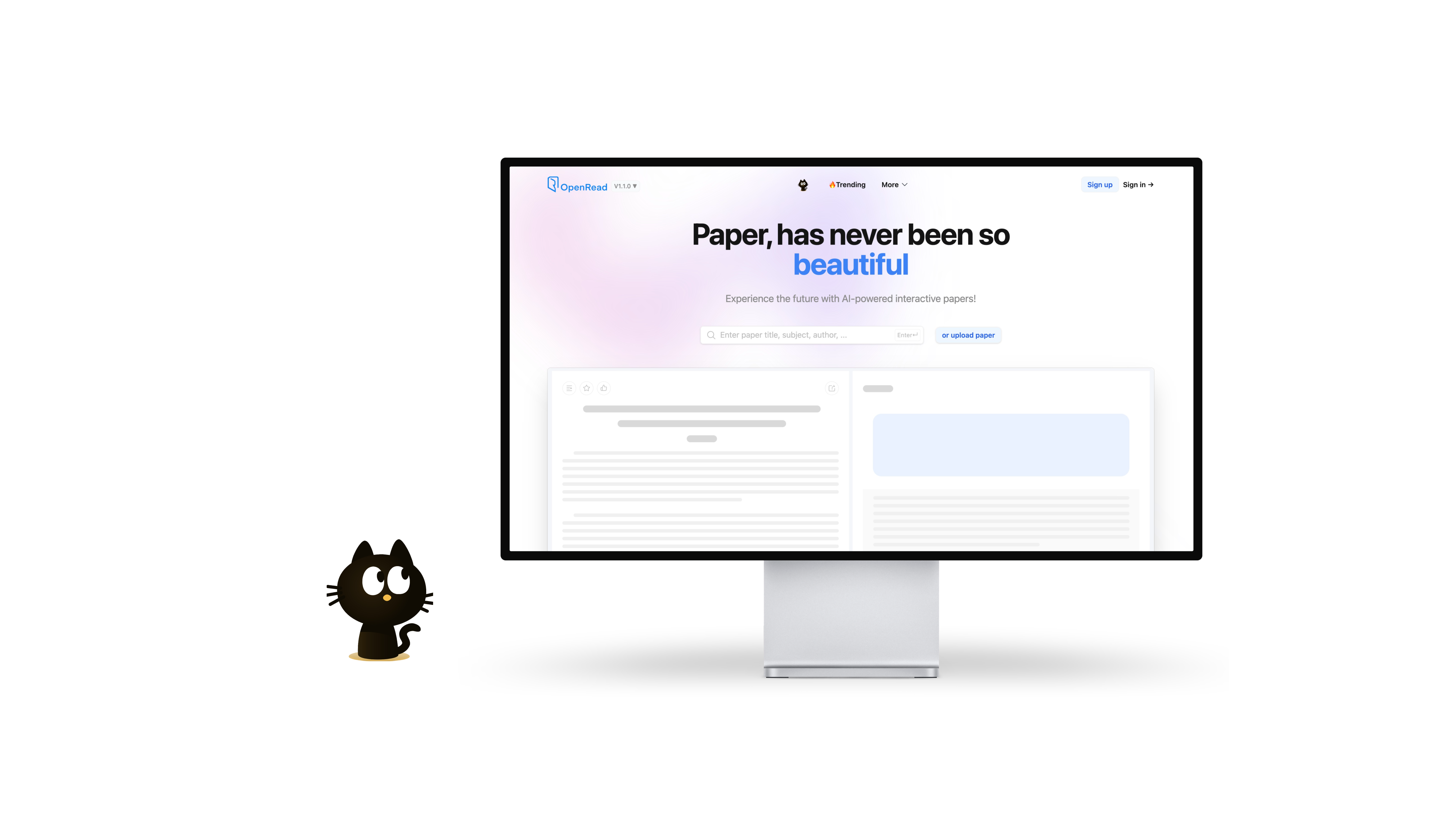
OpenRead
OpenRead is a web platform that searches over 300 million academic papers, parses uploaded PDFs, then summarises, compares and answers questions about them. Its Oat assistant adds multi-model chat, sourced web search and diagram drawing.
What is OpenRead?
OpenRead is a browser-based research platform built around a very large literature corpus. It claims access to more than 300 million academic papers, refreshed every five minutes from over 20,000 journals, and advertises 400+ categories across 1,052+ journals. Two search modes sit on the homepage: a paper search over that corpus and a web search described as reaching trillions of web sources. A Pro Search toggle handles deeper questions such as finding a thesis topic.
The reading side is where most of the work happens. Paper Espresso condenses an article into key insights, with an adjustable summary level and output language. Paper Q&A lets a reader question a paper conversationally. Paper Compare takes up to five papers at once and looks for agreements and contradictions, with expert-review and comparison-framework options. A Related Paper Graph draws a visual map of adjacent work, and notes can be taken beside the paper and stored in the cloud. PDF upload and parsing are unlimited in file count, capped at 2 MB per file on the free tier. An LLM translation feature covers papers in other languages.
Alongside this sits Oat, the company's assistant, a contraction of cat and OpenRead that also stands for OpenRead AI Technology. Oat routes to leading third-party models, listed on the site as GPT, Gemini, Claude, Grok and FLUX generations, and adds sourced web answers, diagram drawing, image editing and homework help.
The company documents three of its own models on a dedicated technology page: Hawkeye, a 152-million-parameter vision model that locates titles, abstracts, figures, tables, equations and references inside a PDF with roughly 93.7% accuracy; Oath, a natural-language model of over 70 billion parameters powering Q&A, summaries and translation; and Gauss, a 110-million-parameter OCR model converting inline and block mathematics into LaTeX, scoring 0.91 BLEU.
Access is web-only and requires an account. The interface exists in English and Chinese. There is no mobile application, no browser extension and no documented public API.
What it does
- Search more than 300 million academic papers, refreshed every five minutes from over 20,000 journals
- Upload PDFs without a file-count limit and have them parsed into structured, readable text
- Summarise any paper with Paper Espresso, choosing the depth of the summary and its language
- Ask questions about a paper in plain language with Paper Q&A
- Compare up to five papers side by side and surface contradictions between them
- Explore a visual map of related work through the Related Paper Graph
- Chat with the Oat assistant, run sourced web searches, draw diagrams and edit images
When to use OpenRead / When not to
A quick filter to help you decide if OpenRead is the right fit.
When to use OpenRead
- Graduate students, PhD candidates and postdocs facing a large body of literature to review
- Academic researchers and faculty who need to summarise, compare and cross-check papers quickly
- Scientists and engineers reading maths-heavy PDFs, since the in-house Gauss model converts equations to LaTeX
- University librarians and lab managers mapping a field through the Related Paper Graph and Trending feeds
- Budget-constrained readers, thanks to a permanent free tier and a paid entry point at 4.75 USD per month
When not to use OpenRead
- Organisations that require a signed DPA, a named subprocessor list or a written GDPR commitment, none of which OpenRead publishes
- Teams bound by data-residency rules, since the privacy policy commits to no hosting location and states data may sit anywhere in the world
- Individual users who need a guarantee that their content is excluded from AI training, a promise reserved for the institutional plan
- Developers wanting to embed the service elsewhere, as no public API, SDK or documentation exists
- Legal or patent researchers, whose case law and IP filings fall outside a corpus made of scientific papers
How to use OpenRead
A typical end-to-end flow, from setup to results.
- Create an account on the sign-up page; the free tier requires no payment card
- From the homepage, either type a query in the search bar or switch to the Upload tab
- Choose Search or Chat on the search bar, and turn on Pro Search when a question needs deeper treatment
- To work on your own document, drag a PDF into the Upload tab, picking 'Upload Paper PDF' to unlock Paper Espresso and Related Papers
- Upload several files at once if needed and follow the per-file progress counters
- Open a paper to get the reading view, with summary, question answering, related-paper graph and notes side by side
- Run Paper Espresso for a summary, adjusting the depth level and output language
- Select up to five papers and launch Paper Compare to surface contradictions
- Switch to Oat for open-ended chat, choosing a model and adding images or diagrams as needed
- Manage billing, invoices and cancellation from Personal Center, then Subscription, then the Change button
Pros & Cons
Pros
- Very large stated corpus, 300 million+ papers from 20,000+ journals, refreshed every five minutes
- Unlimited PDF upload and parsing even on the permanent free plan, capped only at 2 MB per file
- Low entry price: 5 USD per month billed monthly, or 57 USD per year, that is 4.75 USD per month
- Oat credits can be bought outright for 10 USD without any subscription, and they never expire
- In-house models are documented with parameter counts and published metrics rather than described in slogans
- The terms state plainly that users keep copyright on their content and that personal data is never rented or sold
- A named team with verifiable LinkedIn profiles and identified academic advisers, including a Nobel physics laureate
Cons
- The GDPR is never mentioned anywhere on the site, despite the policy acknowledging EEA and UK users
- No DPA, no named subprocessor list, no security page and no certification such as SOC 2 or ISO 27001
- No retention period is ever quantified, and hosting is committed to nowhere: data may sit anywhere in the world
- Exclusion from AI training is guaranteed only on the institutional plan, never for individual accounts
- The privacy policy carries paragraphs belonging to an unrelated calendar product and invokes Singapore's PDPA for a San Francisco company
- Refunds are limited to 24 hours by email, and opening a bank dispute leads to the account being blacklisted
- No mobile app, no browser extension and no documented API; the interface exists only in English and Chinese
Pricing & Plans
A permanent free plan is available and requires no payment card, offering five monthly uses of each AI feature together with unlimited PDF upload and parsing, capped at 2 MB per file. The lowest paid entry point is the Basic plan at 4.75 USD per month when billed annually, that is 57 USD per year; the same plan costs 5 USD per month when billed monthly. The Premium plan is 20 USD per month, or 228 USD per year, that is 19 USD per month. Oat credits may also be purchased outright at 10 USD without any subscription, and institutional licences are quoted at 200 USD per seat per year.
- 0 USD per month
- permanent. Five monthly uses each of Paper Espresso
- Paper Q&A
- Oat chat
- Answer by Oat and Pro Search
- Related Paper Graph and LLM translation
- unlimited PDF upload and parsing
- 2 MB per file
- 5 USD per month billed monthly
- or 57 USD per year
- that is 4.75 USD per month. 100 Paper Espresso
- 300 Paper Q&A
- 300 Oat chats with up to five images each
- 300 Pro Searches
- 300 graphs
- 30 Paper Requests
- 20 USD per month billed monthly
- or 228 USD per year
- that is 19 USD per month. Everything unlimited
- Oat chat with images
- search and drawing
- access to top-tier models and 10 million premium-model credits included each month
- 10 USD one-off
- no subscription. 100 million credits for Oat and every top-tier model behind it
- credits never expire and accumulate across purchases
- 200 USD per seat
- billed annually. All Premium features plus an admin dashboard
- single sign-on
- higher upload capacity
- priority support
- and organisational data excluded from AI training by default
Data, GDPR & hosting
A consolidated view of how OpenRead handles your data.
GDPR overview
The site never mentions the GDPR. Neither the privacy policy nor the terms use the words General Data Protection Regulation or the acronym, and no compliance is claimed anywhere, which is why this record marks OpenRead as non-compliant: this is documented silence, not an explicit denial. What the policy does publish is a generic rights list, covering access, correction, deletion, restriction, objection and non-discrimination, a thirty-day deadline to respond, the possibility of charging for requests, and a named Data Protection Officer, Han Wang, reachable at privacy@openread.academy. EEA and UK residents are told they may complain to a supervisory authority. The legal framework actually invoked is Singaporean, the PDPA and the PDPC. No Article 27 EU representative is designated, no EU entity or address is given, and no DPA, standard contractual clauses or subprocessor list is published.
Who owns the data?
The terms are unusually clear on ownership. Users keep the copyright on the articles and supplementary materials they post and on anything Oat or another AI tool generates for them: nothing is transferred or assigned to OpenRead, and content can be removed, archived privately or taken off a profile page at any time. OpenRead owns the Service itself and grants each user a worldwide, non-exclusive, non-sublicensable and non-transferable licence to use Content solely inside the platform. It positions itself as a temporary online transcoding provider for user-uploaded documents. The terms also state that personal data is never rented or sold, though the privacy policy allows data to be transferred in a merger, sale or bankruptcy.
Reuse rights
End users may not freely reuse the content they access. The licence granted by the terms covers use inside the Services only, which means transcoding or displaying papers online, annotating them and storing note data in the cloud. Any reproduction, modification, distribution or storage for another purpose is expressly prohibited without prior written permission, and users must respect the rules of the publishers and university libraries OpenRead sources from. The terms allow downloading or storing a reasonable portion of a paper together with one's notes for non-commercial educational purposes only, and warn that saving a large portion may breach local copyright law, at the user's own risk. Use of the service is restricted to personal, educational and non-commercial contexts. On its own side, OpenRead collects account details, communications, usage telemetry and advertising identifiers, and shares them with service providers, business and advertising partners; whether individual users' content feeds model training is never addressed.
Data retention & training
Hosting summary
OpenRead commits to no hosting location. Its privacy policy states that all information it processes may be transferred, processed and stored anywhere in the world, including but not limited to the United States, and acknowledges that destination countries may have different data protection laws from the user's own. The only safeguard offered is a generic promise to protect information consistently with applicable law; no mechanism is named, neither standard contractual clauses, nor an adequacy decision, nor any certification. There is no trust or security page anywhere on the site and no certification such as SOC 2 or ISO 27001 is claimed. Security itself is described in two words, physical and technical measures, with no detail and an explicit refusal to guarantee complete security. Breaches are notified to users electronically, by post or by email, and to Singapore's Personal Data Protection Commission when significant harm is likely or at least 500 people are affected. On the technical side, the domain resolves to a Vercel address, which describes where the website is served rather than where user data is stored.
Things to keep in mind
Risks and trade-offs to weigh before adopting OpenRead.
- Summaries can quietly replace reading. Paper Espresso and Paper Q&A are built for speed, and leaning on them for anything you will cite or build on erodes the close reading that research depends on
- The site advertises 99.9% accuracy on Paper Q&A, a figure no reader can verify; treat every generated answer as a pointer back to the source text, not as the source itself
- Your content is not contractually shielded from AI training unless you are on the institutional plan, so avoid uploading unpublished manuscripts, confidential data or anything under embargo
- The privacy policy contains sections describing a calendar product OpenRead does not offer, and invokes Singaporean law for a US-registered company: the document cannot be relied on as an accurate description of actual practice
- No retention period is published and hosting is not committed to any country, so you cannot tell how long anything is kept or where it sits
- Refunds are narrow and the terms explicitly threaten to blacklist accounts that open a bank dispute, which makes it worth reading the subscription clauses before paying
- Structured data on the homepage claims a perfect 5.0 rating from 1,250 reviews that appear nowhere on the site, and the declared logo URL is broken, both of which invite caution about other unverified claims
Setup & Integrations
Technical difficulty
Getting started is easy. Nothing is installed: OpenRead runs in the browser and asks only for an account, created with an email address, a password, a name and some background details. No API key, no connector and no configuration are involved, and a first search or PDF upload works immediately. Two optional steps go further: a School Account can be submitted for verification from the settings panel, and single sign-on comes with the institutional plan, set up by the organisation. No SDK or API is published, so there is nothing to integrate and nothing to maintain.
Deployment
Supported languages
Behind OpenRead
Social
Resources
All the official URLs gathered for verification and reference.
Frequently asked questions
What can OpenRead actually search?
Is there a free plan, and what does it include?
How much do the paid plans cost?
Is my content used to train AI models?
Is OpenRead GDPR compliant?
Can I get a refund?
Is there a mobile app or an API?
Which languages does the interface support?
Who is behind OpenRead?
How do I get support?
Should you pick OpenRead?
OpenRead is a real, working product, and the evidence for that is easy to find: a live sitemap of more than five thousand files, three in-house models published with parameter counts and measured scores, a named team with verifiable profiles, and a pricing page that puts four tiers and a credit pack in plain numbers. For a graduate student or a researcher facing a mountain of PDFs, the value is obvious and cheap, with a permanent free tier and a paid entry point under five dollars a month.
The weak side is the paperwork rather than the product. The GDPR is never mentioned, no data processing agreement or subprocessor list is published, no retention period is quantified, and hosting is committed to nowhere in particular. The privacy policy is visibly built on a borrowed template: it still describes a calendar and video-conferencing product that OpenRead does not offer, and it leans on Singapore's data protection law for a company whose only published address is a private mail box in San Francisco. The homepage also carries structured data announcing a flawless 5.0 rating from 1,250 reviews that exist nowhere on the site.
None of this makes the tool unusable, but it does draw a clear line. Individuals doing their own reading have little to lose and a genuinely capable set of features to gain. Institutions with a compliance function should treat the legal documentation as insufficient as it stands and ask for written answers on training, retention and hosting before committing. One practical note: at the time of this review the live site was fully behind an anti-bot challenge, so the figures above were read from archived captures and the pricing should be re-checked directly.
- Choosing a selection results in a full page refresh.
- Opens in a new window.