
AdaL
AdaL is an agentic coding platform from SylphAI that orchestrates specialised worker agents for coding, deep research, browser verification and code review, letting engineering teams switch between frontier models from a CLI, an agentic IDE or a headless SDK.
What is AdaL?
AdaL is the coding agent built by SylphAI and named after Ada Lovelace. Its starting argument is stated on the homepage as a thesis: the problem with AI-assisted development is not that models write bad code, but that teams mistake code generation for engineering progress. The site puts visible code at 20% of the work, leaving 80% for understanding the problem, planning architecture, making tradeoffs, reviewing decisions, debugging edge cases and maintaining quality.
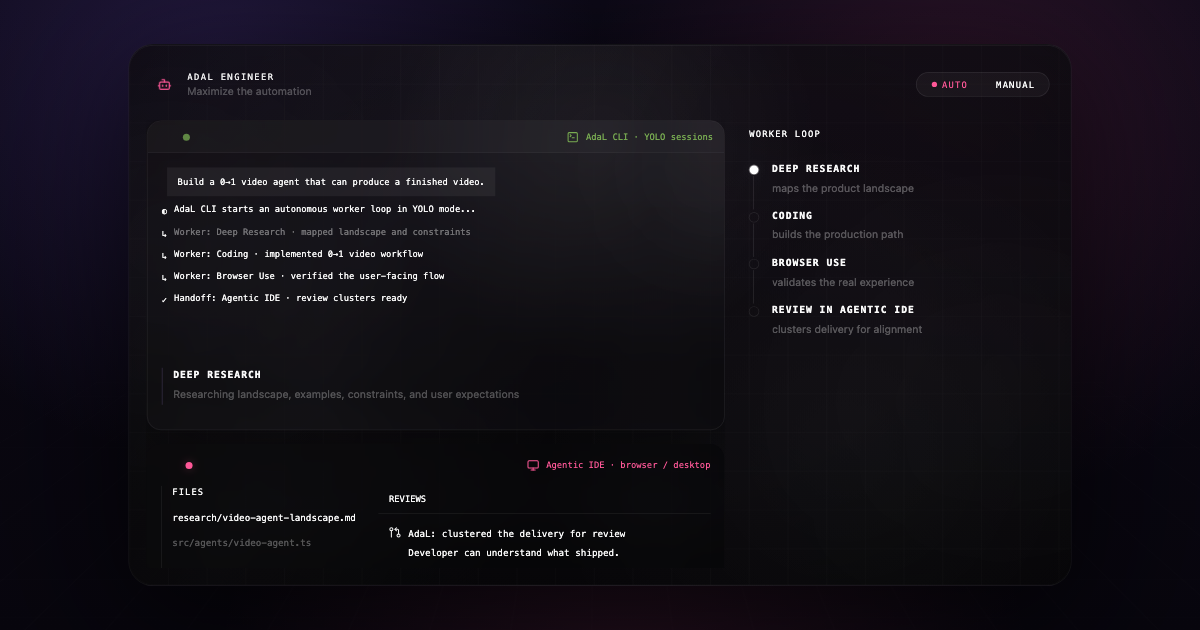
The product answers with orchestration rather than a single assistant. AdaL Engineer plans a task and hands its parts to specialised worker agents: a Coding agent for implementation, refactors and tests; a Deep Research agent for codebase-aware investigation and cited decision memos; a Browser agent that opens a real browser to click through flows, capture screenshots and inspect console, network, cookies and storage; and a Code Review agent that clusters changes into risk units and prepares the pull request.
Four surfaces share the same session. The CLI installs with a single shell command and adds /model, /agent, /ide, /resume and /stats to the terminal, showing plans, tool calls and diffs before an edit is approved. The agentic IDE reopens that session in a browser, or in a desktop preview for macOS Apple Silicon, when visual review is needed. Headless mode triggers agents from CI and background jobs, and an SDK lets teams compose their own workers with their tools, memory, prompts and guardrails.
Model choice is deliberately open: 43 planner models from Anthropic, OpenAI, Google, Meta, xAI, MiniMax, DeepSeek, Z.ai, Moonshot AI and Qwen, with GPT-5.6 Terra as the default, plus local models through Ollama, bring-your-own-API-key and reuse of an existing ChatGPT subscription. Extensibility comes from MCP servers, lifecycle hooks, scheduled prompts and @skills, an open protocol that installs capabilities only when they are used.
SylphAI publishes its benchmark numbers with their methodology: 92% on BU100 for browser use, and on SWE-Bench Pro Curated-50 a 50% pass rate against 46% for Claude Code, at 209 seconds against 315 and 0.68 USD per success against 1.87. The open-source core, AdalFlow, remains public.
What it does
- Orchestrate a task end to end by delegating its parts to specialised worker agents
- Write, refactor and debug code and generate tests, always grounded in the repository
- Drive a real browser: clicks, forms, screenshots, console, network, cookies and storage
- Run multi-source deep research grounded in the codebase and return a cited memo
- Review a diff as clustered risk units and prepare the pull request
- Switch models mid-session with /model across 43 models from ten providers
- Move a session from terminal to agentic IDE with /ide without losing context
When to use AdaL / When not to
A quick filter to help you decide if AdaL is the right fit.
When to use AdaL
- Terminal-first software engineers who want an agent working inside their existing shell and repository
- Engineering teams that require reviewable plans, tool calls and diffs before any change is approved
- QA and front-end engineers verifying real browser flows, console output, cookies and storage
- Small technical teams and startup founders shipping without a large engineering headcount
- Researchers, professors and computer science students prototyping from half-formed specifications
When not to use AdaL
- Non-technical users, since every workflow starts from a terminal or a code repository
- Anyone needing a mobile app: no iOS or Android client exists and the desktop app is a macOS Apple Silicon preview
- Teams working in a language other than English, as no localised interface is offered
- Organisations requiring a contractual guarantee on data location, because no hosting jurisdiction is disclosed
- Users on a tight budget, as the only free access lasts seven days before the 20 USD monthly entry plan
How to use AdaL
A typical end-to-end flow, from setup to results.
- Create an account on adal.sylph.ai and start the seven-day free access
- Install the CLI with the single shell command shown on the homepage, or download the desktop preview for macOS Apple Silicon
- Open a terminal in the repository you want to work on and launch adal
- Describe the task in plain language, as you would brief a colleague
- Let AdaL plan, act and verify, watching the tool calls it exposes as it works
- Route the work to the right specialist with /agent: research, coding, browser, docs or review
- Switch model with /model to match the difficulty and the cost of each step
- Open the same session in the agentic IDE with /ide when the task needs visual review or file navigation
- Read the diff, approve the change and ship it
- Come back later with /resume to continue with the context intact
Pros & Cons
Pros
- One subscription covers every frontier model, with no per-provider contract or setup
- Everything stays reviewable: plans, tool calls, diffs and verification steps, with confirmation before edits
- A single session follows you from terminal to browser to desktop through /ide and /resume
- Browser Use adds an end-to-end verification step that text-only agents cannot perform
- Benchmarks are published with their methodology, the coding suite's source code is public and the leaderboard is refreshed by CI
- The core is open source through AdalFlow, and @skills is an open protocol
- The Commercial Terms assign Output ownership to the customer and forbid training on Customer Content
Cons
- The product is very young: the domain was registered on 3 April 2026 and first archived on 10 July 2026
- No postal address is published anywhere, and a single email address serves legal, GDPR and support requests
- The Terms contradict themselves on training: one section forbids it on Customer Content, another allows it unless you opt out
- No hosting jurisdiction is disclosed and no subprocessor list is published
- There is no permanent free plan: beyond seven days the entry price is 20 USD per month
- No mobile app exists, and the desktop client is a preview limited to macOS Apple Silicon
- The benchmark figures are published by the vendor itself and remain self-reported
Pricing & Plans
AdaL does not offer a permanent free plan. Access is free for the first seven days, after which the cheapest paid tier is Pro at 20 USD per month. An annual commitment reduces the price by 17%, and students receive 50% off every plan for one year.
- seven-day access
- 0 USD for the first week
- 20 USD per month
- presented for short coding sprints in small codebases
- 5x usage
- 100 USD per month
- presented for everyday use in larger codebases
- 20x usage
- 200 USD per month
- for power users needing the widest model access
- custom pricing through a demo
- with up to 150 seats
- custom usage limits
- dedicated onboarding
- SSO
- SAML/SCIM provisioning
- Zero Data Retention and org-level admin controls
- 17% saving on the monthly rates
- 50% off
- bringing Pro to 10 USD
- Max to 50 USD and Max+ to 100 USD per month
Data, GDPR & hosting
A consolidated view of how AdaL handles your data.
GDPR overview
The acronym GDPR appears nowhere on the site or in the three legal documents. Part of the machinery is nevertheless in place: SylphAI distinguishes acting as data controller for consumer products from acting as processor under enterprise accounts, lists rights of access, portability, correction, deletion, objection and restriction "depending on your jurisdiction", routes requests to contact@sylph.ai with possible identity verification, and incorporates a Data Processing Addendum into the Terms by reference. Customers in the EEA, Switzerland and the United Kingdom fall under Irish law with arbitration in Dublin. What is missing is just as clear: no Article 27 EU representative is designated, no data protection officer is named, no EU address is given and no subprocessor list is published. Both documents are dated 7 October 2025.
Who owns the data?
SylphAI's Commercial Terms of Service state that the customer retains all rights to its Inputs and owns its Outputs, and that SylphAI assigns to the customer any interest it might hold in those Outputs. Customer Content is treated as the customer's confidential information, and the same section says SylphAI may not train models on Customer Content from the Services. A later section is markedly less protective: it allows SylphAI to use Materials to improve the Services and develop other products, including training its models, unless the user opts out in account settings. Consumer use places SylphAI as data controller; enterprise access makes it a processor, governed by the customer's own agreements. Feedback submitted to SylphAI may be reused freely.
Reuse rights
Outputs belong to the customer, who can reuse and redistribute them without asking SylphAI for further permission. In exchange, the customer warrants that it holds every right, licence and permission needed for the Inputs it submits, and that neither those Inputs nor the Actions it triggers breach the Terms, the Acceptable Use Policy or applicable law. SylphAI states plainly that Outputs may be inaccurate even when they look authoritative, and that nothing should be relied upon without independent verification; judging whether human review is appropriate is left to the customer. Two limits apply: the Services may not be used to build a competing product or to reverse engineer them, and SylphAI may cite the customer's name and logo as a public reference unless the customer objects through a request form.
Data retention & training
Hosting summary
SylphAI does not name a single country or region where user data is stored. The privacy policy commits to administrative, technical and physical safeguards without locating them, and acknowledges sharing data with affiliates and service providers covering hosting, storage, payments, analytics, security and support, none of which is listed by name. A Data Processing Addendum is incorporated into the Terms by reference, and Zero Data Retention is offered on the Teams & Enterprise plan. Jurisdiction surfaces only through governing law: Irish law with arbitration in Dublin for customers in the EEA, Switzerland and the United Kingdom, Californian law with arbitration in San Francisco elsewhere. One technical indication, which is not a vendor statement: the domain's A record resolves to 216.24.57.15, an address operated by Render and geolocated in the United States. A web infrastructure node is not proof of where data is stored and must not be read as a hosting commitment. The footer claims SOC 2 certification without naming an auditor, a report or a date.
Things to keep in mind
Risks and trade-offs to weigh before adopting AdaL.
- Autonomous delegation: an agent that edits your repository and runs commands can break working code if its autonomy is set too wide
- Approving diffs without reading them erodes your own grasp of the codebase, which is precisely the argument the vendor makes its founding thesis
- SylphAI states that Outputs may be materially inaccurate while still appearing accurate because of their level of detail
- Browser Use drives a real browser with real cookies and sessions, so it can act on production environments or surface credentials
- Your code travels to third-party model providers, and no hosting jurisdiction is declared anywhere
- Training on your data is the default on the consumer side: the opt-out has to be set explicitly in account settings
- Depending on a service registered in April 2026, with a desktop client still in preview, carries real continuity risk
Setup & Integrations
Technical difficulty
Setup itself is trivial: one shell command installs the CLI, the desktop preview downloads directly, and the agentic IDE runs in a browser with nothing to install. No per-provider model configuration is needed, since the subscription carries model access. The real prerequisite is professional rather than technical friction: you must be comfortable in a terminal and have a code repository to point the agent at. The advanced surfaces raise the bar, as headless mode, the SDK, MCP servers, lifecycle hooks, bring-your-own-API-key and local Ollama models all assume engineering skill.
Deployment
Integrations
Behind AdaL
Social
Resources
All the official URLs gathered for verification and reference.
Alternatives
Tools that compete with or complement AdaL.
Frequently asked questions
What exactly is AdaL?
Where do I actually use it?
Which AI models can it run on?
How much does it cost?
Is there a permanent free plan?
Is my code used to train models?
Who owns the code AdaL produces?
Is a Data Processing Addendum available?
What do the published benchmarks say?
How do I reach the team?
Should you pick AdaL?
AdaL arrives with a clear and genuinely differentiated proposition: orchestration instead of a single assistant, and a browser agent that verifies what the coding agent has just written. That combination is rare, and the Browser Use case study on the site shows why it matters, since the bug it describes lived in the rendered DOM rather than in the diff. The transparency around benchmarks is above the norm for this segment: methodology is published, the coding suite's source code is public, and the leaderboard is refreshed by continuous integration. An open-source core, AdalFlow, and an open skills protocol reduce the lock-in that usually comes with this kind of tool.
The weaknesses are the mirror image of those strengths. The product is extremely young, with a domain registered in April 2026 and a first web archive dated July 2026, so there is no track record to lean on. Data governance is visibly unfinished: no postal address anywhere, one email address for legal, privacy and support alike, no declared hosting jurisdiction, no subprocessor list, and an unresolved contradiction in the Terms between a clause forbidding training on Customer Content and another allowing it unless you opt out. The SOC 2 mention in the footer comes without auditor, report or date.
Pricing sits exactly where its competitors sit, at 20, 100 and 200 USD per month, with a genuinely generous 50% student scholarship. The realistic audience is technical teams already comfortable in a terminal, who value seeing every plan and diff before approving it. Teams with strict data residency or compliance requirements should wait for the legal documentation to catch up with the product.
- Choosing a selection results in a full page refresh.
- Opens in a new window.