
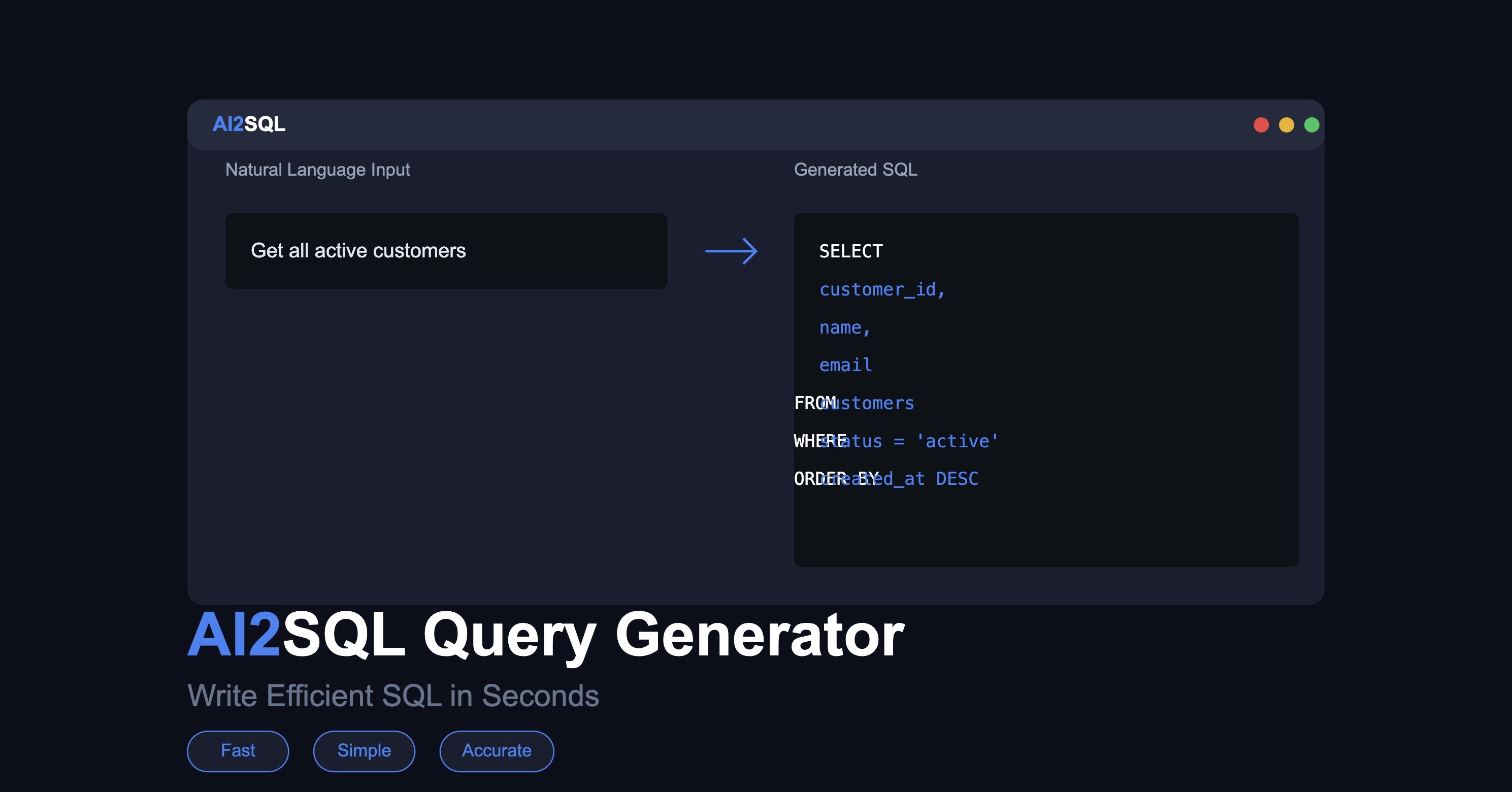
AI2SQL
AI2SQL is an AI SQL assistant that reads your real database schema to generate, explain, fix, optimize and run read-only queries in plain English, and exposes the same tools to Claude, ChatGPT and Cursor over MCP.
What is AI2SQL?
AI2SQL is an AI assistant for SQL work, published at ai2sql.io with the web application on builder.ai2sql.io. Its stated positioning is "the data layer for AI agents: schema-aware, governed, metered", and the product follows three steps. You connect a database with read-only credentials, which are encrypted at rest. The service then grounds itself by building a semantic layer from your schema, covering tables, joins and business terms, so the SQL it writes matches your data rather than a textbook example. Finally it answers: a query runs read-only over MCP or REST, audited and metered per call.
Six actions make up the everyday workflow: generate, explain, optimize, fix, format and run. The homepage lists ten database engines with connectors, among them PostgreSQL, MySQL, SQL Server, Oracle, Snowflake, BigQuery, Amazon Redshift, MongoDB, SQLite and Firebird, while the dedicated databases page adds roughly twenty more dialects for generation only, from ClickHouse and DuckDB to SAP HANA, Cassandra and Trino. Live schema browsing and query execution are narrower than generation: they cover PostgreSQL, MySQL and MariaDB, and Microsoft SQL Server.
The second half of the product is agent access. A hosted MCP server at builder.ai2sql.io exposes eight named tools, from generate_sql and explain_sql to describe_schema and run_query, to claude.ai, Claude Desktop, Claude Code, Cursor, VS Code with GitHub Copilot and ChatGPT in developer mode. Sign-in uses OAuth 2.1 with PKCE, so no API key is pasted into the client. A guard called sqlGuard classifies every statement before it reaches the database: only a single SELECT or WITH passes, and execution happens inside a read-only transaction as a second layer, capped at 1,000 rows and ten seconds. The AI2SQL Gateway adds per-agent API keys, monthly quotas, a full call log and one-click revocation.
For databases that only listen on localhost or a private address, a single-binary Connector runs on Windows, macOS or Linux and reads the schema where it already lives. The site displays customer logos including Nutanix, Gusto, Ocado, CGI, TELUS, Prime Therapeutics and Montefiore.
What it does
- Turn a plain-English request into SQL written against your real tables and columns
- Explain an existing query clause by clause before you trust it
- Optimize a slow query and get the reasoning, including missing indexes
- Fix a query that will not run, from syntax errors to dialect mismatches
- Run a read-only query on a connected database and read the rows
- Convert a query between PostgreSQL, MySQL, SQL Server, Oracle, Snowflake, BigQuery, SQLite and MariaDB
- Give an AI agent governed database access through a single MCP endpoint
When to use AI2SQL / When not to
A quick filter to help you decide if AI2SQL is the right fit.
When to use AI2SQL
- Data analysts who know the question but not the join, and want SQL written against their own column names
- Backend developers with a query that is slow, broken or written by someone who has left
- Data engineers juggling several engines at once, from PostgreSQL and MySQL to Snowflake, BigQuery and Oracle
- Teams giving Claude, ChatGPT or Cursor access to a database and needing that access read-only, logged and revocable
- People learning SQL, since every generated query comes with a clause-by-clause explanation
When not to use AI2SQL
- Anyone who needs to write to a database: inserts, updates, deletes and DDL are refused by design
- Users who must work offline, because query generation always needs a connection to the vendor's API
- Teams whose live querying targets Snowflake, MongoDB or Oracle, which only get SQL written for them for now
- Organizations that require a signed DPA, a published subprocessor list or a stated hosting jurisdiction before connecting production data
- Anyone under 18, who is barred from the service by the terms and conditions
How to use AI2SQL
A typical end-to-end flow, from setup to results.
- Create an account at builder.ai2sql.io/signup; every plan opens with a seven-day trial, nothing is charged on the day, but a card is required
- Add a database connection in the dashboard using read-only credentials
- Describe the result you want in plain English and read back the SQL, written in the dialect of the connection you picked
- Paste an existing query instead, to have it explained, optimized, fixed or formatted
- Run the query from the page and read the rows returned by the read-only connection
- To work from Claude, open Settings then Connectors, add a custom connector, paste https://builder.ai2sql.io/api/chatgpt-mcp, leave client ID and secret empty, press Connect and allow access
- In Claude Code, register the server with claude mcp add --transport http, then run /mcp and choose Authenticate
- In Cursor or VS Code, use the one-click install buttons on the MCP page, then sign in when the client reports that the server needs a login
- For scripts and custom agents, generate an API key at builder.ai2sql.io/api-keys.html and call the key-based server with an X-API-Key header
- For a database on localhost or a private network, download the Connector, clear the unsigned-binary warning once, sign in, load the schema and pick your tables
Pros & Cons
Pros
- Works on your real schema, so joins and column names come from your database rather than a generic example
- Read-only is enforced server-side by a statement classifier and a read-only transaction, not requested politely in a prompt
- One account and one plan cover the web app, the MCP server and the desktop Connector
- Generation, explanation, optimization, fixing, formatting and execution live in the same place
- Ten engines have connectors and roughly twenty more dialects are supported for generation
- MCP setup needs no API key for Claude, Cursor, VS Code or ChatGPT, and one-click installers exist for two of them
- Entry pricing is low and readable at 9 USD per month, or 7 USD per month billed annually
Cons
- A card is required to start the seven-day trial, and the terms rule out any refund once a subscription has begun
- Live querying is limited to PostgreSQL, MySQL, MariaDB and SQL Server; the other engines only get SQL written for them
- On the Gateway, only PostgreSQL is live today, with MySQL described as next
- The Connector binaries are unsigned by Apple and Microsoft, so the first launch has to be forced through manually
- The privacy policy dates from August 2020 and the terms from September 2021, long before the MCP and gateway offering they now cover
- Two different legal entities appear depending on the page: seriouscode GmbH in the privacy policy, Cross Regions Technology in the terms and on the contact page
- No DPA, no subprocessor list, no stated hosting country and no security certification such as SOC 2 or ISO 27001
Pricing & Plans
A permanent free tier is available: the MCP server grants five SQL requests a day with schema browsing, and the Gateway offers a free plan at 0 USD covering one connection and one agent key. The cheapest paid entry point is the Start plan at 9.00 USD per month, or 7 USD per month when billed annually. Every paid plan opens with a seven-day free trial charged at 0 USD on the day, although a payment card is required to begin it.
- sign in
- list connections
- browse schemas and make five SQL requests a day
- shared with the web application
- 100 SQL queries a month
- basic generation
- query explanation
- syntax fixing and chat support
- unlimited queries
- advanced AI model
- optimization and explanation
- your own database connections
- execution from Claude
- ChatGPT and Cursor over MCP
- the desktop app and priority support
- everything in Pro
- five users included
- a shared query library
- role-based access control
- execution priority and advanced analytics
- full access with no recurring charge
- 500 AI queries a month and all databases
- one database connection
- one agent key
- full guardrails
- seven days of audit history and a fair-use monthly call cap
- multiple connections and named keys
- full audit history
- higher call limits
- table allowlist rolling out and priority support
- shared workspace and team members
- key-to-connection scoping
- audit export and Slack alerts
- and a weekly digest of blocked writes
Data, GDPR & hosting
A consolidated view of how AI2SQL handles your data.
GDPR overview
The privacy policy devotes a section to data protection rights under the GDPR for residents of the European Economic Area, listing access, rectification, erasure, objection, restriction, portability and withdrawal of consent, plus the right to complain to a supervisory authority. The legal bases are enumerated: consent, performance of a contract, legal obligation, public interest and legitimate interest. Requests go to support@ai2sql.io and identity is verified first. A separate section covers California residents. Three things are missing: no data protection officer is named, no Article 27 representative for the European Union is designated, and no data processing agreement is published or offered. The policy carries an effective date of 21 August 2020, well before the current product.
Who owns the data?
The privacy policy, last updated on 21 August 2020, presents itself as an agreement between the user and seriouscode GmbH, while the terms and the contact page name Cross Regions Technology. Account data stays under the vendor's control: users may delete some personal information, but an unrevised copy can be kept for as long as legal obligations and partner commitments require, and in a merger or acquisition the account and its personal data are among the transferred assets. Database content is treated differently. Connection credentials are encrypted at rest with AES-256, the gateway states that query results are not retained, and the local Connector keeps credentials, rows and connection details on the user's own machine.
Reuse rights
The vendor lists broad purposes for the data it collects: running accounts and orders, delivering and improving the service, sending administrative, marketing and promotional messages, answering support requests, delivering targeted advertising, running prize draws, enforcing the terms and responding to legal requests. Browsing data such as IP address, browser, operating system, pages visited and internal searches is collected automatically. Third-party payment processors are used but never named, and the policy states that personal information is not shared with unaffiliated third parties. On the user's side, nothing in the terms restricts reuse of the SQL that AI2SQL produces or of the rows returned by a query: the output goes back to the user's own database work without a permission step. Nowhere on the site is model training on customer data mentioned, in either direction.
Data retention & training
Hosting summary
The site never states where data is hosted. No hosting country, region or data centre is named on any of the pages collected, and the privacy policy only acknowledges in general terms that transfers may involve storing information in a country other than the user's own, without naming one. The only concrete indication is technical: the website resolves to 216.150.1.1, an anycast address geolocated in the United States on Amazon's network, which describes the marketing site rather than the query infrastructure. What the vendor does document is protection rather than location: database connection credentials are encrypted at rest with AES-256, the gateway states that query results are not retained and only audit metadata is stored, and the local Connector keeps credentials, rows and connection details on the user's own machine. Anyone with a jurisdictional requirement should ask before connecting a production database.
Things to keep in mind
Risks and trade-offs to weigh before adopting AI2SQL.
- Handing database credentials to a hosted third party is a real decision: read-only access is enforced, but the connection still leaves your perimeter
- The published legal documents predate the current product by several years, so what you agree to may not describe what you are using
- The publisher's identity is inconsistent across pages, which makes it harder to know who actually holds your account data
- Nothing on the site says whether customer data is used to train models, and silence is not a commitment
- Trusting a generated query without reading it is easy, and a wrong join produces a confident answer rather than an error
- Leaning on generated SQL can quietly erode the habit of writing and reasoning about queries yourself
- The trial requires a card and no refund is available once a subscription starts, so an unnoticed renewal cannot be undone
Setup & Integrations
Technical difficulty
Low for the web application: you sign up and start writing, with nothing to install. Connecting a database is a step up, since you need read-only credentials and the right to use them. The MCP route is advertised at two minutes, is a pasted URL and an OAuth sign-in, and has one-click installers for Cursor and VS Code, while ChatGPT requires developer mode. The desktop Connector is the most technical part: the binaries are unsigned, so the first launch means clearing a SmartScreen warning or running a quarantine command in a terminal.
Deployment
Integrations
Supported languages
Behind AI2SQL
Resources
All the official URLs gathered for verification and reference.
Alternatives
Tools that compete with or complement AI2SQL.
Frequently asked questions
Is there a free trial, and do I need a card?
Can AI2SQL read my own database schema?
Can the assistant change or delete my data?
Which databases are supported?
Is there an API, and can my own AI agent use it?
What does the free tier include?
Does it work offline or on the desktop?
Is there a minimum age to use the service?
Should you pick AI2SQL?
AI2SQL is a narrow tool that knows exactly what it is for. Where a general assistant writes plausible SQL from a schema you paste into a chat box, AI2SQL reads the live schema, targets the dialect of the connection you picked, runs the statement read-only and hands back rows. The same capability is offered twice over: once in a browser workspace, once as a hosted MCP server that Claude, ChatGPT, Cursor and VS Code can call directly, with a gateway that meters, logs and revokes what each agent is allowed to do. For a team already pointing agents at production data, that governance layer is arguably the real product.
The pricing is unusually plain for this category. A permanent free tier, a paid entry point at 9 USD per month, a top team plan at 39 USD and a one-off lifetime option leave little room for confusion, although the separate Gateway price list, which runs to 99 USD per month, is easy to mistake for the same thing.
The reservations are about paperwork rather than product. The privacy policy dates from 2020 and the terms from 2021, both older than the MCP and gateway features they are meant to cover. Two different legal entities appear depending on which page you read. There is no data processing agreement, no subprocessor list, no stated hosting jurisdiction and no published security certification, and nothing anywhere says whether customer data feeds model training. For an analyst connecting a staging database, none of that matters much. For anyone connecting production data under a compliance regime, it is the first conversation to have with the vendor.
- Choosing a selection results in a full page refresh.
- Opens in a new window.