
BetterDB
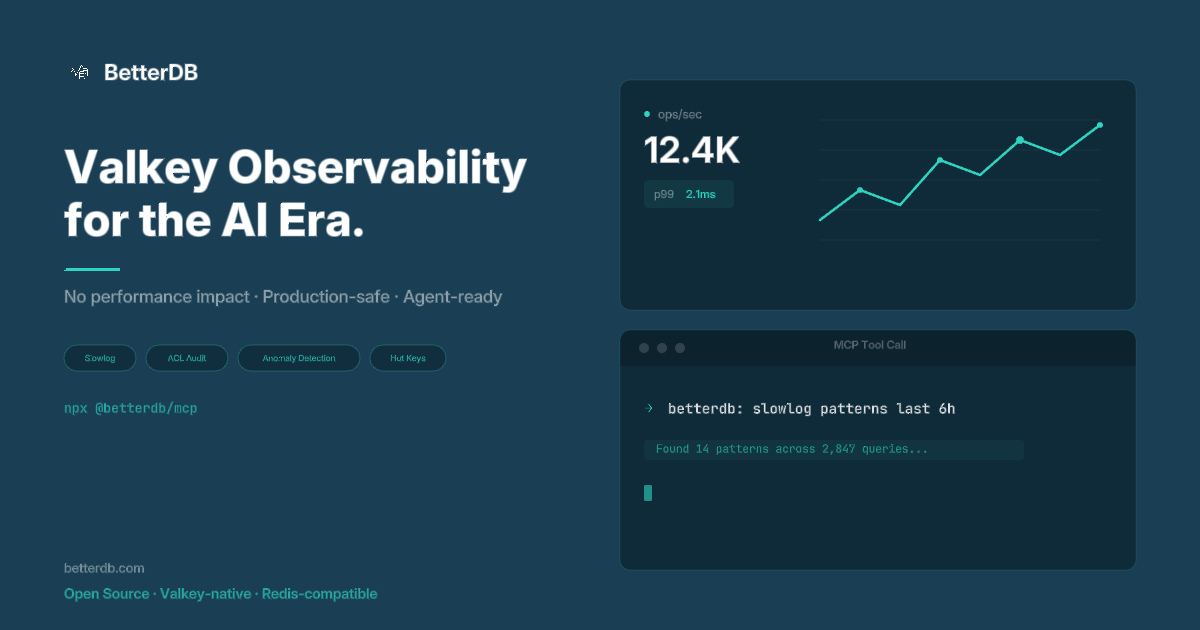
BetterDB is a Valkey-first observability platform for Valkey and Redis that persists slowlog, command history and client analytics, adding real-time dashboards, anomaly detection and ACL audit trails. It runs self-hosted, in the cloud, or fully air-gapped.
What is BetterDB?
BetterDB is a Valkey-first observability platform published by BetterDB Inc., a San Francisco public benefit company operating under the Open Core Ventures Open Charter. It describes itself as the observability and agent context layer for Valkey and Redis.
The problem it addresses is narrow and real. Valkey and Redis expose a snapshot: the SLOWLOG is a 128-entry ring buffer that rotates away precisely while an incident is unfolding, and client statistics reset on restart. BetterDB persists what the engine throws away, writing history to a backend you choose, whether in-memory, PostgreSQL or SQLite, so an operator can ask what happened at three in the morning rather than only what is happening now.
Around that single choice sits a broad product. Monitor covers real-time dashboards, slowlog and COMMANDLOG pattern analysis, latency percentiles, client analytics, cluster topology with slot heatmaps, anomaly detection through baseline learning, hot key tracking, key size distributions built from server-side histograms instead of SCAN, capacity forecasting, MONITOR capture sessions, vector search observability and an ACL audit trail. A second product, Migrate, analyses, replicates and validates moves between Redis, Valkey, managed clouds and self-hosted instances in either direction. A third strand is an MIT-licensed AI SDK bringing agent memory, semantic caching, exact-match agent caching and typed retrieval to the same Valkey connection, in TypeScript and Python.
Compatibility is stated precisely: Valkey 8.0 and above for every feature, including COMMANDLOG on 8.1+ and CLUSTER SLOT-STATS on 8.0+, and Redis 6 and above for everything except the Valkey-exclusive surfaces. Managed providers including AWS ElastiCache, MemoryDB, Redis Cloud and Upstash are documented, with SSH tunnels and an outbound WebSocket agent for VPC-only instances.
The commercial model is open core. The monitor core is MIT-licensed on GitHub and self-hosts through Docker, Helm or an npm CLI, with the interface on port 3001 and no signup required, while Pro features such as anomaly detection and key analytics are commercial. Everything can run fully offline in air-gapped environments, with licence tokens verified locally and no phone-home. An MCP server of sixty read-mostly tools lets Claude Code or Cursor investigate the database directly.
What it does
- Persist SLOWLOG and COMMANDLOG so an incident can still be investigated hours or days later
- Detect memory, CPU and connection anomalies automatically, with cluster guards for split-brain, stuck replicas and data loss
- Attribute load to the client or service that caused it, tracked over time
- Track hot keys and key size distributions without ever running SCAN
- Forecast time-to-ceiling for ops/sec, memory, CPU and fragmentation, and alert before saturation
- Keep an ACL audit trail and raise compliance alerts on ACL violations
- Migrate between Redis, Valkey, managed clouds and self-hosted instances with analysis, live replication and post-cutover validation
When to use BetterDB / When not to
A quick filter to help you decide if BetterDB is the right fit.
When to use BetterDB
- SRE and platform teams running Valkey 8.0+ or Redis 6+ in production, who need history that survives restarts and log rotation
- Database administrators investigating slow commands after the fact, through persisted SLOWLOG and COMMANDLOG pattern analysis
- Organisations operating in air-gapped or regulated environments, where locally verified offline licences and an ACL audit trail are hard requirements
- Engineering teams already invested in Prometheus, Grafana or OpenTelemetry who want a database-specific layer rather than a replacement stack
- AI engineers running RAG or semantic search on valkey-search, who need FT.SEARCH latency profiles alongside agent memory and semantic caching from one SDK
When not to use BetterDB
- Teams whose only requirement is infrastructure-level metrics and custom dashboards, which Prometheus and Grafana already cover, as the vendor itself concedes
- Operators who mainly want to browse keys, edit values and run commands interactively, which is Redis Insight territory rather than BetterDB's
- Organisations standardised on a single commercial APM such as Datadog or New Relic, where a database-specific pane would be redundant
- ElastiCache users content with coarse instance-level CloudWatch metrics, who never need to answer which command, key or client caused an incident
- Anyone running relational databases or non-RESP engines, since the product covers Valkey, Redis and RESP-compatible stores only
How to use BetterDB
A typical end-to-end flow, from setup to results.
- Start self-hosted with a single command, docker run -d betterdb/monitor:latest, then open http://localhost:3001 with no signup required
- Or point it at your instance with environment variables, passing DB_HOST and BETTERDB_LICENSE_KEY and publishing port 3001
- On Kubernetes, add the BetterDB Helm repository and install the betterdb-monitor chart into its own namespace, setting db.host to your service
- Prefer no installation at all? Use the npm CLI or npx, or sign in to BetterDB Cloud and skip the infrastructure entirely
- For VPC-only instances such as ElastiCache or MemoryDB, connect through an SSH tunnel or deploy the BetterDB agent on EC2 with an outbound WebSocket
- Explore the dashboard, then dig into slowlog patterns, client attribution, cluster topology and key analytics as history accumulates
- Wire alerts to webhooks, scrape the Prometheus metrics from /api/prometheus/metrics, and load the nine ready-made Alertmanager rules
- Browse the interactive Swagger and OpenAPI reference at http://localhost:3001/api to drive the platform programmatically
- Connect the MCP server to Claude Code or Cursor with the @betterdb/mcp package, then ask questions in plain language
- For a migration, run Analyze for a readiness report, then Migrate by snapshot, continuous replication or command mode, then Validate after cutover
Pros & Cons
Pros
- The monitor core is MIT-licensed and self-hosts in one Docker command, with no signup and no account
- It keeps the history the engine discards, which is the whole point: post-incident investigation instead of live-only dashboards
- Genuine air-gapped operation with locally verified offline licences and no phone-home, which is rare in this category
- It slots into an existing stack rather than replacing it, exposing over a hundred Prometheus metrics and speaking OpenTelemetry in both directions
- Flat pricing per workspace with unlimited seats, never per user and never per instance
- Self-hosted retention is unlimited, with no commercial ceiling on how much history you keep
- It covers Valkey-exclusive surfaces such as COMMANDLOG, CLUSTER SLOT-STATS and 8.x I/O threads that generalist APMs do not
Cons
- The product is openly in early access, and the pricing page states that current rates will change when the beta ends
- No security certification is published: no SOC 2, no ISO 27001, no HIPAA and no PCI DSS
- No data processing agreement is published or offered on request, and no subprocessor list exists, with Stripe the only third party named
- No EU Article 27 representative and no data protection officer are designated, despite a full GDPR section in the privacy policy
- A single generic mailbox, info@betterdb.com, serves legal notices, GDPR requests and product questions alike
- There is no about page, no contact page and no team page: a first name and a calendar link stand in for the company
- Cloud retention is capped at seven days on Free, ninety days on Pro and one year on Enterprise
Pricing & Plans
BetterDB offers a permanent free plan at 0 USD with no time limit, covering the full monitor for individual use. The cheapest paid tier is Pro, listed at 49.00 USD per month per workspace and billed annually, with Enterprise starting at 599.00 USD per month per deployment. During the current early access period, every Pro and Enterprise feature is unlocked at no charge, and the vendor advertises a retained rate of 29 USD and 399 USD per month respectively for customers who subscribe before the beta ends. Pricing is flat per workspace and is never charged per seat or per instance.
- the full monitor for individual use
- with real-time dashboard
- Memory and Latency Doctor
- slowlog
- COMMANDLOG and ACL analysis
- client analytics
- cluster topology
- vector search
- everything in Free plus shared workspaces and collaboration
- anomaly detection and diagnosis
- key analytics by namespace and stale keys
- cache-proposal review and approval
- alert routing to webhooks
- scheduled and anomaly-triggered captures
- bulk key delete
- migration execution and validation
- everything in Pro plus compliance and ACL-violation alerting through enterprise webhook events
- an ACL audit trail
- and air-gapped deployment with offline licence verification and no phone-home. Retention is one year on Cloud and unlimited self-hosted. Support includes an SLA
- a named contact or shared Slack channel
- and onboarding assistance.
- All three tiers are available both self-hosted and on BetterDB Cloud. Retention windows apply to the cloud only
- and during early access every tier is billed at 0 USD.
Data, GDPR & hosting
A consolidated view of how BetterDB handles your data.
GDPR overview
Implementation is real but partial. The privacy policy, effective 7 January 2026, carries a dedicated section for European users: BetterDB Inc. names itself as data controller, lists four legal bases (performance of a contract, legitimate interests, legal obligations and consent), grants access, rectification, erasure, portability and objection rights to everyone regardless of location, and relies on standard contractual clauses approved by the European Commission for transfers from the EEA, the United Kingdom and Switzerland. The right to lodge a complaint with a supervisory authority is stated, and requests go to info@betterdb.com. The minimum age is 16. What is missing is equally concrete: no Article 27 EU representative is designated, no data protection officer is named, no data processing agreement is published or offered, and no subprocessor list exists.
Who owns the data?
Under the Terms of Use, BetterDB Inc. does not claim ownership of Your Content. You keep it, but you grant the company a fully paid, royalty-free, worldwide, non-exclusive licence to use, reproduce, modify, adapt, publicly perform and publicly display it, for the purpose of operating and providing the Services to you and to other registered users. Everything outside Your Content, from the code to the interface itself, belongs to the company and its suppliers. The privacy policy adds that personal information is never sold. When you self-host, the monitoring history lives in a backend you choose, on storage you own and control.
Reuse rights
The terms grant end users no reuse right over anyone else's content: the licence flows one way, from you to BetterDB Inc. What you may freely reuse is your own monitoring data. Self-hosted, it sits in an in-memory store, a PostgreSQL database or a SQLite file that you point at any connection URL, so you can query, export or delete it without asking permission. The product is also built to hand that data back: MONITOR capture sessions export to JSON or CSV, migration readiness reports export as documents, over a hundred Prometheus metrics are exposed for scraping, and OpenTelemetry metrics and events can be dispatched to any collector. The MIT licence on the monitor core carries no lock-in clause, and the vendor markets that absence explicitly.
Data retention & training
Hosting summary
Where the data lives depends on how you deploy. Self-hosted, BetterDB writes its history to a backend you choose, whether in-memory, PostgreSQL or SQLite, and for the last two you supply any connection URL, so the storage can be local, on your own servers, or with a cloud provider of your choosing. In air-gapped mode nothing leaves your network at all: licence tokens are verified locally and the product never phones home. BetterDB Cloud is offered as a managed alternative, but the site never names the region or country where it runs. On the vendor's own side, the privacy policy states that BetterDB Inc. is headquartered in the United States, that personal information may be transferred there, and that service providers may operate in other countries, with standard contractual clauses covering transfers from the EEA, the United Kingdom and Switzerland. No subprocessor list is published, and Stripe is the only third party named, for payment processing.
Things to keep in mind
Risks and trade-offs to weigh before adopting BetterDB.
- Monitoring data is production data: MONITOR capture sessions can surface key values, and redaction is an option you have to switch on rather than a default
- The advertised prices are list prices, not what is billed today; early access ends at a date the vendor has not announced, and any budget built on 0 USD will move
- Fees are non-refundable and subscriptions renew automatically, with cancellation required at least thirty days before the renewal date
- The terms impose binding arbitration under Delaware law with a class action and jury waiver, and opting out requires a written letter within thirty days
- Handing database investigation to an agent invites over-reliance: the MCP tooling is read-mostly and cache changes need human approval, but the habit of never looking yourself is the real risk
- Legal and privacy transparency lags the engineering, with no DPA, no certifications, no subprocessor list, no named data protection officer and no EU representative
- The registered address is a private mailbox rather than offices and no team is presented, which is normal for a young startup but worth knowing before signing anything
Setup & Integrations
Technical difficulty
Moderate, and squarely aimed at engineers. Self-hosting is genuinely one command, docker run -d betterdb/monitor:latest, with the interface on port 3001 and no signup, and Helm, npm and npx offer the same in other shapes. Configuration is a handful of environment variables. Difficulty rises with the environment rather than the product: VPC-only instances such as ElastiCache need an SSH tunnel or an agent on EC2, and air-gapped deployment adds offline licence token management. BetterDB Cloud removes the setup entirely. This is SRE and DBA territory, not a consumer tool.
Deployment
Integrations
Behind BetterDB
Fundraising
Social
Resources
All the official URLs gathered for verification and reference.
Alternatives
Tools that compete with or complement BetterDB.
Frequently asked questions
Which databases and versions does BetterDB support?
Is BetterDB open source?
Where does my monitoring data actually live?
Can it run without internet access?
Do I have to replace my existing monitoring stack?
Are managed services such as ElastiCache or Upstash supported?
Can an AI agent use BetterDB?
How long is my data kept?
What does BetterDB cost?
Is there a minimum age to use the service?
Should you pick BetterDB?
BetterDB is a deliberately narrow tool, and that is its strength. It does not try to observe your whole stack; it observes Valkey and Redis, and it does so by making one decision the rest of the category has avoided, which is to persist the history the engine throws away. Everything else follows from that: slowlog analysis by pattern, client attribution over time, hot key rank movement, capacity forecasting, an ACL audit trail. Teams that have ever lost a 3 a.m. incident to a rotated ring buffer will recognise the problem immediately.
The commercial framing is unusually clean for the category. The monitor core is MIT-licensed and self-hosts in one command with no account, retention is unlimited when you host it yourself, and paid tiers are flat per workspace rather than per seat or per instance. Air-gapped operation is real rather than aspirational, with licence tokens verified locally and no phone-home, which matters to regulated operators who usually have to build this themselves. The vendor even publishes a page explaining when Prometheus, Redis Insight or CloudWatch would serve you better, which is not common.
The reservations are about maturity, not capability. The product is in early access, the advertised prices are not what is billed today, and the legal surface lags the engineering: no certifications, no data processing agreement, no subprocessor list, no EU representative, no named data protection officer, and a single generic mailbox for legal, privacy and product questions alike. There is no about page and no team page. None of that is disqualifying for a young open-core company, but it belongs in the conversation before an enterprise contract. Trying it costs nothing: one Docker command against a development instance will tell you within an hour whether it catches what you have been missing.
- Choosing a selection results in a full page refresh.
- Opens in a new window.