
Chibi AI
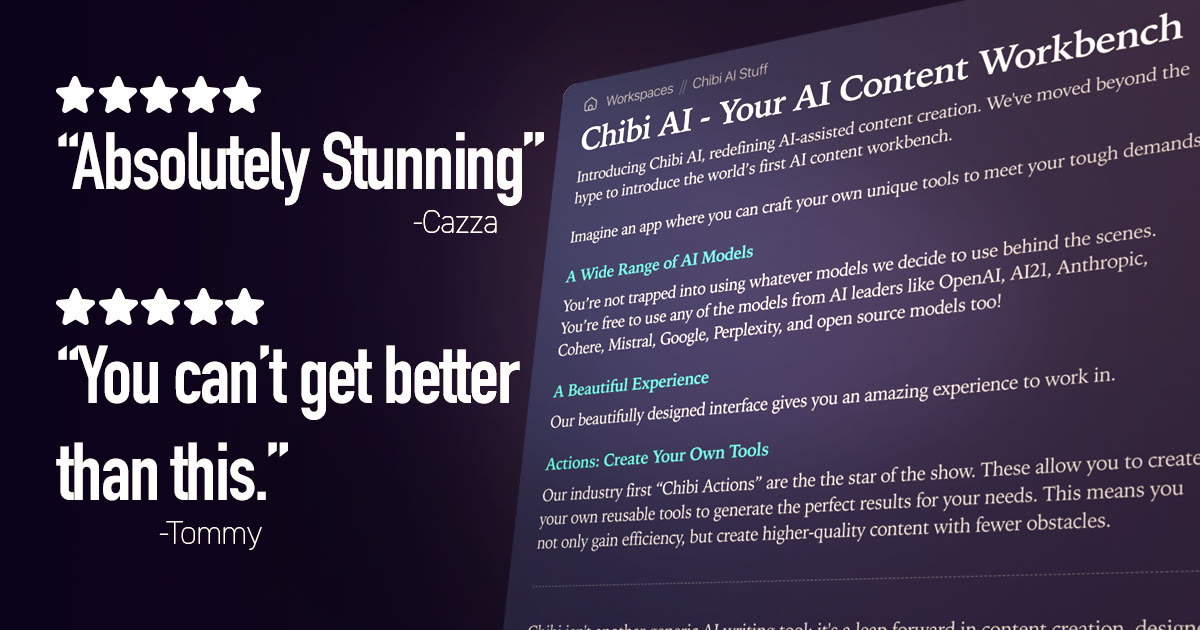
Chibi AI is a writing platform that puts artificial intelligence inside a familiar document editor. Custom personas, persistent memory and one-click workflows keep your voice consistent, while your own OpenRouter key pays for models at market rate.
What is Chibi AI?
Chibi AI is an AI writing platform built around a familiar document editor rather than a chat window. Its guiding idea is that the writer stays in charge: the assistant works inside the document, beside the text, and is summoned with slash commands instead of taking over the page. The product is published by AtMyBase LLC, an Iowa limited liability company founded by Chad Thiele, who also runs the AI Content Dojo. Chibi launched in December 2021 and was rebuilt into its current form in February 2024.
Four building blocks carry most of the work. Roles are custom AI personas holding a model, its instructions and its controls, so a voice or an area of expertise can be reused across documents. Actions are multi-step workflows triggered in one click, assembled from tasks such as Scraper, Image Prompt, Call Webhook, Load Files, conditional branches and loops. Document Memory and Global Memory hold the context an assistant needs, from a single brief to brand guidelines shared by every document. Around them sit Blueprints, Snippets, Chat, Notes, the Web Composer, a Rework Sidebar for testing a rewrite in isolation, and Ask Cheebs, which asks framing questions before producing anything. Memory Composer, Action Composer and Role Composer generate those objects from an example instead of a blank form.
The commercial model has two floors and is unusual in this market. The platform costs 29 US dollars per month or 290 per year, with unlimited documents and workspaces and no word or credit quota. The AI itself is not resold: users bring their own OpenRouter API key and pay token costs directly at market rate, choosing among several hundred models, including GPT-4, Claude, Llama, Mistral, Gemini and free ones, and switching per task. Chibi moved to OpenRouter in September 2024, after direct integrations with individual providers.
Chibi is a web application only, entered with a Google account and tested on Chrome, Safari, Brave, Edge and Firefox. The interface exists in English alone, and the vendor states plainly that enterprise use is out of scope: it sells per seat, to individuals and small teams.
What it does
- Write and edit long-form documents with AI assistance inside the editor
- Build custom AI personas that hold a voice, a style and an area of expertise
- Automate recurring writing tasks as multi-step, one-click workflows
- Keep context in document memory and global memory so the assistant stays on brief
- Switch between hundreds of AI models through a personal OpenRouter key
- Rework a passage in an isolated sidebar before merging the change
- Pull web pages, files and webhooks into a workflow as ordinary steps
When to use Chibi AI / When not to
A quick filter to help you decide if Chibi AI is the right fit.
When to use Chibi AI
- Professional writers and freelancers producing high volumes who need a recognisable voice across every client
- Content marketers and copywriters who want reusable personas and one-click workflows rather than one-off prompts
- Educators and instructional designers building course material, lesson plans and structured student feedback
- Authors working on long-form fiction or non-fiction, where document and global memory keep a project coherent
- Cost-conscious power users who would rather pay OpenRouter directly than buy word credits from a vendor
When not to use Chibi AI
- Companies and larger teams: the vendor states plainly that enterprise use is out of scope and sells per seat
- People unwilling to open an OpenRouter account and handle an API key to pay for AI usage separately
- Anyone needing a mobile app, a browser extension or a public API, since Chibi is a web application only
- Non-English speakers who need a localised interface, which exists in English alone
- Buyers who require readable, current contractual documents: the privacy policy, terms and GDPR page are offline
How to use Chibi AI
A typical end-to-end flow, from setup to results.
- Sign in at chibi.ai with a Google account
- Create an OpenRouter account and generate an API key
- Paste that key during Chibi's onboarding
- Start the three-day trial, which opens every feature without a credit card
- Write in the editor and call the AI with slash commands, without leaving the document
- Create a Role to fix a voice, a style or an expertise you intend to reuse
- Fill document memory with the brief, and global memory with brand guidelines or specifications
- Build an Action for a recurring task, or let the Action Composer generate one from an example
- Test a rewrite in the Rework Sidebar before merging it into the text
- Track token spend in the OpenRouter dashboard
Pros & Cons
Pros
- No word, credit or document quota: every feature is included in the single tier
- Token costs paid directly to OpenRouter at market rate, with no markup and full visibility
- Several hundred models available, switchable per task, with new ones reachable as soon as they ship
- A word-processor interface instead of a chat window, keeping writing and AI in one place
- Deep customisation through Roles, Actions and memory, aimed at consistency over time
- Explicit commitments that user content is never used to train models and remains the user's property
- Three-day trial with no credit card, a 25% trial discount and a 30-day money-back guarantee
Cons
- The total cost is split and uncapped: 29 US dollars per month plus a variable OpenRouter bill
- Setup requires an OpenRouter account and an API key, and sign-in is limited to Google
- No permanent free plan, and the trial lasts only three days
- Web application only: no mobile app, no browser extension, no public API
- English-only interface, and enterprise use is explicitly unsupported
- The privacy policy, terms of service and GDPR page linked in the footer all return 404
- No public update since December 2024, no security certification, no stated hosting country or retention period
Pricing & Plans
There is no permanent free plan. Access to the platform is sold as a single tier at USD 29 per month, or USD 290 per year. A three-day full-access trial is offered without a credit card, with a 25% discount available during that period and a 30-day money-back guarantee for new subscribers. AI usage is billed separately: users connect their own OpenRouter account and pay token costs directly at market rates, with no markup applied by the vendor.
- unlimited documents and workspaces
- custom AI personas and automated workflows
- full document editor and collaboration tools
- use of any model through OpenRouter
- and access to future updates
- full access to every feature
- no credit card required
- with a 25% discount available during the trial and a 30-day money-back guarantee afterwards
- token costs are paid directly to OpenRouter at market rates
- with no markup
- and tracked in the OpenRouter dashboard
Data, GDPR & hosting
A consolidated view of how Chibi AI handles your data.
GDPR overview
Chibi published a dedicated GDPR page and a data processing agreement, but both, along with the privacy policy and the terms, return 404 today; what follows comes from archived copies. The vendor claimed data minimisation, consent obtained through the Google account connection, encryption of API keys, access controls and regular backups. The privacy policy listed the usual rights: access, update, deletion, rectification, objection, restriction, portability and withdrawal of consent. The DPA committed the processor to documented instructions, staff confidentiality, security measures, assistance with data subject requests, breach notification without undue delay, deletion or return of data at the end of the contract, and no sub-processing without prior consent. No Article 27 EU representative is named, no DPO is appointed, and the only contact address is support@chibi.ai.
Who owns the data?
Under the terms of service, users keep full ownership of everything they create in Chibi, text, documents and images alike, and the vendor claims no ownership rights over it. Users grant Chibi only a limited licence to host, store and display that content in order to run and improve the service, and the terms promise it will never be used, shared, sold or distributed for any other purpose without express permission. Vendor access is restricted to four cases: legal obligation, delivering and maintaining the service, answering a support request, and protecting rights or safety. These clauses come from the archived version dated 24 August 2024, the page itself being offline.
Reuse rights
Users may reuse whatever they produce with Chibi without asking permission: ownership stays with them and no licence is claimed over the output. The platform also lets them export and share Actions, Roles, Snippets, Blueprints and global memory, and sharing an item grants other users permission to use and modify it. On the collection side, Chibi gathers an email address, usage data and device data, uses them to run the service, provide support and, with consent, send marketing, and shares them with two named processors, Google Firebase and MailChimp. Email addresses are never sold or rented for third-party marketing. Content sent to AI models through the platform is governed by those providers' own policies, for which Chibi disclaims responsibility.
Data retention & training
Hosting summary
The privacy policy names a single hosting arrangement: Google Firebase, used for storage and processing, with the statement that data is held securely in Google's cloud infrastructure. No country and no region is given, so neither the jurisdiction of storage nor any EU option can be established from the site. The vendor is a United States company incorporated in Iowa, and the terms place any dispute under Iowa law, which is the only jurisdictional anchor available. The security measures announced on the GDPR page are access controls, encryption of API keys and regular backups; no security certification is published and there is no trust or security page. The marketing site and the application are served behind Cloudflare, which says nothing about where data is stored. No international transfer mechanism, whether standard contractual clauses or the Data Privacy Framework, is mentioned anywhere. All of this comes from archived copies, the pages themselves being offline.
Things to keep in mind
Risks and trade-offs to weigh before adopting Chibi AI.
- A whole landing page is built on bypassing AI detectors, an argument that can put users in breach of academic, editorial or client rules
- The three legal links in the footer return 404 and the help centre is offline, so nobody can read the contract they would be agreeing to
- The public changelog stops in December 2024 and the footer still reads 2024: there is no visible sign of ongoing maintenance
- The vendor is a single-founder Iowa LLC with no published continuity commitment, which concentrates the risk on one person
- Spending is not capped inside Chibi: token costs accumulate on the OpenRouter side and are easy to lose track of
- Leaning on personas and memory for consistency can quietly erode the habit of drafting from scratch, since reviewing generated text is not the same skill as writing it
- The documents disagree on the minimum age, 18 in the terms against 13 in the privacy policy, and no Article 27 EU representative is designated
Setup & Integrations
Technical difficulty
Low to moderate. Sign-up goes through a Google account with nothing to install, and writing can start immediately with slash commands in the editor. The one genuinely technical step is external: creating an OpenRouter account, generating an API key and pasting it during onboarding. After that no development skill is needed, since Actions are assembled visually and the Action Composer builds one from an example. Two documented frictions: Brave users must disable shields for chibi.ai, and some security or ad-blocking extensions may need adjusting.
Deployment
Integrations
Supported languages
Behind Chibi AI
Social
Resources
All the official URLs gathered for verification and reference.
Alternatives
Tools that compete with or complement Chibi AI.
Frequently asked questions
How is Chibi AI different from ChatGPT or Claude?
How much does Chibi AI cost?
Do I need an API key to use it?
Is there a free plan?
Is my content used to train AI models?
Who owns what I write in Chibi?
Is there a mobile app?
Where can I read the terms and the privacy policy?
Should you pick Chibi AI?
Chibi AI answers a real complaint about AI writing tools: the constant shuttling between a chat window and a document. Putting the assistant inside a word processor, and letting a writer freeze a voice into a Role and a routine into an Action, is a genuinely different bet from the template-driven products it competes with. The bring-your-own-OpenRouter model is equally distinctive, with no word quota, no credit currency and no markup on tokens, and it suits people who produce a lot and want to see what their output actually costs.
The price of that design is a two-part bill and a setup step: 29 US dollars a month for the platform, plus a variable OpenRouter invoice, after creating an account there and pasting an API key. There is no permanent free tier, the trial lasts three days, and there is no mobile app, no browser extension and no public API.
The larger reservation concerns the state of the site rather than the product. The three legal links in the footer, privacy policy, terms of service and GDPR policy, all return 404, and the whole help centre has been taken down, so the documentation and the contact form went with it. The public changelog stops in December 2024 and the footer still reads 2024. The application and the signup flow are up, which is why the tool is listed as active, but a prospective buyer has no way to read the contract they would be agreeing to.
Chibi AI deserves a look from independent writers, educators and small teams who want control over model, voice and cost. Before committing money, ask the vendor for the current terms, the retention policy and a working support channel.
- Choosing a selection results in a full page refresh.
- Opens in a new window.