
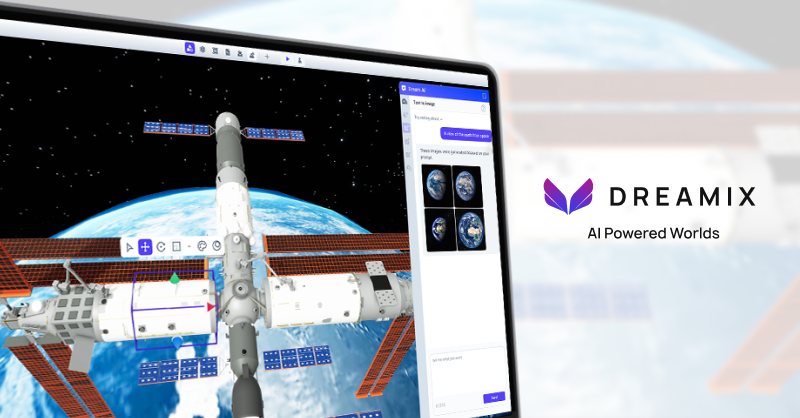
Dreamix
Dreamix is an AI platform for building user-generated 3D worlds and games, aimed at children, classrooms and beginners through its Dream Maker desktop editor. As of August 2026 every AI backend is unreachable and the service is effectively stopped.
What is Dreamix?
Dreamix is an AI-assisted creative platform for building user-generated 3D worlds and games. Its promise is that anyone, whatever their experience, can describe a scene in plain language and get something playable out of it, and the site aims that promise at children, classrooms and first-time creators as much as at hobby game developers.
The platform comes in three pieces. Dream Maker is the core product: a desktop editor downloadable for Windows (.exe) and Mac (.zip), with a Windows installer of roughly 30 MB whose file dates from 20 September 2023. Dreamix App, the companion space announced as Play. Hangout. Create., has carried a Coming soon label since at least 2023 and never shipped: there is no App Store or Google Play listing. Dreamix Labs is a web demo, Text-to-3D AI, that turns a prompt into a textured mesh, exports it as GLB or as .json scene code, and hands it over to Dream Maker.
Six generative building blocks are announced: text-to-3D, text-to-image with outpainting, editing and cutout, prompt-generated audio effects and ambiences, NPC dialogue in text and voice with voice cloning, Lua scripting for gameplay logic, and AI-driven storytelling. An in-editor assistant called AI Assist searches 3D, 2D and audio assets and suggests ideas, while Video to Model rebuilds a real object in 3D from a short clip. Around the editor sit a community asset library and a Creator Marketplace where creators buy and sell models, images, code and world templates.
Dreamix also carries an explicit Web3 layer, with drag-and-drop NFT stores, smart contracts and wallet login, plus two documented developer APIs: the Dreamix Engine API and the Dreamix Web3 API. Its education angle is unusually concrete, with virtual science labs, an interactive history timeline, virtual art galleries and a collaborative coding timeline tied to maths, physics, biology, history and literature.
That is the product as documented. As of 11 August 2026 it no longer runs: the generation backends and the platform server return HTTP 521, and the domain documentation site returns 522. Only the GitBook documentation and the installer file itself are still served.
What it does
- Generate a textured 3D model from a single written sentence
- Generate 2D images and textures, then apply them to 3D surfaces as materials or decals
- Give non-player characters written and spoken dialogue, including cloned voices
- Produce Lua gameplay code from a plain-language prompt
- Assemble a playable world by drag and drop, without writing code
- Turn a short video of a real object into a 3D model
- Export a generated mesh as a GLB file, or its scene code as .json
When to use Dreamix / When not to
A quick filter to help you decide if Dreamix is the right fit.
When to use Dreamix
- Nobody in practice today: the service no longer answers, so the profiles below describe who Dreamix was built for, not who should use it now
- K-12 teachers who were looking for ready-made virtual science labs, an interactive history timeline or virtual art galleries to drop into a lesson
- Instructional designers and edtech teams exploring AI-generated 3D material for maths, physics, biology, history or literature
- Complete beginners in 3D and hobby game makers who wanted to build a world from written prompts instead of modelling and coding it
- Researchers and analysts documenting how AI generation, user-generated content and Web3 were combined for education around 2023
When not to use Dreamix
- Any production use: the generation backends do not respond, so nothing can actually be built today
- Schools and anyone processing children's data: no readable legal framework, no published minimum age, no mention of parental consent
- Organisations with compliance obligations (GDPR, data processing agreement, subprocessor list): none of it is published
- Teams that need a support channel or budget clarity: there is no contact page, no email address and no published price
- Anyone unwilling to install a desktop executable from an unidentifiable publisher, untouched since 2023, or to sign in through a crypto wallet
How to use Dreamix
A typical end-to-end flow, from setup to results.
- Download the Dream Maker editor from the site, choosing the Windows (.exe) or the Mac (.zip) build
- Install the application locally; the Windows installer weighs about 30 MB
- Sign in, either with a crypto wallet (Wallet Login) or with a social account (Social Login)
- Create a project, then open it in the editor
- Describe what you need in plain text to generate 3D models, images, audio or NPC dialogue
- Ask AI Assist for Lua snippets, asset suggestions or help with the editor itself
- Assemble the scene by drag and drop, combining script packages, logic widgets and Web3 functions
- Enter the world to test it from the player's point of view
- Publish in one click to Dreamix App on PC, iOS and Android, and to SDK-connected applications
- Alternatively, skip the install and use the Text-to-3D AI web demo (prompt to mesh, then GLB or .json export). Bear in mind that this walkthrough describes the documented flow: as of 11 August 2026 the servers behind the sign-in, generation and publishing steps do not answer
Pros & Cons
Pros
- An unusually broad creative chain under one roof: 3D, 2D, audio, dialogue and code in a single editor
- A low stated entry barrier, with no-code assembly and drag and drop presented for creators of any level
- A concrete and rarely seen education angle: virtual labs, history timelines, art galleries, shared coding
- Open exports, with meshes in GLB and scene code in .json, so generated assets are not entirely locked in
- Two publicly documented APIs, including a Web3 API, for developers who want to go beyond the editor
- A desktop editor that genuinely shipped: the installer is still served and weighs about 30 MB
- First-party documentation still readable on GitBook, covering the product tour, getting started and both APIs
Cons
- The service is effectively stopped: checked on 11 August 2026, every AI backend returns HTTP 521 and the domain documentation returns 522, so no generative feature works
- The whole product is frozen: the Windows binary dates from 20 September 2023, the sitemap from March 2023, the documentation says it was last updated three years ago and the footer still reads 2024
- No identifiable publisher: no company name, no postal address, no email address, and a waitlist form as the only channel
- No terms of service and no legal notice, while the single privacy policy link points to a Google Drive file that returns HTTP 404
- No pricing information of any kind: no pricing page, no plan, no amount anywhere on the site or in its code
- No minimum age is published, although the product explicitly addresses children and school classes
- Sign-in through a crypto wallet adds friction and ties the account to the Web3 ecosystem, and the announced Dreamix App never shipped
Data, GDPR & hosting
A consolidated view of how Dreamix handles your data.
GDPR overview
The site never mentions the GDPR: an exhaustive search of the pages and their JavaScript bundles returns zero occurrences of GDPR, CCPA or COPPA. The only legal document referenced anywhere is a Privacy Policy link in the footer pointing to a Google Drive file, and that link returns HTTP 404, so no policy can actually be read. There are no terms of service, no legal notice, no cookie information, no data protection officer and no Article 27 representative in the EU. No data controller can even be named, since the site publishes no company name. This is silence rather than an explicit refusal: nothing claims compliance and nothing rejects it. On that basis Guidaio records GDPR compliance as not established.
Things to keep in mind
Risks and trade-offs to weigh before adopting Dreamix.
- Service down, verified on 11 August 2026: api-three.dreamix.com, api-shape.dreamix.com and server.dreamix.com all return HTTP 521, and doc.dreamix.com returns 522. Installing the editor today leads to nothing usable, and no notice on the site warns of it
- No legal commitment can be read: the only referenced document, a Privacy Policy linked from the footer to Google Drive, returns HTTP 404, and there are no terms of service, no legal notice, no company name, no address and no email anywhere
- The platform explicitly addresses children and school classes yet publishes no minimum age and no parental consent mechanism, while one-sentence generation of scenes, dialogue and code can quietly replace the modelling, writing and scripting skills a lesson is meant to build
- The waitlist form sends the email address you type to app.maiyuan2021.com, an unrelated third-party domain that the site never mentions or explains
- Wallet Login and drag-and-drop NFT stores put an audience presented as beginners and children in direct contact with the crypto ecosystem, with no risk statement anywhere on the site
- Downloading a 30 MB executable from a publisher you cannot identify, untouched since 20 September 2023, is a risk in itself: no security update can be expected for it
- The domain was a parked page reading This website is for sale until at least 2019, so its 2004 registration date says nothing about the age or track record of the team behind Dreamix
Setup & Integrations
Technical difficulty
On paper the setup is easy: download a desktop installer of about 30 MB for Windows or Mac, sign in with a crypto wallet or a social account, and build by drag and drop, with Lua reserved for advanced users. The wallet step is real friction for anyone outside the crypto world. The blocking obstacle, however, is elsewhere: as of 11 August 2026 the remote services the editor depends on do not answer, so even a successful installation leads to nothing usable.
Deployment
Behind Dreamix
Social
Resources
All the official URLs gathered for verification and reference.
Frequently asked questions
Does Dreamix work today?
How much does Dreamix cost, and is there a free plan?
Who publishes Dreamix?
How can I contact the team?
Where are the privacy policy and the terms of service?
Does Dreamix have an API?
Is there a mobile app?
Which systems does Dream Maker run on?
Can I export what I create?
Is there a minimum age?
Should you pick Dreamix?
Dreamix was a real product rather than a landing page: a desktop editor still served as a 30 MB installer, two fully documented APIs (Engine and Web3), a getting-started guide covering wallet and social login, and a Text-to-3D demo with GLB export. The ambition was coherent as well, putting 3D, image, audio, dialogue and Lua generation into one no-code editor, then pointing that editor at classrooms with virtual science labs, history timelines and art galleries.
What is missing sits at two levels. First, the publisher is untraceable: no company name, no postal address, no email, no terms of service, no legal notice, and a privacy policy that exists only as a footer link to a Google Drive file returning HTTP 404. No price is published either. For a product that explicitly addresses children and school classes, the absence of any minimum age is the sharpest of these gaps.
Second, the service is stopped in practice. Checked on 11 August 2026, every AI backend returns HTTP 521 and the domain documentation returns 522, while everything else is frozen in the same period: a binary from September 2023, a sitemap from March 2023, documentation last updated three years ago, a 2024 copyright. Nothing on the site announces a shutdown; the state is read from the probes, not from a statement.
Guidaio therefore records Dreamix as sunset. The documentation remains worth reading as a record of how AI, user-generated content and Web3 were being combined for education around 2023, but the generative layer that gave the tool its purpose no longer responds, and there is nobody to ask about it. Anyone tempted by the installer today should weigh that it comes from an unidentified publisher and has not been updated since 2023.
- Choosing a selection results in a full page refresh.
- Opens in a new window.