
FLORA
FLORA is an AI-native canvas where creative teams generate text, image, video and audio from dozens of third-party models, wire reusable node workflows called Techniques, and collaborate on campaign production in real time.
What is FLORA?
FLORA is a generative-AI canvas built by FLORA AND FAUNA FLOWERSHOP, INC., a Brooklyn company that trades under the single name FLORA. Instead of a chat box, it hands creative teams an infinite, multiplayer node canvas: every prompt, reference and generation becomes a node, and the nodes stay wired to the sequence that produced the result. The platform trains no model of its own. It aggregates third-party ones — Nano Banana 2 and Pro, Gemini 3 Pro, Veo3, Sora 2, Aleph, GPT-5.4, the FLUX family, Kling, Ray 2, Seedream 5.0, Seedance 2.5, Recraft V4, Stable Diffusion 3.5 and Marey among them — behind one subscription, so a team stops buying and stitching licences model by model. How many, exactly, the site does not settle: the homepage says 50+, the pricing page 60+, the enterprise page 170+.
The pitch is organised in three moves the homepage calls Ideate, Iterate and Scale: branch a reference into many directions at once, converge on one with the team in real time, then turn the winning route into hundreds of production-grade assets. What makes the third step work is Techniques, saved and reusable workflows published by FLORA and by outside creators, with names such as Character Lock, Logo to Brand Identity, Font Builder and Brand Extension Generator. A Technique runs on the canvas, in App Mode, through the API, or from a chat agent through the MCP server, which exposes seven tools to Claude, Cursor and anything else that speaks the protocol.
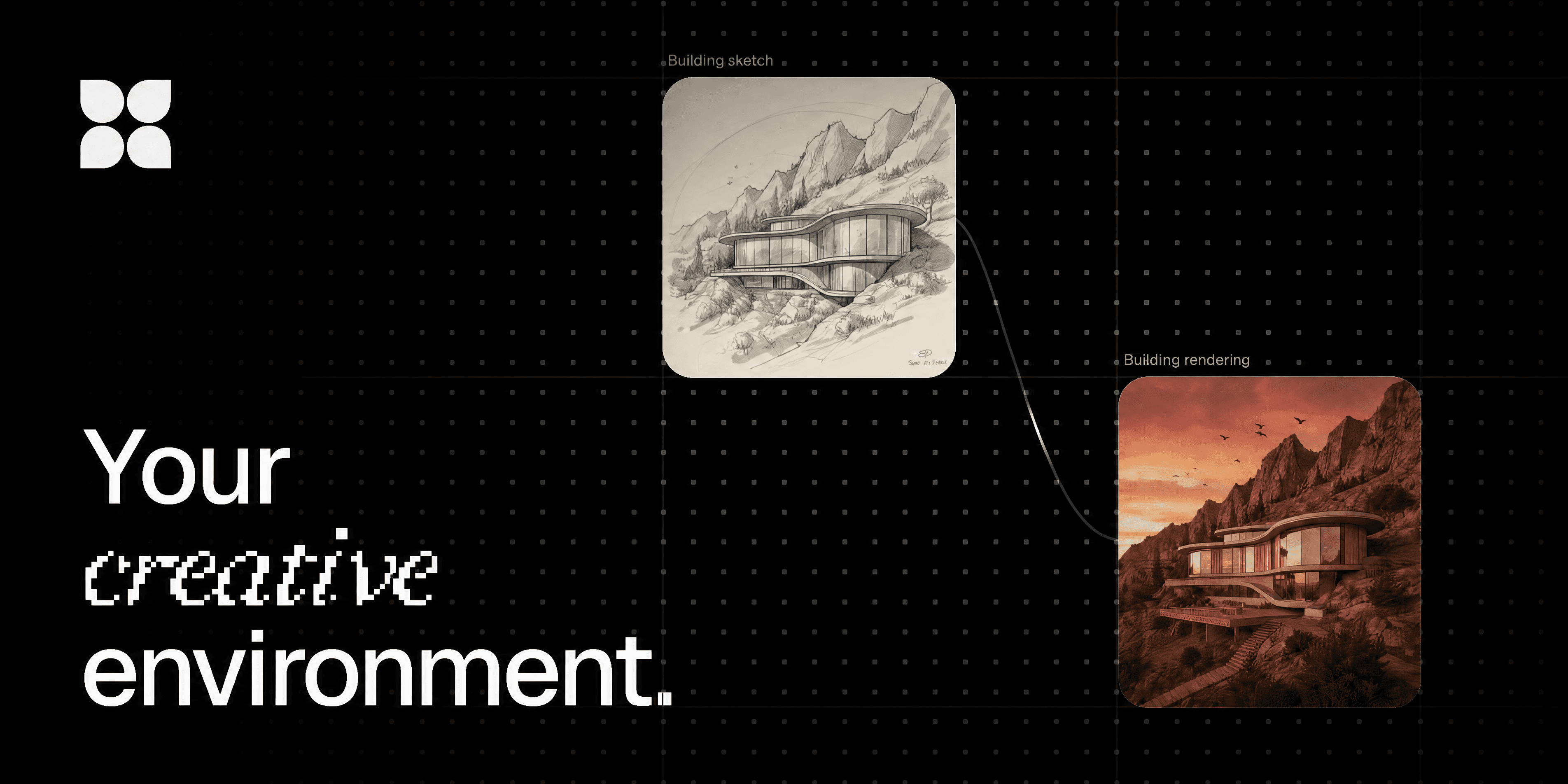
A dedicated Fashion Studio, included in every plan, covers sketch-to-render, flatlay, ghostform, garment recolour, fabric swap, model maker, model try-on and 360 model video. Eight use-case families appear on the homepage: visual effects, fashion, advertising, photography, concepting, branding, motion graphics and architecture. Named references include Pentagram, Lionsgate, Base Design and Hebbia.
Two commitments carry real weight for professional work: what a customer makes never trains a model, at FLORA or at any provider, and the outputs belong to the customer. The company was founded out of the NYU ITP graduate programme and describes itself as an applied HCI company.
What it does
- Generate images, video, audio and text from dozens of models on a single canvas
- Wire generations into a reusable node workflow and save it as a Technique
- Run a batch to apply an approved look across every SKU, variant and format
- Edit in layers, annotate and comment directly on the canvas
- Work live alongside the whole team, with cursors visible
- Call the canvas from Claude, Cursor or any MCP-compatible agent
- Export in every format and publish straight to social from the paid tiers
When to use FLORA / When not to
A quick filter to help you decide if FLORA is the right fit.
When to use FLORA
- In-house creative teams and brand studios producing campaign assets on a repeating cycle
- Advertising and design agencies that need to attribute generation costs back to individual clients
- Fashion and retail teams working from sketch to on-model campaign imagery through Fashion Studio
- VFX, motion and photography professionals who want every leading media model behind a single subscription
- Architecture and product-visualisation practices producing renders, light studies and mockups
When not to use FLORA
- Anyone who needs a mobile app: FLORA is a browser product with no iOS or Android release
- Teams that require an interface in a language other than English
- Buyers looking for a proprietary in-house model rather than an aggregator of third-party ones
- Organisations whose procurement requires a signed data processing agreement, which the site never mentions
- Users who need a fixed monthly bill, since usage beyond the included allowance is metered at published model rates
How to use FLORA
A typical end-to-end flow, from setup to results.
- Create an account in the web app, or sign in with a Google, Microsoft or Discord identity
- Open a project and drop your references, briefs and prompts onto the infinite canvas
- Pick a model for each node, text, image, video or audio, and generate
- Branch a promising result into several directions and compare them side by side
- Refine in the multilayer editor, annotate, and bring the team onto the same canvas
- Wire the nodes behind the winning result into a sequence and save it as a Technique
- Feed the Technique a batch of inputs to roll the look out across every variant and format
- Track spend by project and by member, and set per-seat caps from the admin view
- Connect the MCP server to Claude or Cursor to run the same Techniques from a chat agent
- Export in the formats you need, or publish straight to social from a paid plan
Pros & Cons
Pros
- One subscription covers models from many providers, with no licence to negotiate model by model
- Customer work never trains a model, at FLORA or at any provider, and this is written into the Terms
- Outputs belong to the customer, and no third-party provider claimed ownership as of March 2026
- Pricing is public and itemised, down to a feature-by-feature comparison table
- The cost of each generation is visible by project and by member, so agencies can attribute spend accurately
- API and MCP access are included from the first paid tier rather than reserved for enterprise
- Subprocessors are published and dated, and an Article 27 GDPR representative is named
Cons
- The site contradicts itself on how many models it offers: 50+, 60+ and 170+ appear on three different pages
- SOC 2 status is inconsistent, with the trust portal reporting Type 2 while two FAQs still say Type 1
- No data processing agreement is mentioned anywhere on the site
- FLORA does not indemnify outputs; that protection depends on each model provider's terms
- The seat price is not the bill: usage beyond the included allowance is metered at published model rates
- The entry price is a launch offer flagged as applying only through 31 August
- No mobile app, and no interface language other than English is announced
Pricing & Plans
A permanent free plan is available at USD 0 per month. The lowest paid entry point is the Starter plan at USD 18 per seat per month on monthly billing, which includes USD 12 of usage per seat. Annual billing carries a 20% discount, and the three paid tiers are currently advertised as a launch offer applying through 31 August.
- one seat
- three active projects
- text and image models
- full canvas and layer editor
- run and create Techniques
- unlimited FAUNA
- annotations and labels
- download and export
- USD 12 of included usage per seat
- up to 8 seats
- text
- image and video models
- pooled team usage
- unlimited projects
- all models
- API and MCP access
- USD 50 of included usage per seat
- up to 8 seats
- everything in Starter plus shared team assets
- shared elements
- per-member usage caps and usage analytics
- USD 100 of included usage per seat
- up to 8 seats
- everything in Pro plus custom ElevenLabs voices
- three per organisation
- SSO/SAML
- an embedded Forward Deployed Creative
- bespoke training
- white-glove support with a dedicated Slack channel
- granular permissions
- sub-workspaces and centralised billing
Data, GDPR & hosting
A consolidated view of how FLORA handles your data.
GDPR overview
Implementation is concrete and documented. The Privacy Notice of 1 June 2026 maps each category of personal data to a lawful basis under Article 6(1)(b) or 6(1)(f), and sets out the rights of EEA, UK and Swiss data subjects article by article: access (15), rectification (16), erasure (17), restriction (18), portability (20), objection (21), automated decision-making (22), withdrawal of consent (7(3)) and complaint to a supervisory authority (77). FLORA states it carries out no automated decision-making with legal effect and answers requests within one month. Having no EU establishment, it has appointed an Article 27 representative in Ireland, BizLegal Ltd trading as EU Rep. Transfers out of the EEA rely on the European Commission's Standard Contractual Clauses. The trust portal lists GDPR alongside SOC 2 and CCPA.
Who owns the data?
The Terms of Service state that, as between the user and FLORA, the user owns all rights, title and interest in every Output, and that FLORA makes whatever assignments are needed to achieve it. Inputs and Outputs are both treated as the user's own User Data. FLORA takes only a service licence over that material, to reproduce, display, distribute and technically adapt it so the platform can work, sublicensable to hosting providers and transferable to affiliates or to an acquirer. FLORA may separately exploit aggregated, de-identified data that cannot be linked back to anyone. The Privacy FAQ adds that, as of 26 March 2026, no third-party model provider on the platform claimed ownership of outputs.
Reuse rights
Yes. FLORA claims no ownership of what users create, and its Privacy FAQ confirms that outputs may generally be distributed commercially without asking permission, provided the user holds the rights to whatever was uploaded or referenced, the result does not copy or closely reproduce protected third-party content, does not misuse a person's likeness or a trademark, and respects the terms of the model that produced it. There is no blanket indemnification on outputs: FLORA indemnifies only third-party claims that the Service itself infringes intellectual property, and any cover on a generated result depends on the terms of the model provider used.
Data retention & training
Hosting summary
FLORA states it is based in the United States, and its Privacy Notice warns EEA, UK and Swiss users that their personal data may be transferred to and processed in the United States and other countries that may not offer an equivalent level of protection. Where data from those regions goes to a country without an adequacy decision, FLORA relies on the European Commission's Standard Contractual Clauses or the equivalent UK transfer agreements, and will supply a copy of the mechanism on request. No hosting region is named and no data-residency choice is offered. What the company does publish is a dated subprocessor list. Convex holds accounts, projects, nodes and generated assets; Clerk handles authentication; Vercel serves the application; Liveblocks runs real-time collaboration — all four headquartered in the United States. ImageKit, in Bangalore, stores and serves uploaded and generated images. Model access runs through the aggregators FAL and Runware, the latter in the United Kingdom, and through providers including OpenAI, Anthropic, Google, Alibaba Cloud, Ideogram, Luma AI and Runway. Work is encrypted in transit with TLS 1.2+ and at rest with AES-256.
Things to keep in mind
Risks and trade-offs to weigh before adopting FLORA.
- Creative deskilling: once a Technique reliably produces a usable result, the habit of exploring by hand — and the judgement that comes with it — can quietly erode
- Homogenised output: everyone drawing on the same handful of models tends to converge on the same look, which is the opposite of what a brand is paying for
- Rights on uploaded references are the user's problem: FLORA's own Privacy FAQ ranks extending a copyrighted photo as high risk, and there is no indemnity on outputs
- Likeness and identity: model makers and try-on tools generate people, and misusing a real person's face or a trademark falls outside what may be distributed
- Runaway spend: metered usage on top of a seat price makes an allowance easy to burn without noticing, which is precisely why per-member caps exist
- Data leaves your jurisdiction: FLORA is US-based, its subprocessors sit in several countries, and no data-residency option is offered
- Verification fatigue: generated images look finished long before they are correct, and the Terms explicitly warn that outputs may be inaccurate and must be checked
Setup & Integrations
Technical difficulty
Low to moderate. There is nothing to install: FLORA runs in the browser, and an account opens with an email address or a Google, Microsoft or Discord sign-in. The node canvas asks more of a newcomer than a chat box does, but ready-made Techniques let someone produce work before understanding how to wire a graph, and the site positions the product as everything ComfyUI offers without the GPU or the maintenance. Connecting the MCP server takes a single command. Enterprise rollouts come with an embedded Forward Deployed Creative who builds the first workflows alongside the team.
Deployment
Integrations
Behind FLORA
Fundraising
Social
Resources
All the official URLs gathered for verification and reference.
Alternatives
Tools that compete with or complement FLORA.
Frequently asked questions
Does FLORA train AI models on my work?
Who owns the images and videos I generate?
Is there a free plan?
What does the cheapest paid plan cost?
Is there an API?
What security certifications does FLORA hold?
Is there a mobile app?
What is the minimum age to use FLORA?
Where is my data held?
Can I cap how much each person spends?
Should you pick FLORA?
FLORA occupies a specific slot in the generative-AI landscape. It trains nothing of its own; it puts dozens of third-party media models behind one subscription, on a node canvas built for the part of the job that starts after the first good image — versioning it, keeping it on brand, and rolling it out across a campaign. That answers a real problem, and the named references, from Pentagram to Lionsgate, suggest professional teams have taken it seriously.
The commercial terms are unusually clear where it counts. Prices are public, down to a feature-by-feature table. Customer work never trains a model, at FLORA or at any provider, and that sits in the Terms rather than on a marketing page. Outputs belong to the customer. Subprocessors are published and dated, an Article 27 GDPR representative is named in Ireland, and API and MCP access arrive at the first paid tier instead of being held back for enterprise buyers.
The reservations are mostly documentation failing to keep up with the product. The site cannot agree with itself on how many models it offers — 50+, 60+ and 170+ all appear — nor on its SOC 2 status, which the trust portal reports as Type 2 while two FAQs still say Type 1. No data processing agreement is mentioned anywhere, which will stall some procurement teams. Outputs are not indemnified. And the seat price is not the bill: usage beyond the included allowance is metered at each model's published rate, so the real monthly cost tracks how hard the team works.
For a creative team already paying for several generative tools, FLORA is a credible consolidation. For a buyer working through a compliance checklist, several boxes remain open.
- Choosing a selection results in a full page refresh.
- Opens in a new window.