
GameNGen
GameNGen is a Google research result, not a usable product: a neural model that interactively simulates DOOM (1993) at over 20 frames per second on a single TPU. Published at ICLR 2025; no code, no demo.
What is GameNGen?
GameNGen is a research system presented in the paper Diffusion Models Are Real-Time Game Engines (arXiv 2408.14837, accepted at ICLR 2025). Its central claim is to be the first game engine powered entirely by a neural model, one that also enables real-time interaction with a complex environment over long trajectories and at high quality. The object of the demonstration is DOOM (1993), simulated end to end by the model, with no classical game engine running underneath.
The reported numbers are concrete. The system runs at more than 20 frames per second on a single TPU and stays stable over sessions of several minutes of auto-regressive generation. Next-frame prediction reaches a PSNR of 29.4, which the authors compare to lossy JPEG compression. In a human evaluation, raters do only slightly better than chance when asked to tell short clips of the real game from clips of the simulation.
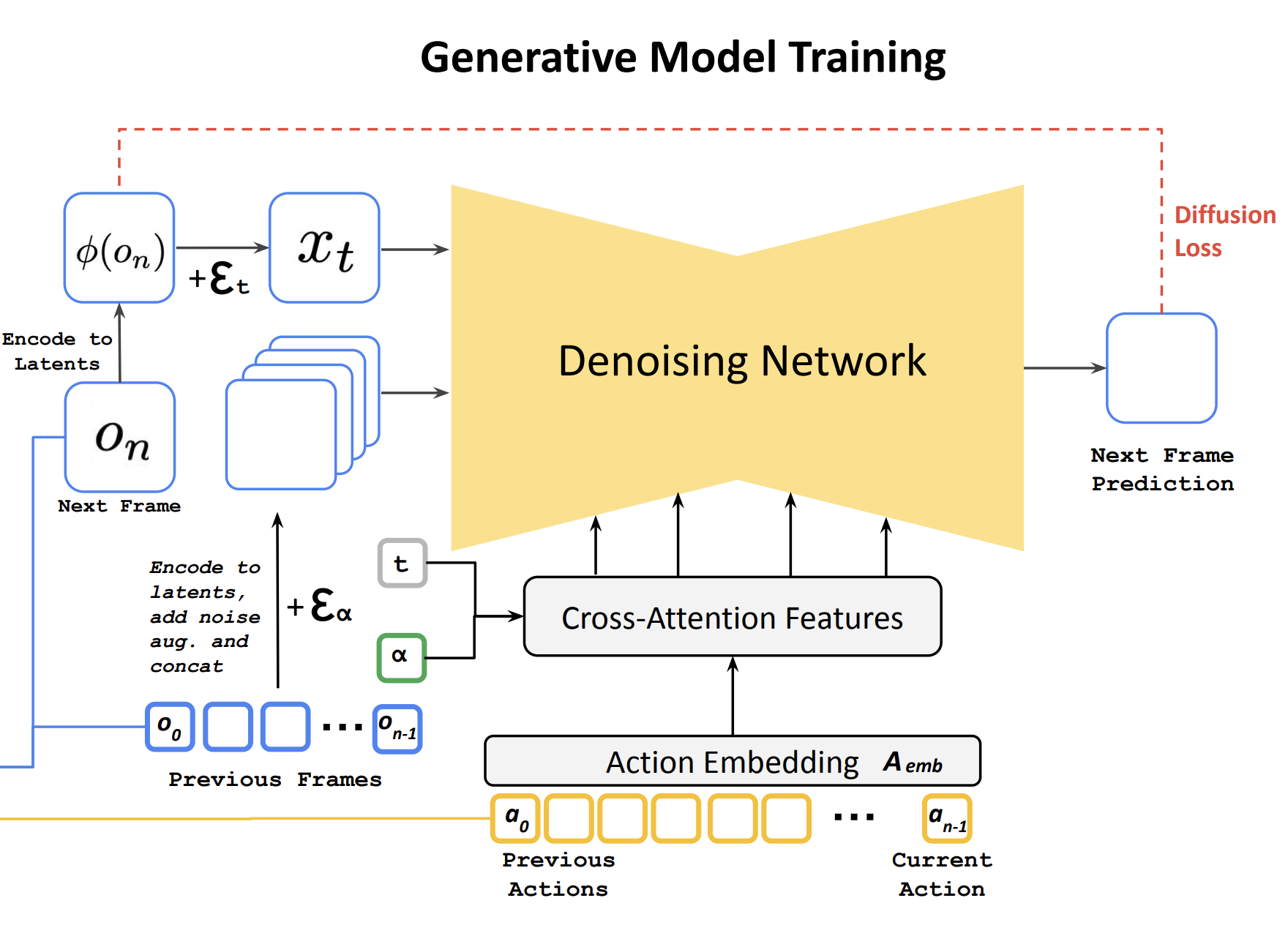
Training runs in two phases. First, a reinforcement learning agent learns to play DOOM, and its episodes of actions and observations are recorded, since human gameplay could not be collected at that scale. Second, a diffusion model is trained on those recordings to produce the next frame, conditioned jointly on the sequence of past frames and past actions. The base model is Stable Diffusion v1.4, repurposed rather than built from scratch.
Two engineering choices carry the result. To limit auto-regressive drift, context frames are corrupted with Gaussian noise added to the encoded frames during training, teaching the network to correct information sampled in previous frames; the authors judge this critical for visual stability over long periods. And because the pretrained autoencoder compresses 8x8 pixel patches into four latent channels, producing artefacts on fine detail and above all on the bottom HUD bar, the decoder alone is retrained with an MSE loss against the target frame pixels; the revised paper reports better fidelity on small details and on text.
The work is signed by Dani Valevski and Yaniv Leviathan (Google Research), Moab Arar (Tel Aviv University, work done at Google Research) and Shlomi Fruchter (Google DeepMind), with equal contribution. What is published is a result, not software: no code, no weights, no checkpoint and no playable demo have been released.
What it does
- Simulates DOOM interactively and in real time from a single neural model
- Predicts the next frame conditioned on the sequence of past frames and past player actions
- Runs at more than 20 frames per second on a single TPU
- Stays stable over long auto-regressive trajectories, across sessions of several minutes
- Reaches a PSNR of 29.4 on next-frame prediction
- Produces frames that human raters barely distinguish from the real game on short clips
- Learns the environment from recordings of a reinforcement learning agent, with no classical game engine underneath
When to use GameNGen / When not to
A quick filter to help you decide if GameNGen is the right fit.
When to use GameNGen
- Generative AI researchers working on diffusion models and world models
- Computer vision researchers studying next-frame prediction, PSNR and autoencoder artefacts
- ML engineers concerned with real-time inference budgets, since the system runs above 20 fps on a single TPU
- Game developers, studios and technical product managers watching neural generation of interactive environments
- ML lecturers and students who need a concrete, documented case study of action-conditioned diffusion
When not to use GameNGen
- Players hoping to play: there is no playable demo and no binary, only recorded videos
- Developers looking for code or weights: no release exists, and the GameNGen GitHub organisation hosts only the website repository
- Teams wanting to embed a game engine in production: no API, no SDK and no product licence
- Buyers comparing commercial tools: no pricing, no offer and no support channel
- Non-technical readers and compliance officers: the page assumes you will read an ML paper, and publishes no terms, privacy policy or DPA
How to use GameNGen
A typical end-to-end flow, from setup to results.
- Set expectations first: the only available use is to read, watch and cite, since there is no account, no download, no API and no playable demo
- Open the project page and read the abstract, which states the claim and the headline figures
- Watch the Full Gameplay Videos section, which shows real-time recordings of DOOM levels e1m1, e1m3, e1m5, e1m9 and e2m2 simulated by the model
- Read the Architecture section and its diagram: data collection by a reinforcement learning agent, diffusion model training, latent decoder fine-tuning
- Open the paper on arXiv (2408.14837), as an abstract page or as a PDF, for the full method and the complete evaluation
- Copy the BibTeX entry at the bottom of the project page to cite the work, under the key valevski2024diffusionmodelsrealtimegame
- Accept that any hands-on work means a full reimplementation from the paper, because nothing is provided
- Scope that reimplementation realistically: a reinforcement learning agent on DOOM, fine-tuning of Stable Diffusion v1.4, and real-time inference on TPU hardware
Pros & Cons
Pros
- Landmark result: the first fully neural game engine running in real time
- Published, checkable figures: over 20 fps, PSNR 29.4 and a human rater study
- Peer-reviewed work, accepted at ICLR 2025
- Method described in enough detail to be discussed: two phases, a named base model, an explicit anti-drift technique
- Free to consult, with no account, no form to fill in and no data-capture wall
- Gameplay videos directly viewable across several levels (e1m1, e1m3, e1m5, e1m9, e2m2)
- BibTeX entry provided, so citation is immediate
Cons
- No code, no weights and no checkpoint released, which makes the work non-reproducible in practice
- No playable demo: the visitor watches recordings and cannot test anything
- A single game demonstrated (DOOM, 1993), with no evidence of generalisation to other environments on the page
- Hardware requirement: a TPU for real-time inference, out of reach for most readers
- No legal document at all (terms, privacy policy, legal notice) while the page loads third-party trackers
- Page frozen since August 2024, with no repository update and no follow-up channel for the project
- No way to contact the authors from the site
Pricing & Plans
No pricing is published, and none is to be expected: GameNGen is a published research result rather than a commercial offering, so there is no paid plan, no free plan and no free trial, for the simple reason that no plan of any kind exists. Consulting the project page and the gameplay videos is free of charge and requires no account, and the arXiv paper is freely accessible under a CC BY 4.0 licence. The only cost implied is indirect, and borne by anyone attempting to reproduce the work: TPU-class hardware for real-time inference, together with a complete reimplementation from the paper.
Data, GDPR & hosting
A consolidated view of how GameNGen handles your data.
GDPR overview
There is no mention of the GDPR anywhere on the site. Searches for "GDPR", "privacy" and "policy" return no first-party occurrence. There is no privacy policy, no cookie banner, no consent notice, no Article 27 representative, no data protection officer and no contact address of any kind. That silence is not a statement of compliance: the page does load Google Analytics (gtag.js, id G-CS1E2LNG5X) and an embedded YouTube iframe, third-party trackers set without prior information or any consent mechanism. Readers in the European Union should weigh the gap between the total absence of documentation and the trackers actually loaded. GameNGen is, in context, a static GitHub Pages project page with no user account and no data collection of its own, but that context does not replace the missing notice.
Who owns the data?
No terms of service, privacy policy or legal notice is published, so no document states who owns what. The project itself collects nothing directly: there is no account, no form and no upload, and a visitor only reads a page and watches videos. The site nevertheless loads third-party resources: Google Analytics (gtag.js, id G-CS1E2LNG5X), Google Fonts, ajax.googleapis.com, cdn.jsdelivr.net, Adobe DocumentCloud and an embedded YouTube player. Any browsing telemetry therefore falls under those third parties' own terms, not under a project policy. Hosting is GitHub Pages, so GitHub's conditions govern the site rather than anything written by the authors. The arXiv paper is released under a CC BY 4.0 licence.
Reuse rights
There is no user data to reuse, because the site produces no output for the visitor: everything on the page is pre-recorded material. The arXiv paper carries a CC BY 4.0 licence, so it may be read, quoted and redistributed with attribution, and the project page supplies a BibTeX entry for academic citation. The gameplay videos are recordings supplied by the authors, and the page states no reuse licence for them. The simulated content is DOOM, a 1993 commercial game by id Software, and the page says nothing about the legal status of that third-party work. Outside the paper itself, nothing should be assumed cleared for reuse.
Hosting summary
No data hosting information is published by the project. That is consistent with what the site does: there is no account, no form and no upload, so the authors collect no user data whose location would need to be declared. No jurisdiction, country or hosting region is announced anywhere. The hosting of the site itself can be observed, and should not be confused with data hosting. The page is served by GitHub Pages; DNS resolves to 185.199.109.153, geolocated in the United States (San Francisco) on AS54113, Fastly, Inc. That address is anycast, so it does not designate a single data centre and gives no reliable indication of where the content is physically served from for a given visitor. Whatever applies to the site therefore comes from GitHub's infrastructure and conditions, not from any commitment made by the GameNGen authors. Third-party resources loaded by the page, such as Google Analytics, Google Fonts, jsDelivr, Adobe DocumentCloud and an embedded YouTube player, are hosted and governed by their own operators, and the project discloses nothing about them.
Things to keep in mind
Risks and trade-offs to weigh before adopting GameNGen.
- Intellectual property: the system simulates DOOM, a commercial work by id Software, and the page says nothing about the legal status of that simulation or of the videos
- Non-reproducibility: without code or weights, the results rest on the authors' word and on the ICLR review alone
- Over-reading the claim: "real-time game engine" can easily be taken for a ready-to-use product, which it is not
- Scope of the human study: raters judged short clips, which is not evidence of general indistinguishability
- A neural engine has no explicit game state and no guaranteed rules, so inconsistencies are possible and cannot be fixed the way a code bug is fixed
- Privacy: the page loads Google Analytics and an embedded YouTube iframe with no privacy policy and no consent request
- Displacement of creative work if such models replaced explicit game design, with the mirror risk of depending on non-deterministic output; the page has also been unmaintained since August 2024, so the figures quoted age without warning
Setup & Integrations
Technical difficulty
There is no setup: nothing can be installed, configured or deployed. Consulting the project page, watching the videos and reading the paper demands no particular skill beyond the ability to follow an ML paper. Reproducing the system is a different matter entirely, since it requires training a reinforcement learning agent on DOOM, reimplementing the conditioning on past frames and actions, fine-tuning Stable Diffusion v1.4 and its latent decoder, then serving real-time inference on TPU hardware. That level of work belongs to advanced ML research teams with access to accelerators, not to end users.
Behind GameNGen
Resources
All the official URLs gathered for verification and reference.
Frequently asked questions
Can I play GameNGen?
Are the code or the model weights available?
Which game does it simulate, and how fast does it run?
What image quality does it reach?
Which model is it built on, and how was it trained?
How is auto-regressive drift avoided?
Who produced this work?
Where can I read the paper and how do I cite it?
Is there any pricing, account or support?
Does the site publish a privacy policy?
Should you pick GameNGen?
GameNGen matters as a demonstration rather than as a tool: it shows that a diffusion model, properly conditioned and stabilised, can take the place of a game engine and hold interactive real time. That result opens a credible path towards interactive world models, well beyond video games.
Credibility is solid on the publication side. The paper was accepted at ICLR 2025, the authors work at Google Research, Google DeepMind and Tel Aviv University, and the figures given are precise enough to be argued with: more than 20 frames per second on a single TPU, a PSNR of 29.4 on next-frame prediction, and a human rater study in which participants do only slightly better than chance on short clips.
The structural limitation is just as clear. Nothing is delivered: no code, no weights, no checkpoint, no playable demo. A reader cannot verify, extend or appropriate the work without a full reimplementation, and real-time inference assumes TPU-class hardware. The project page has not moved since August 2024, offers no contact channel and publishes no legal document, while loading Google Analytics and an embedded YouTube player.
The real audience follows from that: researchers, ML engineers and game developers keeping watch on the field. There is nothing here for an end user looking for something to play, nor for a team looking for something to ship. This record should be read the way a scientific publication is read, as a dated and signed landmark whose contribution is an idea and a set of measurements, not a piece of software to put to work.
- Choosing a selection results in a full page refresh.
- Opens in a new window.