
Generated Photos
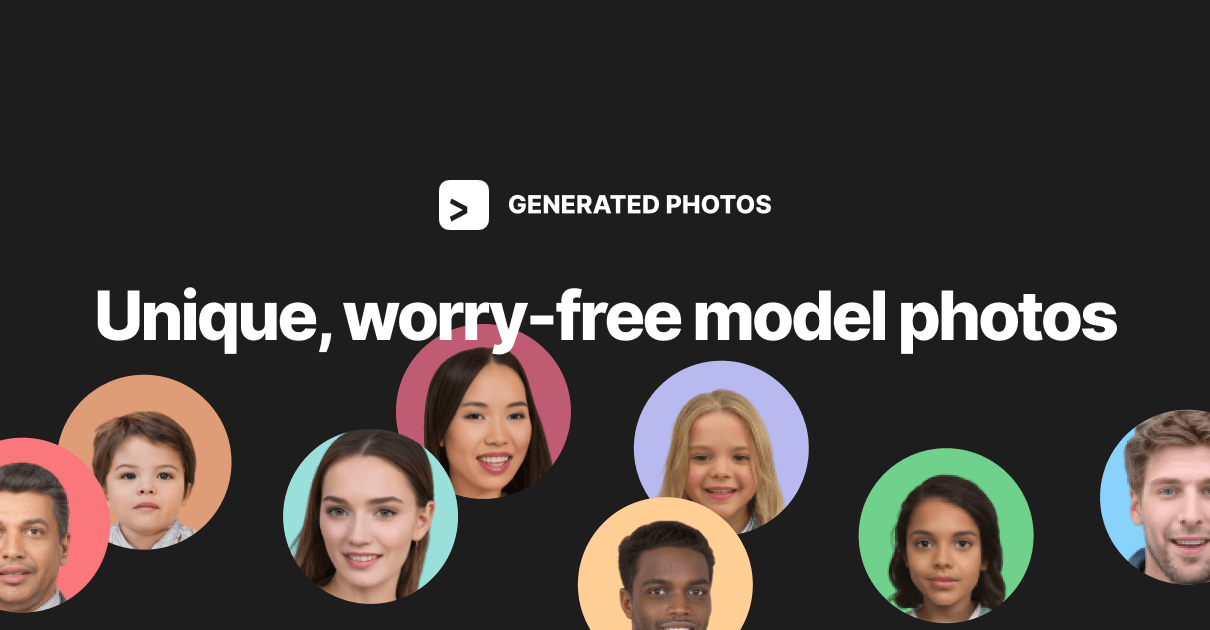
Generated Photos is a stock library of 100% AI-generated people: 2.6 million ready-made faces plus real-time face and body generators. Every image is royalty-free with no likeness rights, so designers, developers and marketers can publish worry-free.
What is Generated Photos?
Generated Photos is a stock library in which nobody is real. It is published by Generated Media, Inc., a Delaware company registered under number 7627361 and run as a fully distributed team. Founded by Ivan Braun, it brings together somewhere between twenty and thirty AI and photography professionals, the site's own figures differing on the point. What sets it apart from most image generators sits upstream: the team built its own photo studio and shot more than 30,000 pictures of 69 real, model-released models in 2018. The claim is explicit: We train our machine learning systems on model-released images that we have captured in our studio. No web scraping. Those studio shots were tagged, categorized, fed to generative models, and defective faces were then filtered out automatically.
The resulting catalog holds over 2.6 million faces and 167,836 full-body humans, all browsable through fine-grained filters. Alongside it sit real-time generators. Face Generator lets you set sex, head pose, age, emotion, skin tone, hair color and length, accessories, makeup and ethnic traits, with a claimed 11,232,000 variations of a single face. Human Generator does the same for whole bodies, covering ethnicities, ages, body types, poses, clothing and backgrounds, and is free for non-commercial use. GenYOU, on iOS, Android and the web since 2025, generates portraits of you while preserving your identity, and Anonymizer turns a real portrait into synthetic look-alikes, processing everything in RAM without storing it. Images come out at 1024 x 1024, with optional upscaling to 4,096 pixels, transparent backgrounds and exclusive rights.
The whole pitch rests on one legal claim: All images have been generated without human intervention through machine learning processes. Generated Photos carry no additional likeness rights. No release to chase, no royalties, no face that can sue you. SAP, Reallusion, Apple TV+ for Spirited, the series Fauda, Tokyo's Miraikan museum and several indie games have used it, and the project has been covered by the New York Times, the BBC, The Verge, the Washington Post, Forbes, VICE, Fast Company and Der Spiegel.
What it does
- Search and filter more than 2.6 million pre-generated faces by age, gender, ethnicity and facial traits
- Generate a unique face in real time from ten families of parameters with Face Generator
- Create full-body people in real time with Human Generator
- Produce portraits of yourself that preserve your identity with the GenYOU app
- Anonymize a portrait by turning it into synthetic look-alikes
- Order custom datasets for machine learning training and testing
- Plug the image library into your own product through the REST API
When to use Generated Photos / When not to
A quick filter to help you decide if Generated Photos is the right fit.
When to use Generated Photos
- UI and UX designers who need believable faces for mockups, design kits and website templates
- Game developers populating 2D and 3D worlds with non-player characters
- Machine learning teams looking for face datasets with landmarks and metadata for training and testing
- Marketing and social media teams building campaign visuals or AI-driven brand personas
- Academic researchers, who can request the free academic dataset already used by teams at MIT, UCL and the University of Zurich
When not to use Generated Photos
- Photojournalists and documentary makers: the site explicitly rules out any use where authenticity is the point
- Anyone who needs pictures of real, identifiable people, since every image here is synthetic
- Medical and healthcare products: the terms forbid using the images to provide medical advice or interpret medical results
- Resellers and white-label operators, because redistributing or sublicensing the images is prohibited
- Developers who want to train a model on API output, which the API terms rule out
How to use Generated Photos
A typical end-to-end flow, from setup to results.
- Open generated.photos and sign in to create an account, a free one being enough to start
- Either browse the Faces and Humans galleries with the filters, or open one of the generators
- In Face Generator, set the parameters (sex, age, emotion, skin tone, hair, accessories) and watch the face render in real time
- In Human Generator, choose the body type, pose, clothing and background, optionally starting from a real face
- In Anonymizer, upload a sharp front-facing portrait as JPG, PNG or WEBP and get synthetic look-alikes back
- For GenYOU, install the iOS or Android app or use the web version, then upload your own photos
- Add the images to your cart and pick the options you need: transparent background, upscaling, exclusive rights
- Choose between a subscription (15 credits per month) and a bulk download with volume pricing
- On the free plan, download at 500 x 500 and keep the clickable attribution link visible
- For integration, go through the REST API with a monthly or annual subscription
Pros & Cons
Pros
- No likeness rights and no royalties, because every image is fully synthetic
- Models trained on the company's own model-released studio photos rather than scraped material
- Volume and diversity: 2.6 million faces with fine-grained filters
- Real-time parametric generation, not just a fixed catalog
- Perpetual license with subscriptions and bulk downloads
- A permanent free tier at 500 x 500 with attribution, plus a three-day trial
- Anonymizer processes photos in RAM without storing them, and a free academic dataset is available
Cons
- Subscriptions cap downloads at 15 per month and unused credits do not roll over
- No refunds beyond what the law requires
- Several everyday uses need prior written approval: templates and UI kits, NFTs, synthetic personas, paid campaigns, logos
- Hard ceilings apply: one million impressions on social media and video, 1,000 copies in print
- Visual artifacts acknowledged by the publisher itself, around hair, unusual angles and teeth
- No published DPA, no subprocessor list and no hosting country disclosed
- Chat support is reserved for paying accounts, and accounts are strictly single-user with sharing forbidden
Pricing & Plans
A permanent free plan is available: images at 500 x 500, for personal non-commercial use, with mandatory clickable attribution. A three-day free trial of Face Generator is also offered, with watermarked images. The lowest paid entry point is USD 19.99 per month, for the Face Generator subscription including 15 downloads per month. Above that, annual subscriptions are listed at USD 199 per year, single images at USD 8.97, bulk downloads from USD 9 down to USD 1 per photo, and API access from USD 250 per month.
- 500 x 500 images
- personal non-commercial use
- mandatory clickable attribution
- Face Generator
- watermarked images
- USD 199 per year or USD 19.99 per month
- 15 downloads per month
- unlimited face generations
- no watermark
- commercial use
- USD 199 per year
- 15 ready-made humans per month
- 1
- 000 priority generations
- no watermark
- commercial use
- USD 9 per photo (1-20)
- USD 7 (21-50)
- USD 5 (51-250)
- USD 2.5 (251-1000)
- USD 1 (1000+)
- USD 8.97 per image
- USD 250 per month
- USD 300 per month
- on quotation
- with a free academic dataset
- exclusive rights (3 credits or +100%)
- transparent background (+20% in bulk)
- upscaling to 4
- 096 px (+20%)
Data, GDPR & hosting
A consolidated view of how Generated Photos handles your data.
GDPR overview
Implementation is real but incomplete. The privacy policy states that it is designed to comply with the privacy requirements established by the General Data Protection Regulation. It has been in force since 29 November 2020 and the page is dated 14 February 2024. Its definitions follow Article 4, retention is justified under Article 5(1)(e), access, rectification, objection and erasure rights are set out with reference to Articles 12 to 23, and the right to complain to a supervisory authority cites Article 77. A Data Protection Officer is appointed and reachable at support@generated.photos, and the policy applies to all users, including those outside the EU. EU residents who have downloaded nothing get a 14-day refund window, and the datasets are advertised as GDPR and CCPA compliant. What is missing: no Article 27 EU representative, no published DPA, no subprocessor list.
Who owns the data?
Generated Media, Inc. keeps ownership of everything it produces. The terms state that the company retains all rights, titles and interests in the copyrighted Materials it creates, and that customers receive a license, never a transfer of title. A subscription or a bulk download grants a perpetual commercial license for one project; the exclusive rights option removes the image from the service after purchase. What you upload stays yours: the privacy policy says the company does not reuse uploaded faces and asserts no rights over them. Reviews and comments you post are the exception, since they carry a worldwide, perpetual and irrevocable license granted to the publisher.
Reuse rights
A free account allows one copy of an image, at half resolution (500 x 500), for personal non-commercial use, with a visible and clickable attribution link. Any commercial reuse requires a paid license, whether by subscription, bulk download or API. Once licensed, you may reuse the images without asking further permission in software and website interfaces, 2D and 3D non-player characters, presentations, native advertising, print runs under 1,000 copies, one-off editorial use with credit, scientific journals, social posts under one million impressions and indie films with no theatrical release. Written approval is still required for resold products where the image is the main element, NFTs, synthetic personas, templates and UI kits, logos, paid campaigns and professional TV or cinema. Reselling, sublicensing, extracting images as standalone files, reverse engineering and deceptive uses are forbidden outright. Note that cropping, color grading, rescaling or compiling does not count as substantial modification. API material may be used while the subscription is active, plus three days after cancellation.
Data retention & training
Hosting summary
No hosting country or region is stated anywhere on the site. What is documented is the legal framework: the terms are governed by the law of Delaware, in the United States, and mediation also takes place in Delaware. The publisher, Generated Media, Inc., is a Delaware company operating as a fully distributed organization with employees in six countries. Technically, the site is served behind Cloudflare, resolving to the anycast address 172.67.181.54 through a US node, and CDN77 is credited in the footer, but neither of those tells you where user data actually rests. On security, the privacy policy mentions an SSL certificate and nothing more. No SOC 2, ISO or equivalent certification is claimed, and no subprocessor list is published. In short: the governing law is American and the delivery infrastructure passes through American nodes, but the storage jurisdiction itself is simply not disclosed.
Things to keep in mind
Risks and trade-offs to weigh before adopting Generated Photos.
- Impersonation and fake profiles: the terms forbid deceptive use, but the tool makes it technically effortless
- Disinformation, through believable people who never existed, a risk the terms explicitly target
- GenYOU manipulates the faces of real people, including photos of your friends, and the tool does not verify third-party consent
- AI influencers blur the line between authentic and synthetic for the audience watching them
- Detection is not guaranteed: the publisher admits that spotting a generated image is never a certainty
- Diversity depends on the training data, a bias the publisher acknowledges itself
- Economic pressure on human models and stock photographers, and license duties that travel with the finished work, so a badly attributed free image contaminates the whole deliverable
Setup & Integrations
Technical difficulty
Very easy for everyday use. The gallery and both generators run in the browser as soon as you have signed up, with nothing to install. Anonymizer and GenYOU only ask for a photo upload, and the mobile app is a standard App Store or Google Play install. The REST API is the one demanding path: it calls for developer skills, an active subscription and close attention to the usage restrictions. Custom datasets are not self-service at all, since they go through a commercial exchange with the team.
Deployment
Apps stores
Supported languages
Behind Generated Photos
Social
Resources
All the official URLs gathered for verification and reference.
Frequently asked questions
Are the images really free of likeness rights and royalties?
What are the models trained on?
Can I use Generated Photos for free?
How much does commercial use cost?
Is there an API?
Are the photos I upload used to train the models?
How long are uploaded faces kept?
Is there a mobile app?
Which uses are forbidden?
Can I get a refund?
Should you pick Generated Photos?
Generated Photos is not a general-purpose image generator, and reading it as one misses the point. It is a stock library of synthetic people, backed by real-time generators, and its real strength sits upstream of the product: the company shot its own studio photographs of released models and trained on those. That controlled pipeline is what makes the legal promise credible, with no likeness rights, no royalties and no release to chase, and it is a firmer position than most competitors trained on scraped material can claim.
The track record backs it up. The domain was first archived in September 2019, the About page traces product milestones back to 2017, and SAP, Apple TV+, Reallusion and a Tokyo museum feature among the documented users.
The limits are commercial rather than technical. Fifteen downloads a month is a modest quota, credits do not carry over, and several perfectly ordinary uses, from UI kits and paid campaigns to NFTs, synthetic personas and logos, need prior written approval rather than simply falling under the license you paid for. Impression ceilings apply on social media and in print.
Transparency is uneven. The privacy policy takes the GDPR seriously on user rights, citing articles, naming a Data Protection Officer and setting a clear retention rule. But no data processing agreement, no subprocessor list and no hosting country is published anywhere, and the publisher is a fully distributed Delaware company with no postal address at all. For a design or marketing team that is usually acceptable; for a procurement review with a compliance checklist, it is a gap worth raising before signing.
Verdict: a mature, legally well-grounded library of synthetic people, best suited to design, gaming and marketing work, provided the intended use is checked against the license grid first.
- Choosing a selection results in a full page refresh.
- Opens in a new window.