
GitPodcast
GitPodcast turns any GitHub repository into a spoken audio walkthrough in seconds. Paste a repository URL and get a five-minute overview or a ten-minute deep dive. The hosted service is free and the code is open source under MIT.
What is GitPodcast?
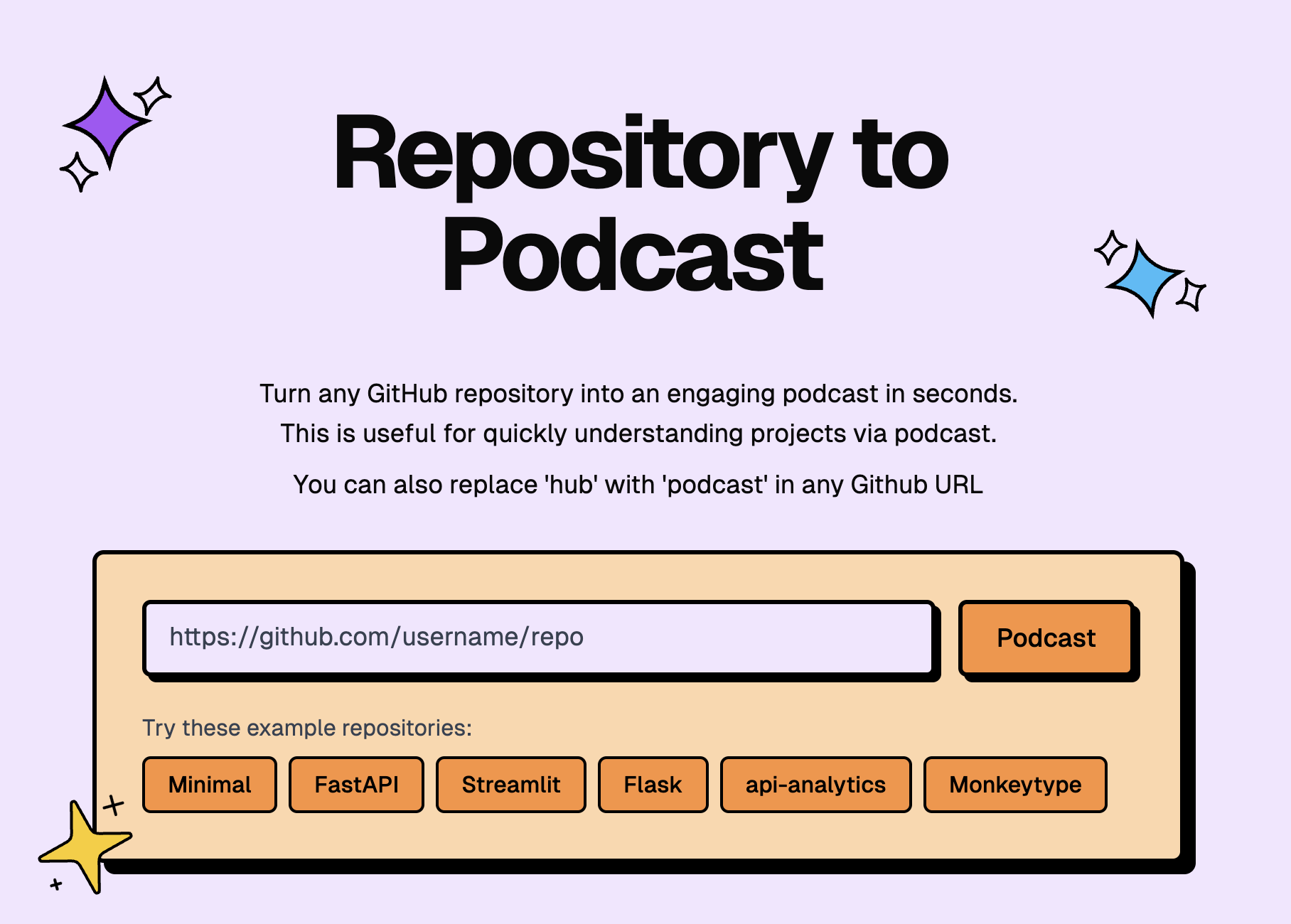
GitPodcast is a single-purpose web tool that turns a GitHub repository into a spoken podcast. You paste a repository URL into the field on the home page, where the placeholder reads github.com/username/repo, and the tool reads the project and narrates it back as audio. There is a shortcut worth remembering: replace hub with podcast in any GitHub address, and gitpodcast.com/owner/repo opens the same result.
Two lengths are offered. Basic runs to roughly five minutes and needs no account. In Depth runs to roughly ten minutes and requires signing in. An optional custom-instructions field lets you steer what the narration focuses on, and an existing output can be regenerated or modified. Six example repositories are wired into the home page, namely Click3, FastAPI, Streamlit, Flask, api-analytics and Monkeytype, so the tool can be tried without supplying anything of your own. Private repositories are supported as well: a dialog in the header accepts a GitHub personal access token with the repo scope, which the interface states is kept in your browser's local storage only.
Under the hood, the repository is condensed into SSML by a language model, Gemini Flash Exp. 2.0 alongside OpenAI or Azure OpenAI, with Anthropic used for token counting, and that SSML is spoken by Azure Speech Service. Sign-in runs through Clerk, analytics through PostHog and Api-Analytics.
The publisher is Bandar Labs, a GitHub organization whose bio reads "Experimenting with LLMs" and which holds four public repositories. The project is open source under the MIT license, with 815 stars, 91 forks and 171 commits as of August 24, 2026, and full self-hosting is documented using Docker Compose, FastAPI and PostgreSQL, provided you bring your own Azure Speech and OpenAI or Gemini keys. The author hosts the public service free of charge, in exchange for shared rate limits. The site itself is deliberately minimal: one page, no pricing, no terms, no privacy policy, no contact route. The README credits Gitingest and Gitdiagram as inspirations, and the last code push to the repository was on August 30, 2025.
What it does
- Turn any public GitHub repository into a spoken podcast from its URL
- Swap 'hub' for 'podcast' in a GitHub address to jump straight to the audio
- Pick the length: Basic at around five minutes, or In Depth at around ten minutes after signing in
- Steer the narration with optional custom instructions
- Regenerate or modify an output that missed the point
- Process a private repository by supplying a GitHub personal access token with the repo scope
- Self-host the whole tool with Docker Compose and your own API keys
When to use GitPodcast / When not to
A quick filter to help you decide if GitPodcast is the right fit.
When to use GitPodcast
- Developers and consultants sizing up an unfamiliar or third-party GitHub repository
- New joiners being onboarded onto an existing team codebase
- Students, interns and career changers exploring open-source projects
- Technical writers and documentation maintainers who need a quick architectural overview
- Open-source enthusiasts who would rather listen on the move than read code
When not to use GitPodcast
- Anyone who needs exact reference documentation, since the narration is LLM-generated and unverified
- Teams whose code is not on GitHub, as no GitLab or Bitbucket support appears anywhere
- Organizations bound by written compliance: no privacy policy, terms of service or DPA is published
- Automation and high-volume users, since the public API is still marked 'WIP' and the hosted service runs on shared quotas
- Listeners who need a language other than English or a choice of voice, neither of which is available
How to use GitPodcast
A typical end-to-end flow, from setup to results.
- Open the home page and paste the URL of a GitHub repository into the input field
- Or skip the home page entirely and go straight to gitpodcast.com/owner/repo
- Or click one of the six example repositories to hear the output on a project you already know
- Optionally type custom instructions to steer what the narration covers
- Choose Basic for a podcast of around five minutes; In Depth, at around ten minutes, requires signing in
- For a private repository, open the Private Repos dialog in the header and paste a GitHub personal access token with the repo scope, which is kept in your browser's local storage
- Launch the generation and listen; a malformed address is rejected with 'Please enter a valid GitHub repository URL'
- Regenerate or modify the result if the narration misses what you were after
- To lift the shared rate limits, self-host: clone the repository, run pnpm i, copy .env.example to .env and add your Azure Speech and OpenAI or Gemini keys
- Then run docker-compose up --build -d, ./start-database.sh, pnpm db:push and pnpm dev, which serves the front end on localhost:3000 and the backend on localhost:8000
Pros & Cons
Pros
- Free to use on the hosted service, with no paid tier at all
- No sign-up required for the five-minute Basic format
- Nothing to learn: one repository URL is enough, and the hub-to-podcast address trick is faster still
- Open source under the MIT license, so the whole pipeline can be audited and self-hosted
- Private repositories are supported, and the access token is stated to stay in the browser's local storage
- Six ready-made example repositories let you judge the output before supplying anything of your own
- The audio format gives a feel for a project without reading a line of code
Cons
- No legal documents at all: no privacy policy, no terms of service and no legal notice, as those addresses return real 404 responses
- No contact route, since not a single email address appears anywhere on the site
- No legal entity and no postal address; the publisher amounts to a GitHub organization
- Modest shared quotas on the hosted service: 15 calls per minute and 0.5 million characters of speech synthesis
- The public API is announced but marked 'WIP' and undocumented; voice selection is 'WIP' too, and the interface and output are English only
- No code has been pushed to the repository since August 30, 2025, which leaves maintenance uncertain
- The narration is LLM-generated, so accuracy is not guaranteed and the site carries no warning to that effect, while the In Depth format also forces a sign-in
Pricing & Plans
GitPodcast is offered free of charge. A free plan is available and there is no paid tier: no pricing page exists, no plan is proposed and no amount is quoted in any source, so no lowest price point can be reported. The author states in the project README: "I am currently hosting it for free with the following rate limits. If you would like to bypass these, self-hosting instructions are provided." The consideration is therefore capacity rather than money: the hosted service operates under shared quotas of 15 calls per minute for the repository-to-SSML step through Gemini Flash Exp. 2.0, and 0.5 million characters for speech synthesis through Azure Speech Service. Users who need more must self-host and supply their own Azure Speech and OpenAI or Gemini keys, in which case the real cost becomes third-party API consumption billed directly to them. The project also mentions an intention to add a field for the user's own OpenAI key.
Data, GDPR & hosting
A consolidated view of how GitPodcast handles your data.
GDPR overview
There is no GDPR content of any kind on gitpodcast.com. A sweep of the thirteen pages collected, in plain text and in raw HTML, returns zero occurrences of GDPR, data processing agreement, sub-processor, retention or opt-out. No privacy policy exists: /privacy, /terms and /legal all return genuine 404 responses. No data protection officer is named, no Article 27 EU representative is designated, no contact address is offered and no minimum age is stated. The publisher is a GitHub organization, Bandar Labs, with no registered legal entity or postal address on record. Hosting is technically observable, with Vercel for the front end and EC2 for the back end according to the README, but no jurisdiction is declared. This is an absence of published information rather than proven non-compliance: nothing has been stated either way.
Who owns the data?
No terms of service, privacy policy or legal notice is published on gitpodcast.com, and those addresses return genuine 404 responses, so no contractual rule states who owns the repositories, instructions or audio files you submit. The only processing statement found anywhere sits in the interface itself: for private repositories, the tool says the GitHub personal access token you supply is "stored securely in your browser local storage only and used to authenticate your requests". Beyond that, ownership, licensing and reuse of the generated audio are undefined. Because the project is MIT-licensed, self-hosting is the only way to keep the whole chain under your own control.
Reuse rights
Nothing on the site grants or restricts reuse of the podcasts you generate. There are no terms of service, so no license is attached to the audio, no attribution is required and no usage limit is stated: in practice you may use the output as you wish, without asking permission, but you do so without any written assurance. What is documented, in the project's public README rather than on the site, is the processing chain behind it. The repository is read from GitHub, condensed into SSML by a language model (Gemini Flash Exp. 2.0, with OpenAI or Azure OpenAI, and Anthropic used for token counting), then spoken by Azure Speech Service. Sign-in is handled by Clerk and analytics by PostHog and Api-Analytics. Private repositories are supported through a GitHub personal access token with the repo scope that the user provides. No purpose, legal basis or retention period is published, and no source says whether submitted content is used to train models. The tool's own source code is MIT-licensed, so it may be reused, modified and self-hosted freely.
Data retention & training
Hosting summary
No hosting jurisdiction is announced anywhere on the site and no data residency commitment is made. What can be established is technical rather than contractual. The project README describes the deployment: the front end on Vercel, the backend on EC2, with a PostgreSQL database on the publisher's side. DNS for the domain resolves to 76.76.21.21, a Vercel anycast address that geolocates to the United States within AS16509 (Amazon.com), which identifies an edge entry point rather than the place where repositories are actually processed. Several third parties are necessarily involved in the pipeline, namely Azure Speech Service for synthesis, OpenAI or Azure OpenAI and Gemini for generation, Anthropic for token counting, Clerk for sign-in and PostHog for analytics, but no sub-processor list is published and none of these providers is named on the site itself. In short, the components can be inferred from the open-source repository, while the jurisdiction, the storage duration and the guarantees are simply not stated. Anyone with data residency requirements should assume nothing and self-host, which the MIT license allows.
Things to keep in mind
Risks and trade-offs to weigh before adopting GitPodcast.
- No privacy policy, terms of service or legal notice is published on the domain, so nothing about the service is contractually committed
- No email address appears anywhere on the site, leaving no route to ask a question, report a problem or request deletion
- The publisher has no legal entity and no postal address; it amounts to a GitHub organization named Bandar Labs
- The token requested for private repositories carries the broad 'repo' scope, and the statement that it stays in browser local storage only is the sole safeguard on offer
- Nothing is published about retention, model training, sub-processors or the jurisdiction in which submitted repositories are processed
- No list of supported countries or regions is published, so availability cannot be checked before trying
- The narration is generated by a language model and can be confidently wrong; treating it as documentation, or letting it stand in for actually reading the code, is the main cognitive risk, all the more so as the repository has had no code pushed since August 30, 2025
Setup & Integrations
Technical difficulty
Difficulty depends entirely on how the tool is used. On the web there is none: paste a repository URL, or swap 'hub' for 'podcast' in a GitHub address, and the podcast is generated. The In Depth format adds a single sign-in step through Clerk. Private repositories are a notch harder, since you must create a GitHub personal access token with the repo scope and paste it into the header dialog. Self-hosting is genuinely technical: pnpm, Docker Compose, a PostgreSQL schema to push, and your own Azure Speech and OpenAI or Gemini keys to obtain and configure.
Deployment
Integrations
Supported languages
Behind GitPodcast
Resources
All the official URLs gathered for verification and reference.
Frequently asked questions
What does GitPodcast do?
Is GitPodcast free?
Do I need an account?
Can GitPodcast work on a private repository?
Is there a shortcut for generating a podcast?
Is there an API?
What are the usage limits?
Can I self-host GitPodcast?
Can I choose the narration voice or another language?
Does GitPodcast publish a privacy policy?
Should you pick GitPodcast?
GitPodcast does one thing, and it does it without friction: you hand it a GitHub repository and it hands back a spoken walkthrough of about five or about ten minutes. The short format asks nothing of you, with no account, no key and no payment, and the trick of swapping hub for podcast in a GitHub address makes it about as fast as a tool can be. Its real value is the first pass over an unfamiliar project: a sense of what the code is for and how it hangs together, absorbed while walking or commuting rather than while reading.
The counterweight is how little surrounds the product. The domain publishes no terms, no privacy policy and no legal notice; there is no contact address of any kind, no registered company and no postal address behind the GitHub organization that ships it. The hosted service runs on shared quotas of 15 calls per minute and half a million characters of speech synthesis, the announced API and voice selection are both still marked 'WIP', and no code has been pushed to the repository since August 30, 2025.
Two things keep this in proportion. First, the output is a narration produced by a language model, so it deserves to be treated as an orientation aid and never as reference documentation. Second, the MIT license is a genuine escape hatch: the code is auditable, and self-hosting with your own Azure Speech and OpenAI or Gemini keys removes both the quotas and the question of who processes your repositories. Used that way, GitPodcast is a pleasant, low-stakes way into a codebase. Used on a client repository inside an organization that requires written commitments, it is hard to recommend, because there are simply none to point at.
- Choosing a selection results in a full page refresh.
- Opens in a new window.