
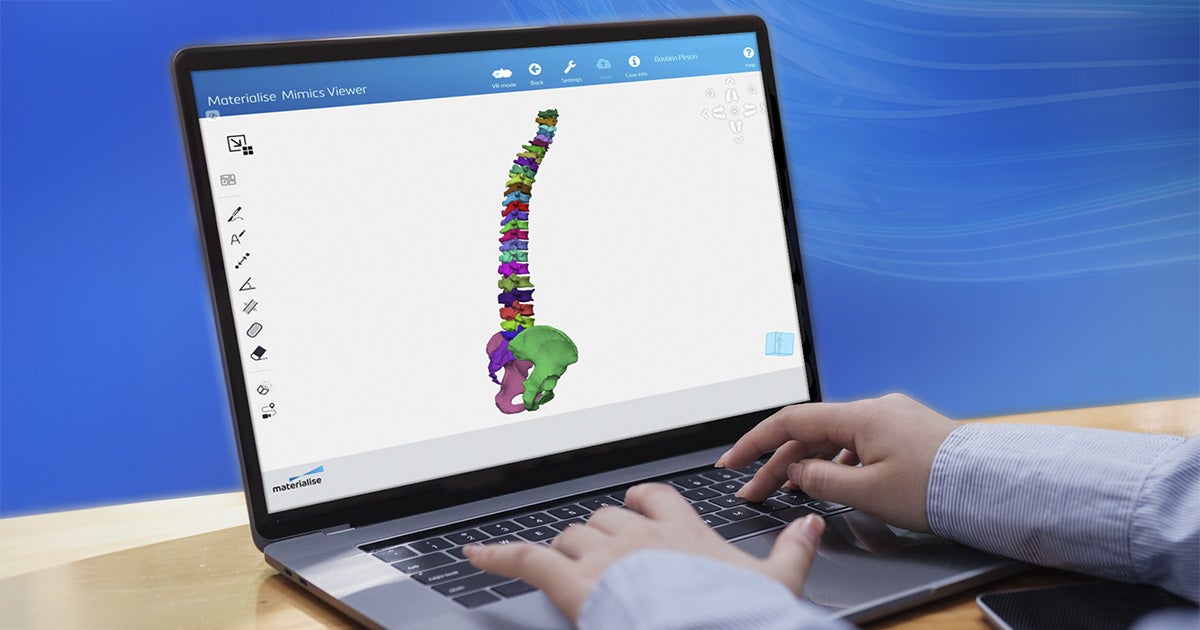
AI-Enabled Segmentation
AI-Enabled Segmentation is the automated segmentation module of the Materialise Mimics healthcare platform. It labels anatomical structures in CT, CBCT and MRI scans through twelve validated algorithms, returning editable 3D models to clinical and engineering teams.
What is AI-Enabled Segmentation?
AI-Enabled Segmentation is the automated image segmentation module of Materialise Mimics, the healthcare software platform published by the Belgian group Materialise NV. Under regulatory documentation it carries the name Materialise Mimics Automatic Algorithms, currently at version 6.0, a module that has been shipping since 2021 and is CE marked as a medical device with its own unique device identifier and published instructions for use. Its job is narrow and concrete. Radiological images arrive as stacks of two-dimensional slices; turning them into a usable three-dimensional model normally means outlining anatomy slice by slice, which is slow and depends heavily on operator experience. The module does that step automatically, then labels the structures it has found. The product page advertises twelve algorithms, each tuned to a body region and an imaging modality: heart CT, knee CT and knee MRI, hip, shoulder, shoulder arthroplasty, ankle, torso bones, an all-bones algorithm covering twenty-one structures, and three craniomaxillofacial variants for reconstruction, orthognathic surgery and CBCT. Outputs range from individual vertebrae and separated dentition to aorta, ventricles and myocardium, and metal implants are identified as their own mask. Technically the module is a cloud service. The instructions for use are explicit that nothing is installed: the algorithms run as web applications reached through Mimics Flow. The user works inside Mimics Medical or Mimics Enlight CMF on a Windows workstation, uploads the study, requests segmentation, and is notified when the result is ready to synchronise back for review and editing. Control stays with the operator, and Materialise repeats that algorithm output must always be verified before any clinical decision. One nuance matters. Materialise draws a firm line between the research edition and the regulated one: plain Materialise Mimics is not a medical device, while Mimics Medical is. Where a country has granted no clearance, only a research build is supplied, and the algorithms are described as locked and validated before release rather than as adaptive machine learning.
What it does
- Segment CT, CBCT and MRI scans automatically instead of outlining anatomy by hand
- Label anatomical structures such as bone, teeth, heart chambers, soft tissue and metal implants
- Absorb peaks in clinical case volume without adding segmentation staff
- Hand the resulting 3D model straight to planning, device design or 3D printing
- Share a case with colleagues who hold no Mimics licence for review and measurement
- Refine any imperfect result with the editing tools already present in Mimics
- Drive repetitive steps through the platform's Python scripting interface
When to use AI-Enabled Segmentation / When not to
A quick filter to help you decide if AI-Enabled Segmentation is the right fit.
When to use AI-Enabled Segmentation
- Hospital 3D planning and printing teams facing peaks in clinical case volume
- Craniomaxillofacial, orthopaedic and cardiovascular surgeons preparing patient-specific procedures
- Engineers at medical device companies scaling personalised implant and guide production
- Biomedical researchers and university laboratories building anatomical models for analysis
- Existing Mimics Medical or Mimics Enlight CMF licence holders looking to automate a manual step
When not to use AI-Enabled Segmentation
- Anyone without a Mimics Medical or Mimics Enlight CMF licence, since the module cannot run on its own
- Radiologists working from mammography images, which the instructions for use exclude explicitly
- Teams on macOS or Linux workstations, as only Windows 11 is supported
- Clinicians in countries where no regulatory clearance has been obtained, who receive a research build only
- Buyers who need a published price list before starting a conversation with a sales representative
How to use AI-Enabled Segmentation
A typical end-to-end flow, from setup to results.
- Obtain a licence for Materialise Mimics Medical version 18 or later, or for Mimics Enlight CMF
- Check the workstation against the published requirements: Windows 11 22H2, .NET Framework 4.8 or higher, a current Chrome or Edge build, a ninth-generation Intel Core i7 and 16 GB of RAM
- Open the network path to the Mimics Flow services through the site firewall; the module's instructions for use ask for at least 20 Mbps, while the Mimics Core FAQ quotes 2 Mbps
- Import the DICOM 3.0 study into Mimics Medical or Mimics Enlight CMF
- Log in to the Mimics cloud account
- Request automatic segmentation and pick the algorithm matching the anatomy and modality
- Wait for the completion notice, which reports success or failure for the case
- Synchronise and open the project through the Mimics Flow Agent
- Review the masks, correct anything imperfect with the Mimics editing tools, and validate the result
- Share the case with colleagues for annotation or measurement, or push it on to design and 3D printing
Pros & Cons
Pros
- A measured time saving, with up to 30% less segmentation effort claimed on orthognathic and reconstruction cases
- The module itself is CE marked, with instructions for use published in twenty-four languages
- Unusually complete public documentation: instructions for use, DPA, HIPAA business associate agreement, SaaS agreement, service level agreement and DICOM conformance statement
- Data hosted in the AWS Frankfurt region, encrypted with AES-256 at rest and TLS 1.2 or above in transit
- Named subprocessors published in the Data Processing Agreement, which few vendors do
- Locked algorithms validated before release, so behaviour is reproducible from one case to the next
- A long-established publisher, listed on Nasdaq and Euronext Brussels, employing over 2,400 people across 31 offices and certified to ISO 27001, ISO 27701, ISO 13485 and ISO 9001
Cons
- No public pricing whatsoever: not one pricing page exists across the 1,911 English URLs in the sitemap
- The module cannot be bought alone; it requires a paid Mimics Medical or Mimics Enlight CMF licence
- Windows only, on demanding hardware, with a 16 GB memory floor
- The software interface is available in English only
- Clinical use depends on national regulatory clearance, and three algorithms are not cleared under Mimics Enlight CMF in the United States
- The privacy notice still refers to the EU-U.S. Privacy Shield, invalidated in 2020, and carries no effective date
- The site contradicts itself on the required bandwidth, quoting 2 Mbps in one place and 20 Mbps in another
Pricing & Plans
There is no permanent free plan and no published price. Materialise operates no pricing page at all for its medical software, and the module is sold through a sales conversation reached from the 'Talk to our team' form; a free trial of the Mimics platform can be requested separately. The end-user licence agreement describes the commercial mechanics without figures: an Annual License billed as a yearly subscription, a Perpetual License with no time limit, a Limited License for an agreed period, and temporary evaluation licences, declined across research, educational, hospital and commercial categories. Maintenance is included in the fee for subscription and annual licences, but only for the first year of a perpetual licence, after which it renews annually and must be taken up at least once every five years. Readers should note that the amounts visible on the Mimics pages, including a figure of EUR 3,500, come from a podcast transcript in which a surgeon discusses the per-surgery cost of a third-party robotic arm. None of them is a Materialise price.
Data, GDPR & hosting
A consolidated view of how AI-Enabled Segmentation handles your data.
GDPR overview
GDPR compliance is stated concretely. The data privacy notice identifies MATERIALISE NV, company number BE 0441.131.254, Technologielaan 15 in Leuven, as controller, and is written against Regulation (EU) 2016/679. It documents the six data subject rights, a one-month response deadline extendable by two months, and a data protection officer reachable at privacy@materialise.be. A Data Processing Agreement for Mimics Flow is published, alongside a HIPAA Business Associate Agreement, and it lists authorised subprocessors by name. The information security page adds EU MDR, NIS2 and HIPAA, backed by ISO 27001 and ISO 27701 certificates. One caveat: the notice still cites the EU-U.S. Privacy Shield as a transfer mechanism, although it was invalidated in 2020, and it carries no effective date.
Who owns the data?
The customer keeps ownership of the images and patient data it uploads. In the published Mimics Flow Data Processing Agreement the customer acts as data controller and Materialise only as data processor, meaning Materialise may process the material solely on the customer's documented instructions. On termination the customer decides whether the data is deleted, destroyed or returned, and may ask for a destruction certificate; subprocessors are notified of the same obligation. Materialise states that it does not share customer data with third parties without explicit consent or a legal requirement, and that it never sells personal data. Ownership of the software itself, by contrast, remains entirely with Materialise under the end-user licence agreement.
Reuse rights
Outputs belong to the customer and can be reused without asking Materialise for permission: the licence governs use of the software, not of the anatomical models produced with it. The licence type does set the boundary, however, since research, educational, hospital and commercial licences each cover a different purpose, and selling or renting the output for consideration falls under commercial use. Materialise reserves only a narrow right to collect technical data, and states that this is limited to detecting unlicensed or illegal use of the software. The segmentation algorithms themselves are locked and validated before release, with no adaptive machine learning, so uploaded cases do not reshape the models.
Data retention & training
Hosting summary
Materialise states that all Mimics Flow data is stored in the AWS Frankfurt region, so the hosting jurisdiction is Germany and therefore the European Union. The environment is managed entirely by Materialise on Amazon Web Services and certified to ISO 27001:2022. Data is encrypted with AES-256 at rest and TLS 1.2 or higher in transit, keys are held in AWS KMS, and files land in locked S3 buckets that cannot be overwritten, with backups kept in separate buckets as a ransomware defence. Administrators reach production only through privileged access management with multi-factor authentication, and access to patient data is logged per user. An independent external penetration test is run at least annually and servers are patched monthly. The Data Processing Agreement names Amazon Web Services in Germany as the European subprocessor and authorises transfers to four Materialise entities outside the European Economic Area, in Ukraine, Colombia, Malaysia and the United States.
Where AI-Enabled Segmentation works
Country-level availability.
Not available in
Things to keep in mind
Risks and trade-offs to weigh before adopting AI-Enabled Segmentation.
- Automation bias: an algorithm result that looks clean invites less scrutiny, yet Materialise states plainly that outputs may contain errors and must be reviewed before any clinical decision
- Skill erosion: teams that stop segmenting by hand may lose the judgement needed to spot a subtly wrong mask, and the vendor still recommends formal training for every user
- Regulatory confusion: plain Materialise Mimics is not a medical device while Mimics Medical is, and using the research build clinically would be a serious misuse
- Patient data exposure: the platform allows identifiable data to be uploaded even though the service is designed to run on anonymised material, so the choice sits with the customer
- Cross-border access: the Data Processing Agreement authorises transfers to Materialise entities in Ukraine, Colombia, Malaysia and the United States, which some hospitals will need to assess
- Lock-in and lifecycle: the module is only usable with a paid Mimics licence, and its declared device lifetime is five years from release, after which continued safe performance is not assured
- Stale legal text: relying on a privacy notice that still cites the EU-U.S. Privacy Shield, and carries no effective date, is a weak basis for a data protection assessment
Setup & Integrations
Technical difficulty
Moderate, and mostly borne by the IT department rather than the clinician. The module installs nothing, but it presupposes a licensed Mimics Medical or Mimics Enlight CMF on Windows 11 with .NET 4.8, a current browser, an Intel Core i7 and 16 GB of RAM. The firewall must be opened to the Mimics Flow services, and the stated bandwidth floor is 20 Mbps in the instructions for use against 2 Mbps on the site. Hospitals will also want PACS and quality-system integration, which Materialise says it supports. Vendor-led training is recommended for every user.
Deployment
Supported languages
Behind AI-Enabled Segmentation
Fundraising
Social
Resources
All the official URLs gathered for verification and reference.
Frequently asked questions
What exactly is AI-Enabled Segmentation?
Which images and modalities does it accept?
How many algorithms are available?
Do I need to install anything?
Is it a regulated medical device?
What does it cost?
Where is my data stored?
Is my patient data used to train the AI?
Is a Data Processing Agreement available?
In which languages is the software available?
Should you pick AI-Enabled Segmentation?
AI-Enabled Segmentation is a narrow, serious tool rather than a general-purpose assistant. It removes one specific bottleneck in the medical 3D workflow, the slice-by-slice outlining of anatomy, and it does so inside a platform that hospitals, device makers and university laboratories already use. Materialise quantifies the benefit carefully, claiming up to 30% less segmentation time on certain craniomaxillofacial cases on the strength of an internal study, and is equally careful about the limits, repeating that every algorithm output must be reviewed before a clinical decision. What stands out is the paperwork. Few vendors publish instructions for use, a data processing agreement with named subprocessors, a HIPAA business associate agreement, a service level agreement, a security overview naming the hosting region and a DICOM conformance statement, all freely downloadable. The module is CE marked in its own right, hosting sits in Frankfurt, and the publisher holds ISO 27001, ISO 27701, ISO 13485 and ISO 9001 certificates. For a buyer in a regulated environment that is a substantial head start. The friction is commercial and operational rather than technical. Nothing is priced publicly, so evaluation begins with a sales call. The module cannot be used on its own: it presupposes a paid Mimics Medical or Mimics Enlight CMF licence on a well-specified Windows workstation, and the interface is English only. Clinical availability depends on national clearance, and three algorithms remain uncleared under Mimics Enlight CMF in the United States. Two documentary blemishes deserve a question during due diligence: the privacy notice still names the long-invalidated EU-U.S. Privacy Shield, and the site quotes two different minimum bandwidths, 2 Mbps in one place and 20 Mbps in another. Neither is fatal, but both suggest documents that have not all been refreshed at the same pace.
- Choosing a selection results in a full page refresh.
- Opens in a new window.