
ModularMind
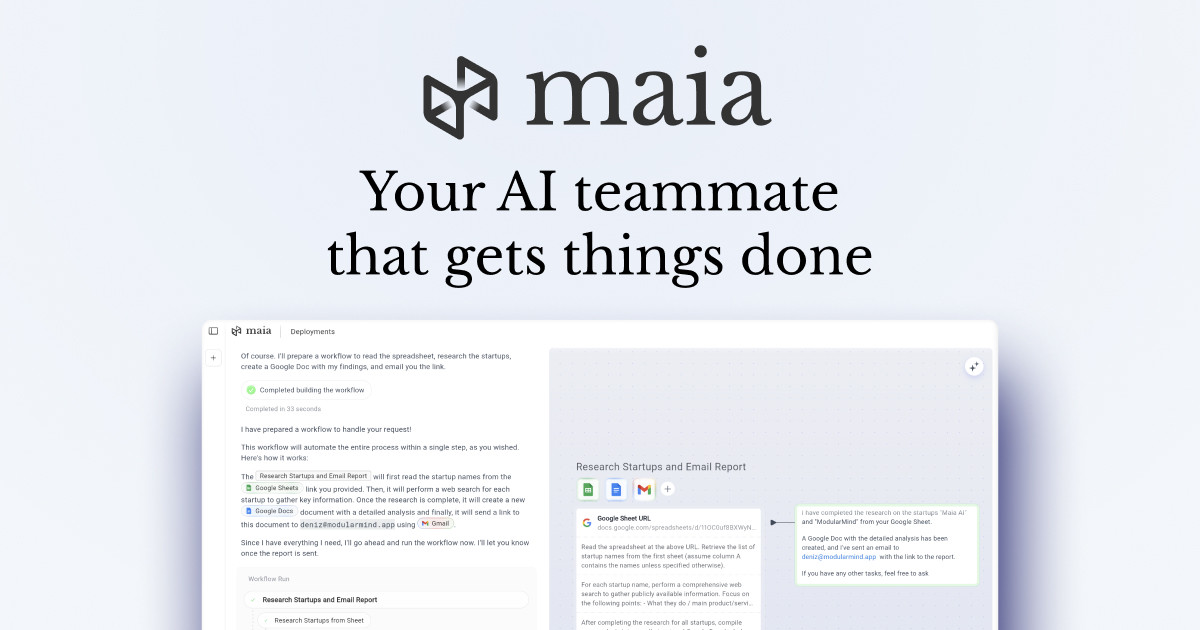
ModularMind builds Maia, a massively multi-agent AI teammate that turns plain-language requests into deployed business workflows. It browses the web, generates documents and sites, connects to your apps and runs operations around the clock.
What is ModularMind?
ModularMind is a United States company whose product, Maia, is presented as the infrastructure layer for what it calls AI executives. The starting argument is a criticism of ordinary agent design: a single context window accumulates instructions, tool calls and intermediate output until it collapses under its own weight, so long-horizon work drifts and fails. ModularMind's answer is a hierarchically modular system in which context does not accumulate but routes, flowing downward, upward and forward so that each agent unit works within a bounded context.
On that foundation, Maia runs as a massively multi-agent system that orchestrates hundreds of specialised agents at once and assigns each task to whichever model suits it best, naming Gemini 3.1 Pro, GPT 5.6 and Claude Opus 5 among them. Three things separate an AI executive from an agent in this framing: workflows, described as modular standard operating procedures that compose hierarchically; hierarchical memory that persists across decoupled workflows so an executive retains decisions and constraints; and genuine parallel execution across a swarm of agents.
The documented capabilities are broad. Maia performs live web research, drives a secure built-in browser that reads pages, clicks and fills forms across parallel instances, generates documents running to dozens of pages, builds and instantly deploys single-page apps, dashboards and landing pages, executes code for calculations and data analysis, and generates images. Ten native connections are listed, covering Gmail, Outlook, Google Calendar, Docs, Drive and Sheets, Notion, Airtable, X and TikTok, alongside Custom Actions that let Maia call arbitrary HTTP endpoints. Finished workflows are deployed and then triggered by a recurring routine, by another workflow, or by a webhook that turns the workflow into an HTTP API returning structured responses.
Ready-made playbooks cover TikTok content automation, lead hunting across X and Reddit, and competitor tracking. Access is through the web workspace at maia.is, iOS and Android applications, and those webhook endpoints. A free tier sits alongside paid plans, with a Business tier for teams of five users or more. Documentation, an FAQ and a security page are public, and the company runs a Discord community.
What it does
- Plan and run multi-step business operations autonomously, from start to finish
- Deploy workflows to the cloud and run them on a schedule, on demand or on a webhook
- Browse websites like a human, reading pages, clicking buttons and filling forms in a secure built-in browser
- Search the web for real-time information and synthesise what it finds
- Read and produce PDFs, spreadsheets, presentations and Word documents
- Connect to Gmail, Google Workspace, Notion, Airtable, Outlook, X and TikTok
- Generate and deploy websites, dashboards and landing pages, and execute code for analysis and charts
When to use ModularMind / When not to
A quick filter to help you decide if ModularMind is the right fit.
When to use ModularMind
- Operations teams that want to hand over entire recurring processes rather than isolated tasks
- Small and mid-sized businesses with no dedicated automation or engineering team
- Marketing and sales teams chasing leads, competitors and social content, which the ready-made playbooks cover directly
- Developers who need an AI-driven backend they can call over HTTP through webhook endpoints
- Companies wanting a shared, administered workspace with member, role and billing controls on the Business plan
When not to use ModularMind
- Anyone under 18, who is excluded outright by the privacy policy
- Regulated sectors that require audited compliance: no SOC 2, ISO 27001 or HIPAA certification is published
- Teams handling sensitive personal data or high-risk activities, both banned by the terms of service
- Buyers who want to pay per use: there is no pay-as-you-go option and workflows cannot be bought individually
- Organisations that need a named legal entity and a postal address before signing, since neither is published anywhere
How to use ModularMind
A typical end-to-end flow, from setup to results.
- Sign up at maia.is with an email address or a Google account; the free plan asks for no payment details
- Describe what you need in plain language and let Maia turn the request into a plan
- Work through the conversation interface, switching between planning and execution modes
- Refine the generated prompts with the modular prompt editor if the plan needs correcting
- Connect the third-party accounts the workflow needs through the standard OAuth flow
- For anything without a native connection, define a Custom Action pointing at an HTTP endpoint
- Authenticate yourself in the Secure Browser for any site Maia must operate on your behalf
- Deploy the workflow, then attach a trigger: a recurring routine, an action call from another workflow, or a webhook
- For a webhook, take the generated hooks.modularmind.app URL and POST JSON to it from your own systems
- Start from a ready-made playbook if you would rather not build from scratch, or contact sales for the Business plan
Pros & Cons
Pros
- A genuine free plan with unlimited workflow deployments rather than a time-boxed trial
- Model-agnostic by design: work is routed to the best-suited model instead of being locked to one vendor
- Unusually specific disclosure of subprocessors and hosting locations, down to named cloud regions
- A documented training opt-out, applied automatically to Company Plan subscribers
- Serious security engineering on paper: AES-256 at rest for stored sessions, OAuth 2.0, private VPCs and 72-hour breach notification
- Data pulled from connected platforms is processed in memory and discarded rather than stored
- Webhook triggers turn any workflow into an HTTP API that existing systems can call
Cons
- No postal address anywhere on the site, and no legal form or state of incorporation beyond the phrase 'a United States corporation'
- A single mailbox, contact@modularmind.app, answers for legal, GDPR and support enquiries alike
- The terms of service date from June 2023 and contradict the December 2025 privacy policy on model training
- No independent certification is published: no SOC 2, no ISO 27001, no HIPAA
- Prices are absent from the rendered pricing page and injected by JavaScript, and the step from Plus to Pro is tenfold with nothing in between
- No interface or processing languages are documented anywhere
- No pay-as-you-go, no per-workflow purchase, and the Data Processing Agreement is reserved for enterprise customers
Pricing & Plans
A permanent free plan is available at no cost, with starter limits and unlimited workflow deployments. The lowest paid entry point is the Plus plan at USD 29 per month, falling to USD 24 per month on annual billing. Pro is charged at USD 290 per month, or USD 240 per month annually, while the Business plan is quoted on request for teams of five users or more. Annual commitment is advertised as a 17% saving.
- starter limits
- strong AI models and unlimited workflow deployments
- five times the Free limits
- the best available models
- advanced connections including X and TikTok
- built-in data sources for leads and trends
- custom executives
- early access to new features and priority at peak times
- ten times the Plus limits
- with the same feature scope otherwise
- everything in Pro plus member
- role and billing management
- a dedicated secure workspace with admin controls
- 24/7 priority support and volume discounts on limit extensions
Data, GDPR & hosting
A consolidated view of how ModularMind handles your data.
GDPR overview
GDPR is addressed, though unevenly. The security documentation carries a dedicated GDPR section for EU customers covering access, erasure, portability and consent management, and offers a Data Processing Agreement to enterprise accounts. The privacy policy, effective 19 December 2025, lists the matching rights: access and copy, correction, deletion, restriction and objection, portability in a machine-readable format, and marketing opt-out. Breach notification to affected customers is promised within 72 hours. The gaps are real, however. No Article 27 EU representative is designated, no data protection officer is named, no legal basis for processing is stated, and international transfers are covered only by a generic reference to safeguards, with no standard contractual clauses or adequacy framework cited, despite the company being established in the United States. Every privacy enquiry goes to a single address, contact@modularmind.app.
Who owns the data?
The terms are explicit: you keep ownership of your Customer Content, including anything that reaches the service from your connected third-party accounts. ModularMind grants itself a worldwide, non-exclusive, limited-term licence over that content, but the stated purposes are narrow, covering the operation, maintenance and support of the service, the resolution of security or technical incidents, and compliance with the law. Each account sits in its own encrypted environment, and the documentation states that ModularMind staff cannot reach customer data without explicit permission. In exchange, you carry full responsibility for the legality of what you transmit and for holding the rights to it.
Reuse rights
Because you retain ownership of your Customer Content, you may reuse what you put in and what Maia produces for you without asking ModularMind for permission; the licence you grant runs in the other direction. What you may not do is resell, sublicense or rent the service itself, reverse-engineer it, or use it to build a competing product, since no ownership of the platform is conveyed. On the vendor's side the picture is less settled. The privacy policy of 19 December 2025 states flatly that personal data and content are never used to train its AI models, and the security documentation repeats it, adding that the underlying model providers are contractually barred from training on data submitted through the service. The terms of service, unchanged since 4 June 2023, take a different line: they allow ModularMind to use de-identified Customer Content and usage information for model training, offer an opt-out on written request, and opt Company Plan subscribers out automatically. Data pulled from connected platforms during a run is not stored at all, being processed in memory and discarded, so only what Maia itself produced remains.
Data retention & training
Hosting summary
Hosting is spread across three providers, all named in the privacy policy: Amazon Web Services, Google Cloud Platform and Microsoft Azure. The regions are given precisely, covering AWS us-east-1 in Northern Virginia and us-west-1 in Northern California, Google Cloud us-central-1 in Iowa and europe-central2 in Warsaw, and Azure East US. The company summarises this as data centres in the United States and Europe. Network controls described in the documentation include private VPCs, firewalls restricting traffic to authorised sources, and provider-level DDoS protection, while stored browser sessions are encrypted with AES-256 at rest. Jurisdictionally, ModularMind is established in the United States and says its service providers sit in other countries, so personal data may be transferred outside a user's own jurisdiction; the policy refers only to applying safeguards, without naming standard contractual clauses or any adequacy framework. The site itself resolves to an IP address geolocated in the United States. Only the Warsaw region gives European data a European home, and nothing indicates that a customer can choose where their data lands.
Things to keep in mind
Risks and trade-offs to weigh before adopting ModularMind.
- The two legal documents disagree: the June 2023 terms permit model training on de-identified content while the December 2025 privacy policy denies any training at all, and the contract is the document that binds
- The training opt-out must be requested 'through mail', yet no postal address is published and no procedure is described, which makes the right hard to exercise in practice
- The Secure Browser holds authenticated sessions for services such as Gmail and LinkedIn; the model sees only the screen, but the session cookies live on the vendor's servers, and a compromise there reaches those accounts
- Custom Actions issue arbitrary HTTP requests to third-party systems, which is exactly the surface through which data can leave, so connections deserve tight scoping
- Delegating whole processes to an autonomous system erodes the operational knowledge of the people who used to run them, and when it fails nobody may remember how the process worked
- Beta releases are excluded from every warranty and their data may explicitly be used for training, which is easy to opt into without noticing
- With no address, no named officer and a single mailbox, there is little to escalate to when something goes wrong
Setup & Integrations
Technical difficulty
Getting started is genuinely easy: sign-up is self-service by email or Google, the free plan asks for no card, and the first workflow is described in plain language rather than built by hand. Ready-made playbooks deploy in one click and native connections use a standard OAuth flow. Difficulty rises at the edges, since Custom Actions require constructing HTTP requests against third-party APIs and webhook triggers involve JSON payloads and configured response parameters, both of which assume some developer comfort. The Business plan is not self-service and goes through a sales form.
Deployment
Apps stores
Integrations
Behind ModularMind
Social
Resources
All the official URLs gathered for verification and reference.
Alternatives
Tools that compete with or complement ModularMind.
Frequently asked questions
What is the difference between ModularMind and Maia?
Which AI models does Maia run on?
Is there a free plan?
What does the cheapest paid plan cost?
Is my data used to train AI models?
Can I opt out of model training?
Where is my data hosted?
Does Maia offer an API?
Are there mobile applications?
What is the minimum age to use the service?
Should you pick ModularMind?
ModularMind's pitch is more considered than most in this space. Rather than another agent wrapper, it argues a structural point, that a single accumulating context cannot hold a real operational environment, and answers it with hierarchical routing, bounded agent units and persistent memory. The capability list that follows is broad and, unusually, matched by public documentation detailed enough to check: named models, named cloud regions, named subprocessors, a described credential model for the secure browser, and a webhook surface with worked examples.
The reservations are not about the product but about the company behind it. No postal address appears anywhere on the site, no legal form is given beyond a United States corporation, and one mailbox answers for legal notices, privacy requests and support alike. GDPR compliance is claimed in the documentation, yet there is no Article 27 representative, no data protection officer, no stated legal basis and no named transfer mechanism. Most awkwardly, the terms of service have not moved since June 2023 and still permit de-identified customer content to be used for model training, while the privacy policy of December 2025 says plainly that no such training happens. Both documents are live on the same site, and no independent certification supports either.
For a small team automating marketing, sales or back-office operations, the free plan makes evaluation cheap and the architecture is worth the time. For anyone with a procurement checklist, an auditor, or sensitive personal data in scope, the missing corporate identity and the contradiction between the two legal texts are the things to settle first, ideally in writing, before any workflow touches production data.
- Choosing a selection results in a full page refresh.
- Opens in a new window.