
PIXO
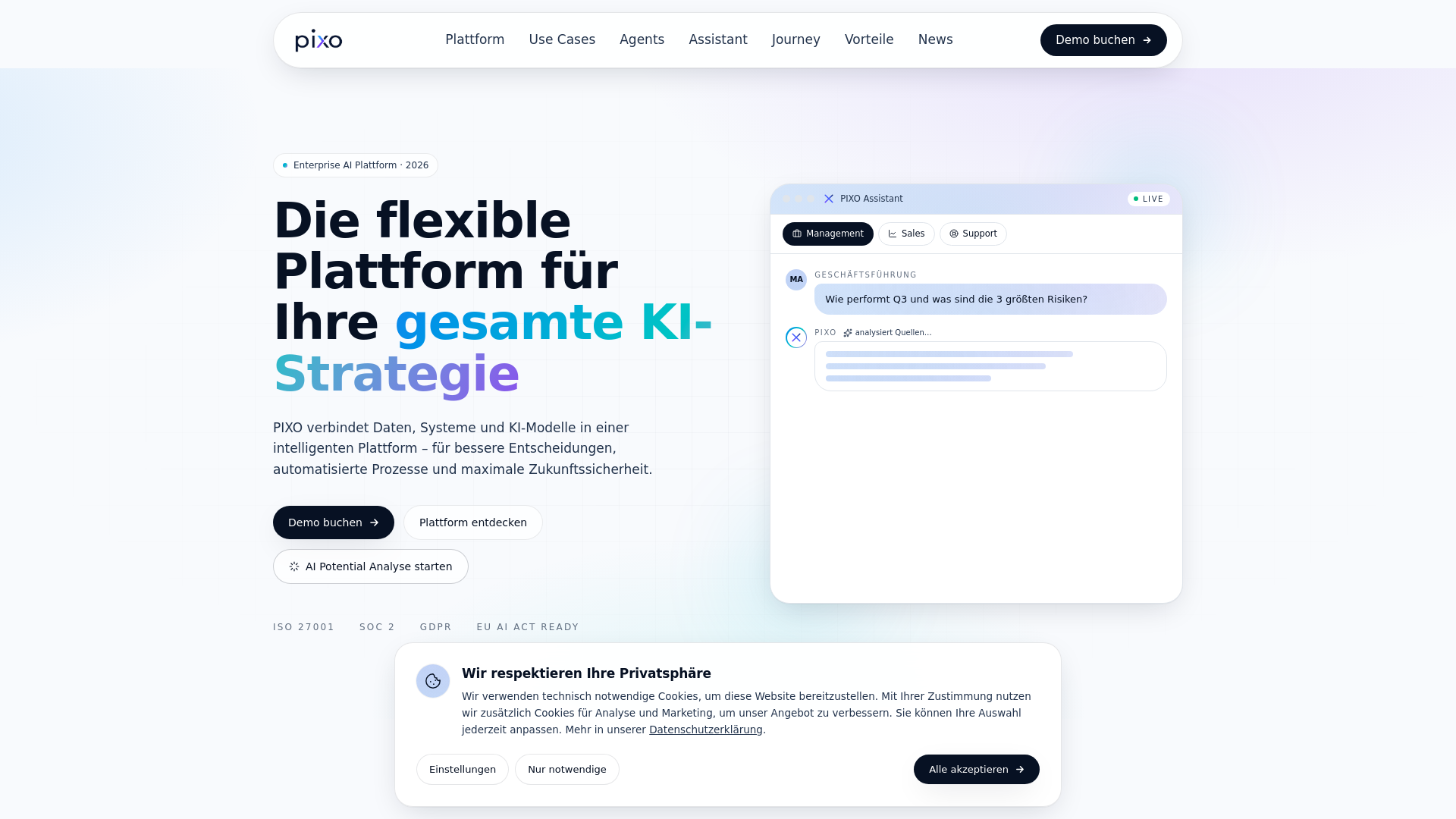
PIXO is a Swiss enterprise AI platform that connects existing systems, data and interchangeable language models in one orchestration layer. Built for DACH companies and SMEs, it runs governed autonomous agents on public cloud, private cloud or on-premise.
What is PIXO?
PIXO is an enterprise AI platform published by the Swiss company LINXYS GmbH, based in Rossrüti in the canton of St. Gallen. It positions itself as an orchestration layer rather than another chatbot: a layer sitting between a company's existing systems, several language models and the applications people already work in. The problems it claims to address are data silos, proprietary data lock-in, rigid processes and the cost of switching model provider.
The architecture is presented in seven layers, from data and systems at the bottom to the places where teams work at the top. The orchestration layer groups eight building blocks: AI agents, a knowledge graph, workflow automation, governance and security, monitoring, model routing, business rules and persistent context. Connectors read from ERP, CRM, SAP, SharePoint, Teams, databases, APIs and documents such as PDF, Office files and mail, in real time. The stated principle is that nothing is copied and nothing is stored twice. Routing spreads work across OpenAI, Anthropic's Claude, Gemini, Llama, Mistral, open source and future models, selected per request by cost, latency, data protection and task complexity, so that a model, a system or an application can be replaced without re-architecting.
On top sit delivered applications: management insights, sales and support assistants, HR and onboarding, compliance, process automation, dashboards and custom workflows. Agents are deliberately bounded. Every action passes four security gates, namely a named and revocable agent identity, a wallet with a spending ceiling, rules and mandates, and audit; a human is brought in whenever risk, value or confidence crosses a threshold. Six agents covering sales, support, procurement, campaigns, finance and research are shown in demo mode alongside a simulated online shop, so they illustrate the concept rather than customer results.
PIXO can be deployed as public cloud, private cloud or on-premise, the last allowing air-gapped installations. Adoption is not self-service: LINXYS frames it as a six-phase engagement running from potential analysis and strategy through architecture, integration, agents and ongoing operation. The site is entirely in German and no pricing is published.
What it does
- Connect ERP, CRM, SharePoint, Teams, databases, APIs and documents and read them in real time
- Route each request to the most suitable language model according to cost, latency, data protection and complexity
- Run bounded autonomous agents that choose their tools, execute steps and report results back, with a full audit log
- Build a knowledge graph linking documents, databases, people and processes into a single semantic layer
- Automate multi-step workflows including approvals and escalation to a human
- Publish a 24/7 customer assistant embedded on your own website
- Monitor latency, accuracy, hallucinations and token consumption, and apply business rules and guardrails without touching code
When to use PIXO / When not to
A quick filter to help you decide if PIXO is the right fit.
When to use PIXO
- Companies that want to avoid vendor lock-in and keep their language models interchangeable
- IT and integration teams with many existing systems to connect, from ERP and CRM to SharePoint, databases and ticketing
- Regulated organisations that need audit trails and named compliance frameworks such as the EU AI Act, GDPR, the Swiss revDSG, BaFin, KRITIS or HIPAA
- Swiss and wider DACH companies and SMEs looking for a German-speaking enterprise AI partner
- Organisations that require data sovereignty and can justify a private cloud or an on-premise, potentially air-gapped deployment
When not to use PIXO
- Individuals and small teams looking for a self-service tool they can sign up for and use the same day
- Buyers who need a published price, a free plan or a free trial before entering a sales conversation
- Non-German speakers outside the DACH region, since the site and the documentation exist only in German
- Developers looking for a documented public API, a mobile app or a browser extension
- Organisations that cannot commit to a six-phase integration project and a six to twelve week pilot
How to use PIXO
A typical end-to-end flow, from setup to results.
- Try the interactive demo on the homepage: the assistant answers clickable questions and six agents run in demo mode, with no sign-up required
- Download the 2026 Executive Paper on AI as enterprise architecture by giving your name, company and email address
- Book a demo through one of the site's calls to action; the appointment is scheduled through Calendly
- Take the 90-minute AI potential workshop to map the vendor's roadmap onto your own organisation
- Go through the first LINXYS phase, the analysis and assessment of your AI potential
- Agree an AI strategy and roadmap, then the platform architecture that supports it
- Run the integration: connect your source systems and define roles, rights and guardrails at source, agent and answer level
- Configure agents and automations, setting autonomy limits, spending ceilings and human approval thresholds
- Run a pilot of six to twelve weeks with a defined business case, a baseline measured beforehand and KPIs reviewed weekly
- Move into operation, scaling and optimisation, with day-to-day access through the authenticated customer area
Pros & Cons
Pros
- Vendor independence is built into the architecture rather than used as a slogan: models, systems and applications are meant to be swapped without rebuilding
- One platform covers connectors, retrieval, agents, workflows, governance and monitoring instead of several tools stitched together
- Three deployment models including on-premise and air-gapped, which is rare and often decisive for sovereign and regulated sectors
- Governance designed in from the start: per-step audit trail, role-based access, guardrails and numeric autonomy limits
- Monitoring explicitly names hallucinations and token cost, two metrics many vendors leave out
- Swiss publisher claiming dual revDSG and GDPR compliance, with EU AI Act readiness stated on the homepage
- Structured six-phase support from LINXYS, which claims more than 450 DACH projects, plus an interactive demo you can try on the site without signing up
Cons
- No public pricing at all: no price page, no range and no billing unit, and the /pricing URL still indexed by search engines returns a 404
- No free plan and no free trial announced; entry is sales-led, with a pilot of six to twelve weeks expected
- The site and documentation exist only in German, and the former English product pages have been taken down
- No email address anywhere on the site, for support, legal or data protection: the only channel is a form
- No terms of use, no trust or security page, no data processing agreement, no subprocessor list, and nothing said about whether customer data trains models
- No documented public API, no mobile app and no browser extension
- No named customer, testimonial or case study; the headline figures come without methodology, several site sections are simulated demonstrations, and the product is young, with the domain registered in April 2024 and a single blog article online at review time
Pricing & Plans
No price is published anywhere on the site. There is no pricing page, no price range and no billing unit, and the /pricing URL still indexed by search engines returned a 404 when checked on 16 August 2026. No free plan and no free trial is announced. Commercialisation is entirely sales-led: the available routes are booking a demo, requesting an analysis or speaking to sales, after which pricing is discussed individually. The only monetary figures published are a 20% recurring margin offered to partners and an illustrative agent spending ceiling of EUR 10,000 used in a demonstration, neither of which is a product price. Available free of charge and without commitment: the interactive demo on the site, the Executive Paper in exchange for contact details, and a 30-minute partner conversation.
- the site lists no tiers
- no amounts and no billing units
- and every option is quoted individually
- ready to use
- low upfront cost
- ISO 27001 certified hyperscalers
- EU regions with selectable data residency
- unlimited horizontal scaling. Price on request
- dedicated environment with full control
- isolated tenants
- your own KMS keys
- custom networking and peering
- claimed BaFin
- KRITIS and HIPAA compliance
- guaranteed capacity. Price on request
- data never leaves your data centre
- air-gapped deployments possible
- your own hardware and models
- cluster-based scaling. Price on request
- Partner programme with four profiles
- reseller
- implementation
- consulting and technology partner
- carrying a 20% recurring margin
- this is a channel arrangement
- not a customer plan
Data, GDPR & hosting
A consolidated view of how PIXO handles your data.
GDPR overview
GDPR handling is claimed but only partly evidenced. The privacy policy, dated May 2026, states that personal data is processed confidentially and in line with the revised Swiss Data Protection Act and the GDPR. It lists the rights of access, rectification, erasure or restriction, portability, objection and complaint to a supervisory authority, and names the Swiss EDÖB. Rights are exercised by an informal message to the controller, since no dedicated email address is published. Security is described through technical and organisational measures and TLS-encrypted transmission, and the homepage displays GDPR and EU AI Act ready badges. What is missing is substantial: no data processing agreement, no subprocessor list, no data protection officer, no Article 27 EU representative although the publisher is established outside the EU, and no transfer mechanism cited for Calendly LLC in the United States.
Who owns the data?
The controller named in the privacy policy is LINXYS GmbH, Agathafeld 11, 9512 Rossrüti, Switzerland, whose managing director is Ossian C. Scheller; PIXO is a LINXYS brand. The policy claims a dual regime, the revised Swiss Data Protection Act and the EU GDPR, and points users to the Swiss federal supervisory authority (EDÖB). On the product side, PIXO states that it reads customer data in place and in real time and copies nothing, which implies the customer keeps its records in its own systems. Note that the published policy covers the showcase website only: no contract governing customer data inside the platform is published anywhere.
Reuse rights
No terms of use are published, so the contractual rules on reusing data cannot be consulted before contact. The privacy policy covers the website only. Server logs, with anonymised IP addresses, are said to serve trouble-free operation and improvement of the offering, and are not merged with other data sources. Demo and contact form entries, meaning name, company, email and the subject of the request, are processed to answer and to prepare a possible meeting, on the basis of Art. 6(1)(b) or Art. 6(1)(f) GDPR. Appointment booking runs through Calendly LLC in the United States, where the data entered is transmitted and stored. Technically necessary cookies and local storage stay on the user's device and support authentication. Personal data is passed to third parties only where it is needed to perform a contract, where the user has expressly consented, or where the law requires it. On the platform side, PIXO logs every agent step, source and model decision for audit, and escalates sensitive requests to a human. Nowhere does the site state whether customer data is used to train models: there is no commitment either way and no documented opt-out.
Data retention & training
Hosting summary
Hosting depends on the deployment model, which is the core of the offer. Public cloud is described as running on ISO 27001 certified hyperscalers in EU regions, with selectable data residency and unlimited horizontal scaling. Private cloud means a dedicated environment with isolated tenants, customer-owned KMS keys, custom networking and peering, guaranteed capacity, and claimed BaFin, KRITIS and HIPAA compliance. On-premise means, in the vendor's words, that data never leaves your data centre, with air-gapped deployments possible and your own hardware and models. Across all three, the stated principle is real-time reading from the customer's existing systems, with nothing copied and nothing stored twice. Beyond that, the picture is thin. No hosting country is named for the platform itself, and no data centre or cloud provider is identified. The mention of Switzerland or the EU found on the site comes from an architecture guide, as a recommendation rather than a hosting commitment. The showcase site is served behind Cloudflare on an anycast address, which says nothing about where customer data actually resides.
Things to keep in mind
Risks and trade-offs to weigh before adopting PIXO.
- The ISO 27001 and SOC 2 badges on the homepage come with no scope, no report and no trust page, while another line of the same site attributes ISO 27001 to the public cloud hyperscalers rather than to the publisher; EU AI Act ready is likewise a statement of intent, not an attested conformity. Ask for the certificates before relying on them
- These agents act, they do not merely answer. With spending ceilings such as the EUR 10,000 example shown on the site, an over-broad mandate or a badly set threshold turns a wrong answer into a wrong purchase order, so review the gates, the limits and the audit trail before granting autonomy
- No terms of use, no data processing agreement and no subprocessor list are published; only Calendly LLC in the United States is named, with no transfer mechanism cited, no Article 27 EU representative is designated although the publisher sits outside the EU, and the privacy policy covers the showcase site rather than customer data inside the platform
- Nothing is said about whether customer data is used to train models, and no opt-out is documented anywhere: silence is not a guarantee, so get the position in writing
- Much of what looks like proof is simulated: agents run in demo mode, the shop assistant serves a fictional store, systems are displayed as connected, and the figures shown, from -68% and -54% to +92%, 97% accuracy and more than 450 projects, come with no methodology, scope or source. Do not read them as customer results
- Commercialisation is DACH-oriented and the site exists only in German, with no email address anywhere, so every question has to pass through a form and a sales conversation before you can assess the offer
- Old English product pages such as /pricing, /about, /assist and /pixo-search are still indexed by search engines but return 404, and the domain only dates from April 2024, so what you read in a search result may describe a version of the product that no longer exists
Setup & Integrations
Technical difficulty
High, and by design. There is no sign-up: entry is a demo and a sales cycle, followed by a six-phase engagement with LINXYS. Connecting ERP, CRM, SAP, SharePoint, databases and APIs requires access, credentials and a role and rights model defined at source, agent and answer level. The recommended pilot runs six to twelve weeks with a business case, a baseline and weekly KPIs, and on-premise or air-gapped options add your own hardware and operations. The vendor's counter-argument is that new models arrive in days rather than quarters and components can be swapped without re-architecting.
Deployment
Integrations
Behind PIXO
Resources
All the official URLs gathered for verification and reference.
Frequently asked questions
How much does PIXO cost?
Is there a free trial or a free plan?
Who is behind PIXO?
Which language models can I use?
Where is my data hosted?
Does PIXO copy my data?
Is my data used to train models?
How are the agents kept under control?
Is PIXO GDPR compliant?
How long does an implementation take?
Should you pick PIXO?
PIXO makes a clear and internally consistent proposition: an orchestration layer rather than yet another chatbot, with vendor independence carried through into the architecture instead of being used as a slogan. The governance work is genuinely deep for a product this young, with four security gates on every agent action, complete audit trails, role-based access, numeric autonomy limits and monitoring that explicitly names hallucinations and token cost. The on-premise and air-gapped options are a real differentiator for sovereign and regulated organisations, and the Swiss publisher, LINXYS GmbH, claims dual revDSG and GDPR compliance along with more than 450 projects across the DACH region.
Against that stands a striking commercial opacity. There is no price, no terms of use, no email address, no named customer and no case study. The security claims that would carry the most weight, ISO 27001 and SOC 2, appear as badges without a stated scope, and another line of the same site attributes ISO 27001 to the hyperscalers behind the public cloud deployment. Nothing is said about whether customer data trains models. The site is also young: the domain was registered in April 2024 and one blog article was online at review time, while a good part of what looks like product proof, from agents in demo mode to a fictional shop, connected systems and headline percentages, is a simulation rather than customer evidence.
The sensible way to approach PIXO is therefore a demo followed by a tightly scoped pilot, with everything the site does not publish demanded in writing: pricing and billing unit, contractual terms, a data processing agreement, the subprocessor list, the position on training and retention, and the actual holder of each certification claimed.
- Choosing a selection results in a full page refresh.
- Opens in a new window.