
PocketPod
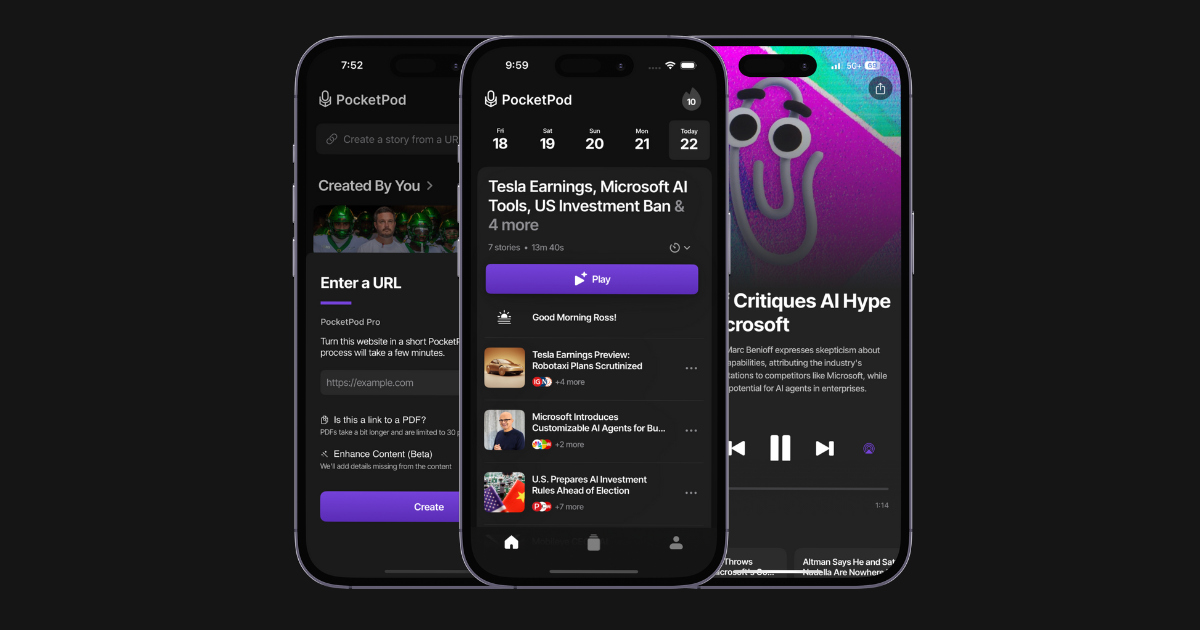
PocketPod built an AI-generated daily podcast tailored to each listener's declared interests, folding in calendar, reminders and local weather. Delivered through an iOS app, with episode length adjustable between five and sixty minutes.
What is PocketPod?
PocketPod is an AI-generated daily podcast, composed for one listener at a time. The homepage sums it up as Daily podcasts, made for you: rather than hunting for a show, you receive one assembled each morning around the subjects you picked, with calendar and reminders integrations that brief you on the day ahead. Delivery was through an iOS application. There is no Android build, no web player and no API.
The product page lists seven claims. Interests drive AI personalisation of the news and stories served. Calendar and reminders feed the morning briefing. Local weather is folded in. Episode length is adjustable from five to sixty minutes. Listening is ad-free. The library is described as hundreds of daily stories plus focused channels covering AI, startups, lifestyle and business. Finally, listeners could push a story of their own into the next day's episode.
Alongside the personalised feed, Pocket AI, Inc. published eleven fully AI-generated shows of its own: Trending News, Startup News, AI News, Space News, Science News, Environment News, the AI Papers Podcast, The Reggie Van Houten Show, Today in History, Guide to Startups and Startup Launch. The AI Papers Podcast walked through several new machine learning papers each day with links in the description; The Reggie Van Houten Show retold the day's stories in the manner of a 1920s radio broadcast. These shows were distributed on Spotify, Apple Podcasts, Amazon Music and by RSS. A second offering, PocketPod Studio, was pitched at creators, brands, writers and businesses, but never moved past a Google Forms waitlist.
The publisher is Pocket AI, Inc., trading as PocketPod, registered in California and based in San Francisco. The homepage carries a Backed By strip naming Y Combinator and ElevenLabs Grants, and the footer describes the app as a product of Lumetric.
One finding overrides the rest. As of 17 August 2026 the marketing site still answers and still invites you to download, but the App Store listing returns 404 across five storefronts, the iTunes lookup returns nothing, and the eleven RSS feeds, the Spotify and Apple Podcasts pages and the homepage content API all answer 404. No route into the product remains open.
What it does
- Generate a daily podcast built around the listener's own declared interests
- Read the day's calendar entries and reminders into the same episode
- Add local weather to the morning briefing
- Set episode length anywhere between five and sixty minutes
- Follow dedicated channels on AI, AI research papers, startups, science, space and the environment
- Share a story so that it lands in tomorrow's episode
- Join the PocketPod Studio waitlist to have a podcast produced
When to use PocketPod / When not to
A quick filter to help you decide if PocketPod is the right fit.
When to use PocketPod
- Commuters and gym-goers who want a hands-free news briefing shaped around their own subjects rather than a broadcaster's schedule
- Professionals tracking one narrow beat, served by the dedicated AI, AI research, startup, science, space and environment channels
- People who want the day's calendar entries, reminders and local weather read out inside the same audio session
- Researchers and students who valued the AI Papers channel, a daily walk-through of new machine learning papers with links in the show notes
- Creators, brands and writers who signed up to the PocketPod Studio waitlist to have a podcast produced for them
When not to use PocketPod
- Anyone looking for a working product today: the iOS app is delisted and every podcast feed answers 404, so there is no way in
- Android users and desktop listeners, since the service shipped as an iOS app only, with no web player and no API
- Buyers with a compliance checklist, as there is no DPA, no subprocessor list, no stated hosting country and no GDPR section anywhere
- Listeners who need a language other than English, none being declared for either the interface or the generated audio
- Anyone under 18, whom the terms of service explicitly bar from registering or using the service
How to use PocketPod
A typical end-to-end flow, from setup to results.
- Download the iOS app from the App Store button on the homepage, or scan the QR code shown on desktop
- Create an account with a name, email address, username and password, or sign in through a third-party social account
- Pick the interest categories that will drive how each episode is composed
- Grant calendar and reminders access if you want the day ahead read into the briefing
- Grant location access if you want local weather folded in
- Set the episode length you want, anywhere from five to sixty minutes
- Listen to the episode delivered each morning
- Share a story from the library so it lands in tomorrow's episode
- Subscribe to the AI-generated Originals separately on Spotify, Apple Podcasts, Amazon Music or by RSS, with no account needed
- Note that the first step no longer works: the app is no longer distributed and the feeds are switched off, leaving support@pocketpod.app and the LinkedIn, X and Instagram accounts as the only live contact routes
Pros & Cons
Pros
- Personalisation reaches the composition itself, not just the selection: the episode is assembled for the listener rather than picked from a catalogue
- News, calendar, reminders and weather arrive in one audio stream instead of four separate apps
- Episode length adapts to the time actually available, from a five-minute walk to an hour-long commute
- Ad-free listening is claimed across the library
- Tightly scoped channels, including a daily digest of AI research papers with source links in the show notes
- The in-house Originals needed no account and no app, playing from any podcast client
- Legal documents are published and dated, with a full postal address and a telephone number, and the publisher came through Y Combinator's Winter 2024 batch with an ElevenLabs grant
Cons
- No usable channel remains: as of 17 August 2026 the App Store listing, the RSS feeds, the Spotify and Apple Podcasts pages and the content API all return 404
- The site still shows a download button and a listening catalogue that lead nowhere, and its Examples link points at a route that renders nothing
- iOS only, with no Android app, no web player and no API
- No pricing information exists anywhere: no pricing page, and no purchase clause in the terms of service
- No GDPR framework, no DPA, no subprocessor list and no disclosed hosting country
- Complete silence on model training, even though interests and calendar data are passed to AI models
- The contribution licence is unusually broad, reaching the user's image and voice, with moral rights waived
Pricing & Plans
No pricing information is published. The site has no pricing page, and no price, subscription or purchase wording appears anywhere in its code, the sole occurrence of the word free being the phrase ad-free listening experience. The purchases and payment module of the terms of service template was left inactive, so the legal documents contain no price, renewal or refund clause; they merely refer the user to the app distributor for a refund of the purchase price, if any. The App Store listing, which would have carried the price and any in-app purchases, has been withdrawn, so no amount can be verified. Neither a permanent free plan nor a free trial is announced. The in-house Originals were freely available on public podcast platforms without an account.
Data, GDPR & hosting
A consolidated view of how PocketPod handles your data.
GDPR overview
There is no GDPR implementation to report. The privacy notice dated 21 March 2024 contains no GDPR section, no reference to the EEA or the United Kingdom, and no lawful basis in the sense of the regulation. Its table of contents covers United States state law only: CCPA in California, plus the Colorado, Connecticut, Utah and Virginia acts. No Article 27 representative is designated, no data protection officer is named, no data processing agreement is offered, no subprocessor list is published and no standard contractual clauses are mentioned. Generic rights are nonetheless extended to everyone, including access, correction, deletion, portability, objection, withdrawal of consent and appeal, exercised through founders@pocketpod.app within forty-five days. The Global Privacy Control signal is honoured. The minimum age is 18, with no reference to the regulation's 16-year threshold.
Who owns the data?
The terms of service split ownership from licence. Pocket AI, Inc. states plainly that it asserts no ownership over user contributions and that the user keeps full ownership, along with any intellectual property attached to them. What the user grants alongside that ownership is far broader: an unrestricted, unlimited, irrevocable, perpetual, transferable, royalty-free and sublicensable worldwide licence to host, copy, sell, resell, publish, broadcast, archive, reformat, translate, excerpt and distribute those contributions for any purpose, commercial or advertising included, and to build derivative works from them. The licence names the user's image and voice explicitly, and moral rights are waived. Pocket AI, Inc. also keeps the right to edit, recategorise or delete any contribution without notice.
Reuse rights
Nothing in the terms grants the end user a reuse right over the service's own material: the content and marks of Pocket AI, Inc. remain the company's, and the mobile application licence is revocable, non-exclusive and non-transferable, with reverse engineering, derivative works and any revenue-generating use expressly forbidden. Users may not build a competing or substitute product from the app, nor reuse its interfaces or proprietary information. In the other direction, the privacy notice describes what the company does with user data: names, email addresses, usernames and passwords are collected, calendar data is treated as sensitive, and geolocation, calendar access and social account access are requested by permission. The stated product mechanism is that declared category interests and, where allowed, calendar data are passed to AI models to compose the podcast script. Sharing is limited to business transfers and Google Analytics, and the company states it has neither sold nor shared personal information in the preceding twelve months and will not do so.
Data retention & training
Hosting summary
Nothing is disclosed. Neither the privacy notice nor the terms of service names a hosting country, a hosting region or an infrastructure provider, and no subprocessor list is published. The only third parties named anywhere are Google Analytics, the AI models that compose the podcast script, and the social login providers. DNS resolution returns 104.21.53.190, a Cloudflare anycast address: it identifies an edge node and says nothing about where user data actually rests, so it must not be read as a hosting jurisdiction. What can be said is indirect. The publisher, Pocket AI, Inc., is established in San Francisco, the terms of service are governed by Delaware law, and the privacy notice addresses United States state privacy rights exclusively. Together these point towards United States hosting without establishing it. Anyone with a data residency requirement should treat this as unanswered rather than assume an answer.
Where PocketPod works
Country-level availability.
Not available in
Things to keep in mind
Risks and trade-offs to weigh before adopting PocketPod.
- The product is no longer reachable: on 17 August 2026 the App Store listing returned 404 on the us, it, gb, de and fr storefronts, the iTunes lookup returned nothing, and the eleven RSS feeds along with the Spotify and Apple Podcasts pages tested were all dead
- The site keeps advertising what it can no longer deliver, showing a download button, a listening catalogue and an Examples link that lead to missing pages or to no page at all
- Interests and calendar data are handed to AI models, yet neither document says whether that data is used to train models, so a listener cannot know what became of a year of personal scheduling data
- The contribution licence is unusually broad for a consumer app, covering the user's image and voice for any commercial purpose, with moral rights waived and no time limit
- Fully AI-generated news carries an accuracy risk the terms do not underwrite: a summary that sounds authoritative can still be wrong, and a daily audio habit discourages checking the source
- Outsourcing the morning to a generated briefing narrows what you meet by design, since the system serves back the interests you declared and rarely the story you did not ask for
- The legal documents have not been revised since March and April 2024, there is no GDPR framework, no DPA and no disclosed hosting country, and the contact address founders@pocketpod.app is obfuscated on the page rather than shown in plain text
Setup & Integrations
Technical difficulty
None, by design. Setup meant downloading the iOS app, creating an account, choosing interest categories and granting calendar, reminders and location permissions. No technical skill, no API key and no integration work was involved, and the whole thing was a few minutes of tapping. The obstacle today is not technical but one of availability: the application is no longer distributed, so the very first step cannot be completed.
Deployment
Integrations
Behind PocketPod
Fundraising
Social
Resources
All the official URLs gathered for verification and reference.
Frequently asked questions
What is PocketPod?
Which devices does it run on?
Can it still be used today?
How long is an episode?
What data is used to build an episode?
What does it cost?
Is there a minimum age?
Is personal data sold?
Is PocketPod GDPR compliant?
Who publishes PocketPod?
Should you pick PocketPod?
PocketPod had a clean idea and executed it further than most: an audio briefing genuinely composed for one listener, pulling in calendar entries, reminders and local weather, with the running time adjusted to whatever gap in the day you meant to fill. The eleven in-house shows were evidence of real, sustained production rather than a demo, and the AI Papers Podcast, a daily walk-through of new machine learning papers with links in the show notes, was a small piece of genuine editorial thinking. The publisher was credible too, with a Y Combinator Winter 2024 place, an ElevenLabs grant, and legal documents that were published, dated and complete down to a postal address and telephone number.
What remains is another matter. On 17 August 2026 every route into the product answered 404: the App Store listing across five storefronts, the eleven RSS feeds, the Spotify and Apple Podcasts pages of the shows, and the content API that fed the homepage sample player. The marketing site is untouched and still invites a download that cannot happen. The footer now describes the app as a product of Lumetric, and the Y Combinator entry that once belonged to PocketPod resolves to Lumetric as well, which tells its own story about where the two-person team went.
The legal documents have not moved since March and April 2024, and they carry no GDPR framework, no DPA and no stated hosting country. Read today, this entry is documentary rather than practical: a well-built product worth studying for how personalised AI audio was approached, and a reminder to check the download link before trusting a landing page.
- Choosing a selection results in a full page refresh.
- Opens in a new window.