
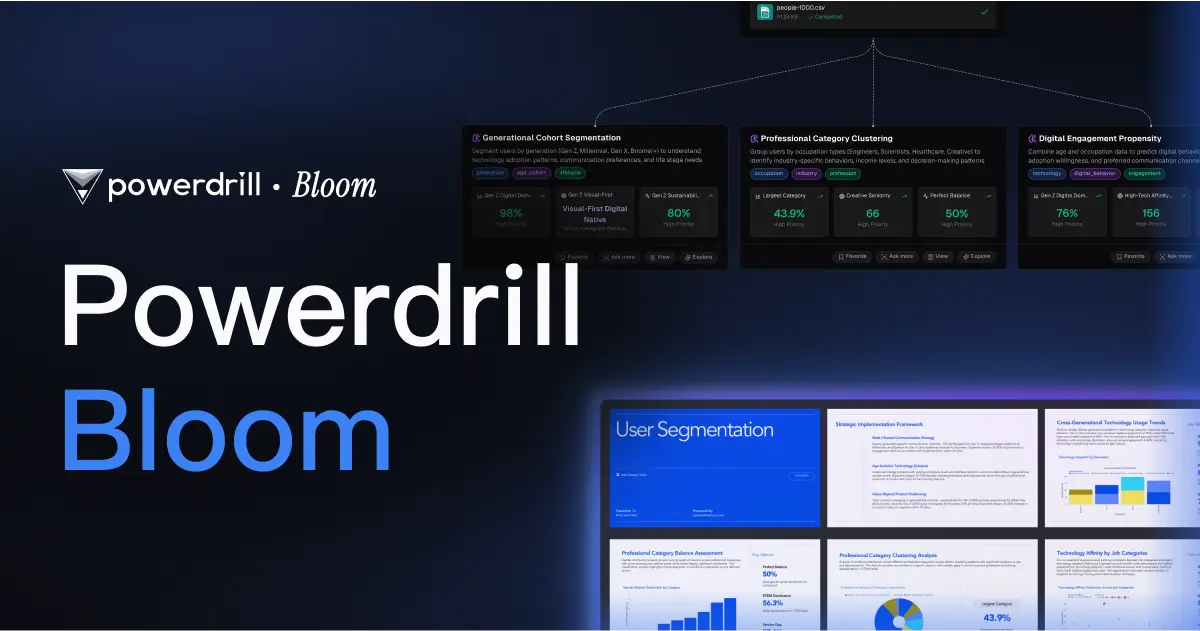
Powerdrill Bloom
Powerdrill Bloom is an AI data-analysis workspace where a team of four specialized agents cleans, analyzes and visualizes spreadsheets, PDFs and public datasets, then exports charts, reports and PowerPoint decks — no SQL or Python required.
What is Powerdrill Bloom?
Powerdrill Bloom is an AI workspace for data analysis, built around what the vendor calls an AI Exploration Canvas: you drop in a spreadsheet or a document, or simply name a subject, and a team of agents works the problem in parallel instead of answering one question at a time.
Four agents are named and given distinct jobs. Eric, the data engineer, cleans and transforms the file. Anna, the analyst, turns an unclear question into structured tasks. Derek, the detective, searches the open web for external data that connects to yours. Victor, the verifier, checks the data and the logic for errors and false leads. The second claimed differentiator is persistent memory: the workspace is meant to carry context from one analysis to the next rather than start cold each time.
Inputs are the everyday ones — Excel, CSV, TSV, PDF, Word, Markdown — plus twelve public datasets the product queries directly, among them 40 million-plus academic papers from arXiv and PubMed, 500,000-plus clinical trial records, three million SEC filings, ten million USPTO patents, market and economic indicators, and live shipment tracking. Outputs are where the tool positions itself against chat-first rivals: charts of every usual kind, dashboards, written insights, editable PowerPoint decks, infographics, Office documents and Notion exports, each reachable from a node in the canvas.
Around the canvas sits a catalog of 121 task-specific tools in nine families, from Excel housekeeping and PDF conversion through financial modeling, TAM sizing and competitive intelligence. A Scheduled Agent reruns an analysis on a timetable, and paid plans add Claude Skills workflows.
Two enterprise routes exist: SaaS Team, activated immediately and driven through an API with isolated projects, and Dedicated Cloud, deployed with Docker inside the customer's own cloud and compatible with proprietary and open-source models alike.
The publisher, by contrast, is thinly documented on its own site. The terms define the company as DATACLOUD, the trust center is titled Rocosky, and there is no about page, no contact page and no postal address — a single mailbox answers legal, privacy and support alike.
What it does
- Upload an Excel, CSV, TSV or PDF file and get insights, charts and a written summary with no setup
- Ask questions in plain language, such as "Show me the top products by revenue"
- Export any finding as an editable PowerPoint deck, an infographic or a Notion page in one click
- Start from a topic instead of a file and let the agents research it across the open web
- Query 12 public datasets — academic papers, clinical trials, SEC filings, markets, economic indicators, patents, shipments
- Chat with a SQL database and turn plain language into runnable queries
- Schedule a recurring analysis so the report rebuilds itself
When to use Powerdrill Bloom / When not to
A quick filter to help you decide if Powerdrill Bloom is the right fit.
When to use Powerdrill Bloom
- Analysts, marketers, operators and consultants who need charts and stakeholder-ready decks rather than a chat transcript — the four audiences the vendor names itself
- Finance teams working from P&L, balance-sheet and cash-flow files, with dedicated tools for valuation, budget-versus-actual and 13-week cash forecasts
- Market and competitive researchers after TAM/SAM/SOM models, weekly competitor digests and cited findings drawn from public data
- Academic and clinical researchers running literature reviews across 40 million-plus papers, 500,000-plus clinical trials and 2 million-plus drug compounds
- Small teams and solo founders on a budget: the free tier is permanent and carries 1,000 credits refreshed daily, and the paid entry point is USD 19.90 per month
When not to use Powerdrill Bloom
- Procurement and security reviewers who need a DPA, a published subprocessor list or a declared hosting country — none of the three exists
- Organizations that must contractually exclude their data from model training: no such option is documented, and the privacy notice never raises the subject
- Teams wanting a mobile, desktop or browser-extension experience — Powerdrill Bloom ships as a web app and an API, nothing else
- Buyers who need published enterprise pricing: both SaaS Team and Dedicated Cloud are quote-only
- Anyone who may need to reverse a purchase: paid subscription fees are non-refundable unless the law requires otherwise
How to use Powerdrill Bloom
A typical end-to-end flow, from setup to results.
- Sign up at powerdrill.ai with an email address, or with a Google or GitHub account — there is nothing to install
- Choose your starting point: upload a file, or pick "Start from a topic" and type the subject you want researched
- Select the response language when the canvas is created; a switch at the bottom of the canvas changes it mid-exploration
- Let the agents read the file's metadata, identify the relevant analytical domains and generate first insights unprompted
- Refine by asking questions in plain language, as many times as you need
- Switch the canvas layout — horizontal, vertical or indented tree — to suit your screen and the shape of your reasoning
- Turn a single node into slides with "View", then "Generate Slides" in the details panel
- Combine several nodes into one deck by marking each with "Favorite", then clicking "Favorite Nodes" at the bottom of the canvas
- Export a node to Notion from the same details panel
- For programmatic use, request an API key and call the Enterprise V2 endpoints for datasets, data sources, files, sessions and jobs
Pros & Cons
Pros
- A free tier that is genuinely usable and permanent: 1,000 credits refreshed daily, file uploads, open-data search, insights, charts and one scheduled task
- Low paid entry point — USD 19.90 per month, or USD 16.58 per month on annual billing
- No technical skill required: neither SQL, nor Python, nor design
- The whole chain lives in one place, from raw file to a deck someone can actually present
- A dedicated verifier agent checks the data and the logic, which is unusual and speaks to the main objection against AI analysis
- Twelve public datasets built in, with links back to the source so a finding can be traced
- Deleting a canvas wipes everything attached to it, and the Dedicated Cloud option moves hosting into the customer's own environment
Cons
- The legal documents are dated 4 July 2023 and were never revised: they describe neither the agents, nor the memory, nor Claude Skills
- Nothing at all on hosting: no country, no region, no subprocessor list, no DPA
- No documented way to exclude your data from model training — the subject is simply absent from the privacy notice
- No GDPR Article 27 representative and no DPO, despite the compliance claim published in April 2024
- The vendor is barely identifiable from its own site: no about page, no contact page, no postal address, and one mailbox for legal, privacy, support and DMCA alike
- Naming is inconsistent — the terms say DATACLOUD, the trust center is titled Rocosky, the product is Powerdrill Bloom — and the site's own llms.txt publishes prices and a language count that the pricing page and the FAQ contradict
- Credit-based quotas that heavy analysis consumes quickly, no refunds, and quote-only enterprise pricing
Pricing & Plans
A permanent free plan is available at USD 0.00 per month. The cheapest paid plan, Pro, is listed at USD 19.90 per month on monthly billing, falling to USD 16.58 per month on annual billing, or USD 199.00 per year. All prices are quoted in US dollars, billed in advance and renewed automatically at the end of each cycle. Paid subscription fees are not refundable unless the law requires it.
- 1
- 000 credits refreshed daily
- uploads of Excel
- CSV
- PDF and documents
- search across the built-in open-data sources
- insights
- charts and summaries
- 1
- 000 daily credits plus 5
- 000 monthly credits
- Claude Code / Codex-level agent tasks
- advanced open-data retrieval
- deep analysis and reporting
- built-in and custom agent skills
- Office documents and Nano Banana images
- the Pro feature set with 1
- 000 daily credits plus 11
- 000 monthly credits
- 1
- 000 daily credits plus 60
- 000 monthly credits
- higher-capacity agent execution
- deep multi-step analysis and visualization
- larger quotas for built-in and custom skills
- and advanced slide
- document
- everything in Pro
- plus team creation
- member invitations and shared Team Credits
- with one seat per member
- credits stack on top of plan credits
- stay valid for 12 months and work on any plan including Free
- the amount is not displayed
- and volume discounts are mentioned
- pricing on request
Data, GDPR & hosting
A consolidated view of how Powerdrill Bloom handles your data.
GDPR overview
GDPR compliance is claimed explicitly, but only in a blog post: on 25 April 2024 the vendor announced it was "now General Data Protection Regulation (GPDR) compliant", citing data protection, explicit consent, lawful handling of EU citizens' data and risk reduction. The legal documents do not back that up. The privacy notice, dated 4 July 2023 and never revised since, does not cite the GDPR at all: it places processing under Singapore's Personal Data Protection Act "and other applicable laws". No Article 27 EU representative is designated, no DPO is named, and no EU establishment address is published. Access, rectification, erasure, objection and consent-withdrawal rights are documented, but inside the Canada and Mexico addenda rather than a GDPR chapter. International transfers are announced without naming a transfer mechanism. Every request goes to one address, service@powerdrill.ai.
Who owns the data?
Under the Terms of Service you keep every right in the Content you upload, and you remain responsible for its legality and for protecting those rights. The platform's own intellectual property stays with the vendor, which grants paying users a limited, non-transferable, revocable and non-exclusive license. One clause deserves attention: feedback, ideas and problem reports you send become the vendor's property, with no confidentiality attached. For personal data, DATACLOUD declares itself the data controller. Deletion is in your hands too — removing an exploration canvas permanently erases the uploaded file together with its insights, visualizations and generated presentations.
Reuse rights
Because the Terms confirm you retain all rights to the Content you submit, nothing stops you from reusing your own files, charts, reports and generated decks, including commercially, without asking permission. The license you receive runs the other way and covers the service itself, not your data: you may not copy, resell, reverse-engineer, sublicense or automate access to the platform, and its trademarks and trade dress stay off-limits without written consent. On the vendor's side, the privacy notice enumerates its purposes for personal information — delivering and maintaining the service, support, billing, usage monitoring, service improvement, and marketing where you consent — and states plainly that personal data is neither sold nor otherwise shared beyond nine listed cases. Advertising cookies are among those in use. Training AI models on customer data is never mentioned, in either direction.
Data retention & training
Hosting summary
No hosting location is disclosed anywhere on the site — not a country, not a region, not a cloud provider. Article 6 of the privacy notice states only that personal data may be transferred to countries other than your own, wherever affiliates, business partners and service providers are located, without naming any transfer mechanism such as standard contractual clauses. Article 8 promises "reasonable" administrative, technical and physical safeguards, backup copies and access restricted to authorized personnel, while explicitly declining to guarantee complete security. SOC 2 Type 2 certification is claimed in the footer of every page and a public trust center exists, though it renders entirely in JavaScript and could not be read. No subprocessor list is published; Stripe is the only third party named, as the payment processor. Organizations that need control can take the Dedicated Cloud route, which deploys the product with Docker inside their own cloud and moves the hosting question onto their side of the line.
Things to keep in mind
Risks and trade-offs to weigh before adopting Powerdrill Bloom.
- The vendor states in its own terms that the AI "is not an expert and may provide inaccurate information": check every figure before it lands in a board pack or an investor deck
- The legal framework has not kept up with the product — a privacy notice written in July 2023 now governs agents, memory and Claude Skills shipped in 2026
- With no DPA, no subprocessor list and no declared hosting country, uploading personal or regulated data is a decision taken without the facts
- Model training is never addressed: the absence of a claim is not a guarantee, and there is no opt-out to fall back on
- The pricing page shows the discounted annual rate by default; the 20% promotion ends 22 August 2026 and the monthly list price is meaningfully higher
- Handing cleaning, analysis and verification to agents all at once makes it easy to stop checking the reasoning — a polished deck looks equally convincing whether or not the logic underneath holds
- Shared datasets and shared conversations push content beyond your own account, and advertising cookies are in use: check the scope before you share
Setup & Integrations
Technical difficulty
Very low. Nothing to install: sign up with an email address, a Google account or a GitHub account and work in the browser. Upload a file and the agents read its metadata, pick the relevant analytical domains and produce insights without configuration. Some tools in the public catalog need no account at all. The terms ask only for a mainstream browser less than a year old with JavaScript enabled. Result quality does depend on tidy input — tabular structure, clear headers, consistent types. Only the Enterprise API and the Docker-based Dedicated Cloud call for engineering help.
Deployment
Integrations
Supported languages
Behind Powerdrill Bloom
Social
Resources
All the official URLs gathered for verification and reference.
Alternatives
Tools that compete with or complement Powerdrill Bloom.
Frequently asked questions
What exactly is Powerdrill Bloom?
Is there a free plan, and what does the first paid tier cost?
Which file formats can I upload?
Do I need to know SQL or Python?
How do I get a PowerPoint deck out of it?
Who are the four AI agents?
Can I delete my data?
Is my data used to train the models, and where is it hosted?
Is there an API, and can it be self-hosted?
What is the minimum age, and are refunds possible?
Should you pick Powerdrill Bloom?
Powerdrill Bloom is a broad, well-built product with a differentiator that survives inspection. The multi-agent canvas is not just branding: a dedicated verifier agent answers the objection most often raised against AI analysis, and the persistent memory is what the whole workspace is organized around. The catalog is unusually deep for the price — 121 task-specific tools, twelve public datasets with links back to source, exports that end in an editable deck rather than a chat reply. The commercial terms are friendly: a free plan that is permanent rather than a countdown, and a first paid tier at USD 19.90 per month.
The reservations are all on the same side of the ledger, and they matter more the larger your organization. The legal apparatus has not kept pace with the product: a privacy notice from July 2023, never revised, now governs agents, memory and Claude Skills shipped in 2026. It says nothing about training models on customer data, offers no opt-out, names no hosting country or region, publishes no subprocessor list and provides no DPA. GDPR compliance is asserted in a blog post but absent from the documents that would carry it, with no Article 27 representative and no DPO. And the publisher is remarkably hard to pin down from its own pages — DATACLOUD in the terms, Rocosky in the trust center, Powerdrill Bloom on the marketing, with no address and a single shared mailbox.
For an individual analyst, a consultant or a small team turning spreadsheets into decks, that gap is a footnote and the value is real. For anyone with a procurement questionnaire, a DPA requirement or regulated data, the questions above need answers before an upload, and the site does not supply them.
- Choosing a selection results in a full page refresh.
- Opens in a new window.