
PPLeGPT
PPLeGPT is a free, single-page web tool that turns a short description of your training experience into an AI-generated exercise suggestion, targeting one of three splits — push, pull or legs. No account, no installation, no payment.
What is PPLeGPT?
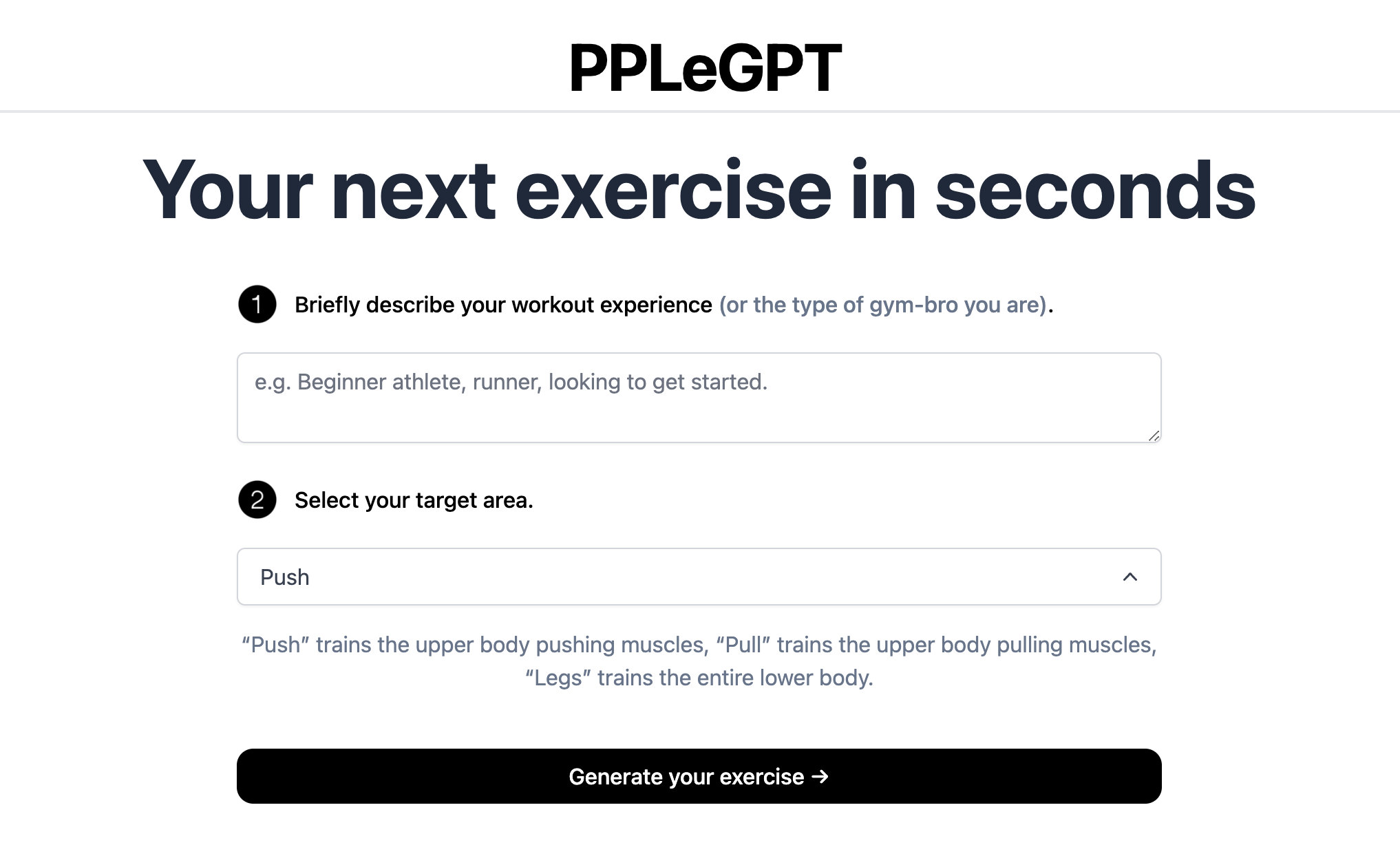
PPLeGPT is a minimal, AI-assisted exercise generator published on a free Vercel subdomain. Its name comes from push/pull/legs, the training split it is built around, and the entire product fits on a single page: a heading, a two-step form, a button and a footer.
The first step is a free-text box asking you to briefly describe your workout experience or, in the site's own words, "the type of gym-bro you are". The field carries its own example — "Beginner athlete, runner, looking to get started." — which sets the expected register: a sentence, not a questionnaire. The second step is a dropdown labelled "Select your target area" offering three options, which the site defines itself: Push trains the upper body pushing muscles, Pull trains the upper body pulling muscles, and Legs trains the entire lower body. Push is selected by default. A single button, "Generate your exercise", then produces a suggestion that appears in the page beneath the form.
The promise is deliberately narrow. The main heading announces "Your next exercise in seconds", and the tool delivers one suggestion at a time rather than a session plan or a programme, even though the page's own social metadata speaks of generating a workout. There is no account, no sign-up, no paywall and no payment mechanism: the generator works immediately on arrival. There is equally no saved history, so a suggestion lasts only as long as the session, and nothing beyond the two inputs can be configured — the form asks nothing about available equipment, session length, sets, repetitions or injuries.
Technically it is a statically exported Next.js application hosted on Vercel and, despite the GPT in its name, the site never states which language model provider sits behind it. The footer describes the project's origin plainly: "Inspired by @nutlope, redesigned by @aaronbuildsmeta." This is a derived community demonstrator rather than a commercial service, and it shows — no company is named, and no address, email or legal documentation of any kind is published. The subdomain has been archived since at least February 2023, and the interface is English only.
What it does
- Generate an exercise suggestion from a free-text description of your training level
- Target the upper-body pushing muscles with the Push split
- Target the upper-body pulling muscles with the Pull split
- Target the entire lower body with the Legs split
- Adapt the suggestion to a stated profile, such as beginner, runner or returning athlete
- Return a result within seconds, directly in the page
- Run entirely in the browser, with no account and no installation
When to use PPLeGPT / When not to
A quick filter to help you decide if PPLeGPT is the right fit.
When to use PPLeGPT
- Lifters who already train on a push/pull/legs split and want a quick exercise idea
- Gym beginners — the input field itself suggests "Beginner athlete, runner, looking to get started"
- Anyone stuck for an idea mid-session who wants a suggestion in seconds
- Coaches and personal trainers looking for a quick variation to offer a client
- Curious users who want to try an AI generator without creating an account or paying
When not to use PPLeGPT
- Anyone who needs a structured, multi-week programme — the tool returns a one-off suggestion, not a periodised plan
- Anyone who wants to track progress: there is no account, no history and no saved workouts
- Anyone training around an injury or under medical supervision — the site publishes no health warning and no professional endorsement
- Anyone who needs contractual guarantees on their data: no terms, no privacy policy, no DPA and no contact channel exist
- Developers who want to embed the generator elsewhere: there is no API and no technical documentation
How to use PPLeGPT
A typical end-to-end flow, from setup to results.
- Open the PPLeGPT home page in any browser — there is nothing to install and no account to create
- In step one, briefly describe your training experience in the text box
- Use the field's own example, "Beginner athlete, runner, looking to get started", to gauge the level of detail expected
- In step two, open the "Select your target area" dropdown
- Choose Push for upper-body pushing, Pull for upper-body pulling, or Legs for the lower body — Push is preselected
- Click "Generate your exercise"
- Read the suggestion that appears below the form
- Change the description or the split and generate again to get a different proposal
- Write the result down yourself if you want to keep it: the page offers no account and no saved history
Pros & Cons
Pros
- Free and immediate: no sign-up, no account, no payment and no paywall
- Essentially nothing to learn — two fields and one button
- Returns a suggestion within seconds, directly in the page
- Accepts plain language instead of a long structured form
- Explains the three splits on the spot, so a beginner can follow
- Collects no account data, because there is no account
- Has been online and working since at least February 2023
Cons
- No legal documentation whatsoever: no terms, no privacy policy, no legal notice and no DPA
- No identifiable publisher — no company name, no postal address, no email and no contact page
- No support channel, so there is no recourse if something goes wrong
- No health warning or disclaimer, even though the tool suggests physical exercise
- Almost no personalisation: the form asks nothing about equipment, session length, sets, repetitions or injuries
- No saved history and no progress tracking
- Narrow scope: three gym splits, an English-only interface, no mobile app and no API
Pricing & Plans
PPLeGPT publishes no pricing whatsoever. The site contains no pricing page, no subscription option and no payment mechanism, and that absence was established by enumerating every route the application exposes rather than by inspection alone. The tool can therefore be used in full, free of charge and without an account. No paid plan is advertised at any price point.
Data, GDPR & hosting
A consolidated view of how PPLeGPT handles your data.
GDPR overview
There is no mention of the GDPR anywhere on this site. PPLeGPT publishes no privacy policy, no terms and conditions, no cookie banner and no consent mechanism, and that absence was confirmed twice: by enumerating every route the application exposes, and by searching the archived page source for any privacy, cookie or consent wording. No data controller is named, no Article 27 representative is designated and no contact address is published, so no documented route exists for exercising access, rectification or erasure rights. The free-text box sends whatever the user types to a language model whose provider the site never names. The tool should therefore be treated as offering no documented data-protection commitment of any kind.
Hosting summary
The site publishes no information at all about hosting or data processing: no jurisdiction, no country, no list of subprocessors and no contractual commitment. The only factual element available concerns the delivery of the site rather than any processing of user data. The host name pplegpt.vercel.app resolves to 216.198.79.3, an anycast address belonging to a Vercel/AWS edge node (AS16509, Amazon.com Inc.) geolocated in the United States. An anycast address identifies the point of presence nearest the visitor, so it indicates where the page is served from and must not be read as the location where data would be stored or processed. In short, nothing about data hosting is documented by the vendor, and the available network evidence cannot substitute for that.
Things to keep in mind
Risks and trade-offs to weigh before adopting PPLeGPT.
- The tool suggests physical exercise with no health warning, no disclaimer and no visible professional validation — following a suggestion uncritically can lead to injury
- The form never asks about injuries, medical conditions, contraindications or available equipment, so the suggestion cannot take any of them into account
- With no privacy policy, what becomes of the text you type into the box is documented nowhere
- The language model provider is not named, leaving the data-processing chain opaque
- No publisher can be identified and no contact channel exists, so there is no recourse in the event of a problem or an inappropriate output
- AI-generated content is fallible: an exercise may be poorly suited to the level you stated, or wrongly named or described, with no way to report it
- Substituting a novelty generator for structured progression can undermine results and consistency, and the service runs on a free subdomain with no availability commitment
Setup & Integrations
Technical difficulty
None. There is nothing to install, nothing to configure, no account to open and no API key to obtain. The tool runs entirely in the browser: open the page, describe your training experience, choose a split and click the button. A non-technical user can be up and running in under a minute.
Deployment
Supported languages
Behind PPLeGPT
Resources
All the official URLs gathered for verification and reference.
Frequently asked questions
What does PPLeGPT do?
What do Push, Pull and Legs mean?
Do I need to create an account?
Is PPLeGPT free?
Is there a mobile app?
Is there an API?
How is my data handled?
Can I find my generated exercises again later?
Who is behind the tool?
How long has it been available?
Should you pick PPLeGPT?
PPLeGPT is honest about what it is: one page, two inputs, one button, and an exercise suggestion a few seconds later. Within that scope it works well. The friction is close to zero, nothing has to be installed or paid for, no account stands between the visitor and the result, and the three splits are explained on the page for anyone who does not already train that way.
The reservations concern not what the tool does but everything around it. No company is named, no address or email is published, no terms or privacy policy exist, and there is no support channel — so there is no way to ask a question, report a problem or find out what happens to the text you type. For a tool that suggests physical exercise, the absence of any health disclaimer is notable in itself, particularly since the form never asks about injuries, equipment or experience beyond a single sentence.
Read for what it is — a community demonstrator built on a free hosting subdomain, credited in its own footer as inspired by one developer and redesigned by another — PPLeGPT is a pleasant way to break out of a routine or find one idea when inspiration runs dry. It is not a training programme, not a coaching service, and not a product with an identifiable organisation standing behind it. Used with that expectation, it delivers exactly what its heading promises.
- Choosing a selection results in a full page refresh.
- Opens in a new window.