
QuestDash
QuestDash is a web app that fills in RFP, RFI, DDQ, security and audit questionnaires for sales, compliance and procurement teams. You upload the spreadsheet plus your own policies and manuals; the AI drafts each answer from them.
What is QuestDash?
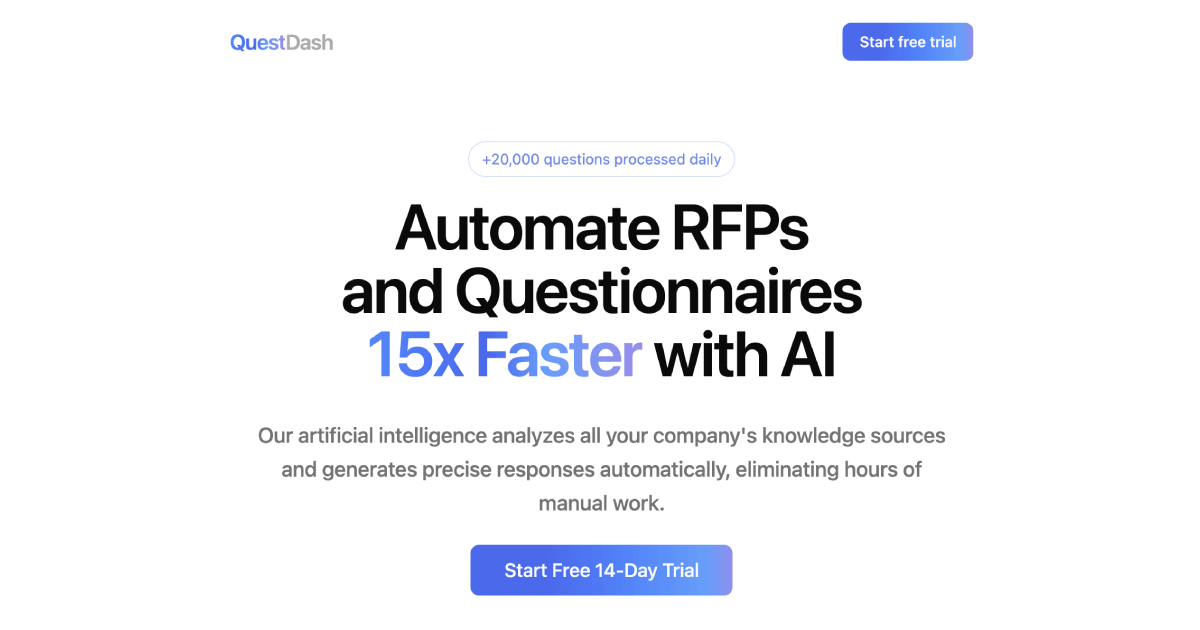
QuestDash is a web application that fills in business questionnaires using your own documents. Its promise runs across the home page: "Answer Questionnaires 15x Faster with Document-Based AI", under the banner "Smart Answers, Straight from Your Files." The document types it targets are spelled out in the site's own keywords: RFP, RFI, DDQ, VSQ, CAIQ, third-party risk reviews, audits and compliance assessments, summarised on the home page as "Audit, Security, Compliance, RFI and More".
The workflow has three moves. You upload the questionnaire as a spreadsheet, in .xls, .xlsx or .csv. You upload the sources the answers should come from, meaning standards, manuals, policies and technical documents, accepted as .pdf, .doc, .docx, .ppt, .pptx, .pot, .potx, .pps, .ppsx, .txt or .md. The AI then extracts the questions, writes an answer for each one and hands you a review screen where every answer carries a confidence score and three controls: edit, regenerate, rate. Once you are satisfied, you download the completed questionnaire.
The problems it claims to solve are the familiar ones: every question turning into a small research project, different writers producing different answers, and outdated information being copied forward year after year. Against those it offers generation that reads context across several sources at once, a unified knowledge base always drawn from the latest files, and answers written in a consistent company tone of voice. The home page advertises three figures: 15x faster, 95% accuracy, 80% fewer rewrites.
Maturity is the part worth knowing. QuestDash is a React and Vite single-page application with Firebase sign-in by email and password or through Google, and its footer reads version 0.1.2, © 2025 A8 Digital. There is no product page, no about page, and neither terms of service nor a privacy policy has been published. A sample questionnaire and a sample source file are downloadable, so the pipeline can be tested without exposing anything of your own. The home page also relays a blog that counted fifteen articles as of 18 August 2026.
What it does
- Extract every question automatically from an Excel or CSV questionnaire
- Draft an answer for each question from your own policies, standards, manuals and technical documents
- Show a confidence score on every generated answer so you know where to look first
- Regenerate any answer that misses the point
- Edit a question or an answer by hand before export
- Rate a result to feed the system's improvement loop
- Download the completed questionnaire
When to use QuestDash / When not to
A quick filter to help you decide if QuestDash is the right fit.
When to use QuestDash
- Sales and pre-sales teams that answer RFPs and RFIs week after week and already hold the material in proposals, technical files and product documentation
- Security, risk and compliance teams buried under vendor questionnaires: DDQ, VSQ, CAIQ and third-party risk assessments
- Startups and small companies with no dedicated bid desk, which need to look credible on a questionnaire without putting three people on it
- Mid-sized companies whose questionnaire volume is growing faster than the team answering them, and large groups juggling several regions and departments
- Teams that receive their questionnaires as spreadsheets and work in English, Spanish or Portuguese
When not to use QuestDash
- Developers and platform teams: there is no public API and no developer documentation, so nothing can be driven programmatically
- Anyone expecting to work from a phone or tablet app: no iOS or Android application exists
- Teams that want their document repository connected: no third-party integration is named, so every file goes through manual upload
- Anyone whose questionnaires arrive as PDFs or live inside a customer web portal, since only .xls, .xlsx and .csv are accepted as input
- Buyers with a procurement or legal review to pass: no terms of service, no privacy policy, no security certification, and no paid plan that can actually be purchased today
How to use QuestDash
A typical end-to-end flow, from setup to results.
- Create a free account with an email and password, or through Google. No credit card is asked for
- On step one, upload the questionnaire by drag and drop or by browsing, in .xls, .xlsx or .csv format
- Or click "Try with a sample" and start from the sample RFI questionnaire QuestDash provides
- On step two, upload your knowledge documents: PDF, Word, PowerPoint, .txt or .md files, with a sample source file available too
- Let the application process the data, extract the questions and generate the answers
- Work through the review screen, where every answer displays its confidence score
- Use "Edit question", "Edit answer" or "Regenerate answer" wherever the draft misses the mark
- Use "Rate this result" to send feedback into the system's improvement loop
- Watch for the plan limits, signalled by "Upgrade your plan to answer all questions" and by the knowledge documents limit message
- Download the finished file once "Your questionnaire is ready!" appears
Pros & Cons
Pros
- Nothing to implement: an account takes seconds by email or Google, no credit card is required, and the site promises setup in minutes
- A confidence score on every answer, which turns proofreading into a targeted pass rather than a full reread
- Answers and questions can be edited, and any answer regenerated, before the file is exported
- A very low paid entry point on paper: 10 USD as a one-time purchase for 500 questions
- A sample questionnaire and a sample source file let you judge the output without exposing any of your own documents
- A broad range of accepted source formats (PDF, Word, PowerPoint, plain text, Markdown) and three announced working languages: English, Spanish and Portuguese
- Cancellation at any time, with no commitment period, and data announced as downloadable for 60 days afterwards
Cons
- Neither terms of service nor a privacy policy is published: the links shown at sign-up lead to routes that do not exist in the application
- The three paid tiers cannot be bought as of 18 August 2026 — every pricing button opens a waiting list instead of a checkout
- No email address, no postal address and no legal form for the publisher A8 Digital: the only channel is a web form
- No API, no mobile app and no named third-party integration, so everything goes through manual file upload
- The input questionnaire has to be a spreadsheet: a PDF or a supplier web portal is not an accepted format
- No security certification of its own, no data processing agreement, no subprocessor list and no hosting country or region stated
- Figures contradict each other between pages (80% fewer rewrites on the home page, 90% in the FAQ), a "Professional" plan is quoted in the FAQ but absent from the pricing page, and the footer still shows version 0.1.2
Pricing & Plans
A free trial is advertised on every page and requires no credit card, but the pricing page shows no permanent free plan. The lowest paid entry point is the Package tier at 10 USD as a one-time purchase covering 500 questions; the cheapest recurring option is Subscription at 30 USD per month, or 25 USD per month when billed annually. Amounts appear with the dollar sign alone, as no currency code is written anywhere on the site. One reservation outweighs the prices themselves: as of 18 August 2026, none of the three buttons completes a purchase. Each opens a waiting-list dialog promising 50% off at launch, so no plan can currently be bought. Cancellation is announced as possible at any time, with no penalty and no commitment period, and the FAQ claims prices up to 30% below the competition without naming a single competitor.
- 500 questions
- up to 12
- 000 characters of knowledge base
- support replying within 48 hours. Described as "Everything necessary to get started"
- 3
- 000 questions per month
- up to 32
- 000 characters of knowledge base
- support replying within 24 hours
- higher limits on questions and on the knowledge base
- dedicated response within 1 hour
- and a success manager
- the "Buy now"
- "Subscribe now" and "Contact us" buttons all open a waiting list promising 50% off at launch
- A "Professional" plan for small and mid-sized businesses is mentioned in the FAQ but does not appear on the pricing page
Data, GDPR & hosting
A consolidated view of how QuestDash handles your data.
GDPR overview
GDPR compliance rests on a single FAQ sentence and nothing else: "We use Google and AWS infrastructure to ensure compliance with regulations such as LGPD and GDPR." No document supports it. There is no privacy policy at all: the Privacy Policy and Terms of Service links shown at sign-up point to /privacy and /terms, two routes absent from the application. No data protection officer is named, no legal or GDPR email address is published, and no Article 27 EU representative is designated. No hosting country or region is stated, no data processing agreement is offered and no subprocessor list exists. The only way to reach the publisher is a web form on /contact asking for a name, an email and a message of 10 to 500 characters. The footer names A8 Digital, with no legal form and no postal address.
Who owns the data?
QuestDash publishes neither terms of service nor a privacy policy, so no contractual document assigns ownership of the files you upload or of the answers the AI produces. The only statement on the subject sits in the marketing FAQ: "Your data is stored securely and is never shared with third parties. You retain full control and ownership over your information." The same FAQ adds that data stays downloadable for 60 days after cancellation. These are commitments in words only. The Terms of Service and Privacy Policy links displayed on the sign-up screen point to /terms and /privacy, two routes that do not exist in the application, so there is nowhere to read what was actually agreed.
Reuse rights
With no terms and conditions published, nothing formally restricts what you do with your own uploads or with the answers you export, and nothing formally grants it either. What the site does describe is QuestDash's own use of the material: the platform reads the documents you provide, extracts the relevant information and drafts the answers. The FAQ then states that "the system learns from your corrections to constantly improve, guaranteeing up to 95% accuracy", without saying whether that learning stays inside your account or feeds model training. No opt-out is documented and no subprocessor list is published, although Google and AWS are named as the underlying infrastructure. On the marketing site itself, Microsoft Clarity, Google Analytics and Ads, and Mixpanel are active, with Firebase handling authentication and reCAPTCHA Enterprise present.
Data retention & training
Hosting summary
The only hosting statement on the site is one FAQ sentence: "We use Google and AWS infrastructure to ensure compliance with regulations such as LGPD and GDPR." No country, no region and no data centre is named, no data processing agreement is offered and no subprocessor list is published. What can be observed from the outside points to Google's stack: the domain resolves to 199.36.158.100, a Firebase Hosting address geolocated in the United States (AS54113, Fastly anycast); the demo video is served from Firebase Storage; sign-in runs on Firebase Authentication; and reCAPTCHA Enterprise is present. These are infrastructure observations, not a hosting commitment, and an anycast address says nothing about where uploaded documents are actually stored or processed. For a European buyer the practical position is simple: the jurisdiction of the data is undetermined, and there is no published document in which to look it up.
Things to keep in mind
Risks and trade-offs to weigh before adopting QuestDash.
- You agree to terms you cannot read: the sign-up screen states "By continuing, you agree to our Terms of Service and Privacy Policy", and both links lead to routes that do not exist in the application
- An RFP or a security questionnaire is a contractual commitment, and the site's own 95% accuracy figure means roughly one answer in twenty is wrong without the tool telling you which one. The confidence score invites skimming exactly where careful reading matters most
- Nothing is on sale: the three pricing buttons buy nothing, they open a waiting-list dialog promising 50% off at launch, so a purchasing decision made today cannot be acted on
- The publisher is barely identifiable: a footer line reading "© 2025 A8 Digital" and a link to a8digital.io, a site that refuses automated consultation, with no email, no postal address and no legal form anywhere
- The FAQ promises data is never shared with third parties while naming Google and AWS as infrastructure, publishes no subprocessor list and no hosting country or region despite claiming GDPR and LGPD compliance, and says the system learns from your corrections without stating whether that feeds model training, with no opt-out documented
- Figures do not match between pages: 80% fewer rewrites on the home page against 90% in the FAQ, 15x faster on the home page against 40 hours cut to 2 or 3 on the blog. A "Professional" plan quoted in the FAQ does not exist on the pricing page, and the 60-day post-cancellation retention rests on a single FAQ sentence
- The testimonials and case studies on the blog, with named companies and spokespeople, read as illustrative examples rather than verifiable customer references, and should not be treated as proof the tool performs as described
Setup & Integrations
Technical difficulty
Minimal. There is no implementation project: you create an account in seconds with an email and password or through Google, no credit card is required, and the site promises setup in minutes. Nothing technical has to be configured, with no API key, no connector and no installation involved. The only prerequisite is having the questionnaire as a spreadsheet and the source documents in an accepted format, and a sample questionnaire and sample source file are provided so you can start with no preparation at all. Case-by-case onboarding support is announced for large organisations.
Deployment
Supported languages
Behind QuestDash
Resources
All the official URLs gathered for verification and reference.
Frequently asked questions
How accurate are the generated answers?
How long does it take to set up?
Which languages does it work in?
Which file formats are accepted?
How are security and privacy handled?
Can I cancel at any time, and what happens to my data?
Is there an API or a mobile app?
Can I try it without paying?
Can I subscribe to a paid plan today?
Should you pick QuestDash?
QuestDash does one thing and states it plainly: it turns a spreadsheet questionnaire and a pile of your own documents into a set of drafted answers. The path is short and honest — upload the questionnaire, upload the sources, review what comes back. The review screen is the good idea here. A confidence score on each answer tells you where to spend your proofreading, and editing or regenerating is one click away. A sample questionnaire and a sample source file let you judge the output before any of your own material goes anywhere, and the free trial asks for no card.
What is missing is not features but paperwork. No privacy policy and no terms of service exist — the links offered at sign-up point at pages that are not in the application — and there is no email address, no postal address, no legal form for the publisher named in the footer, no data processing agreement, no subprocessor list and no stated hosting country. For a tool whose entire purpose is to ingest security policies, technical manuals and internal documentation, that gap is the story.
The maturity signals all agree: version 0.1.2 in the footer, a domain registered in June 2025, a first web archive capture in August 2025, and three paid tiers that, on 18 August 2026, still cannot be bought, since every button opens a waiting list offering 50% off at launch.
The sensible reading is a modest one. QuestDash is worth a low-stakes trial, on the sample file or on a questionnaire that carries nothing confidential, to see whether the drafts hold up on your kind of material. It is not yet a tool to point at sensitive documentation, and it could not be procured today even by a buyer who wanted to.
- Choosing a selection results in a full page refresh.
- Opens in a new window.