
Rows
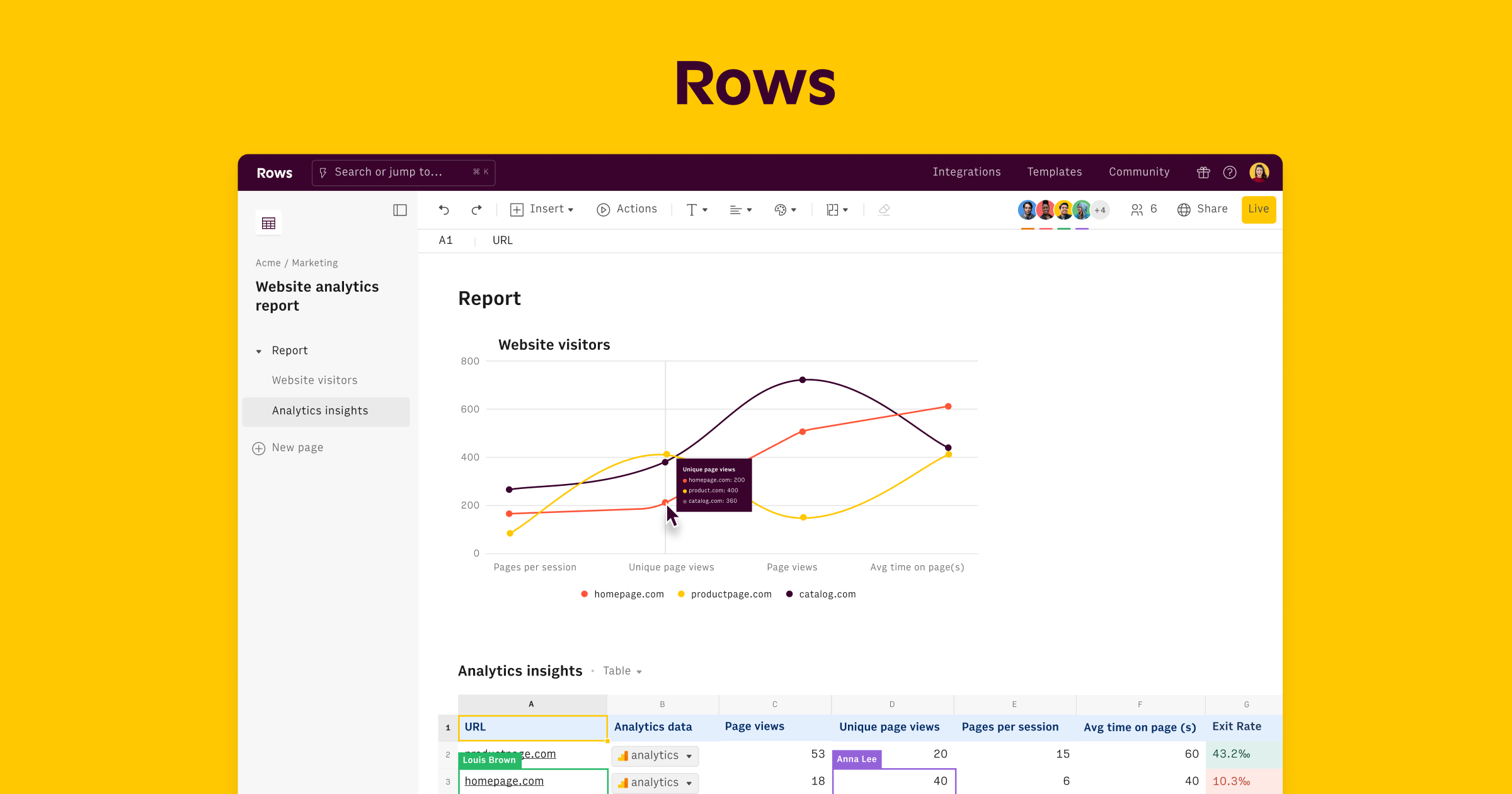
Rows was a browser-based spreadsheet with built-in AI that imported data from 56 connected services, turned PDFs into tables and answered questions in plain language. The product has been sunset following its acquisition by Superhuman.
What is Rows?
Rows was a browser-based spreadsheet built around an AI assistant, developed by Rows GmbH in Berlin. Its pitch was to remove the three things that usually sit between business data and an answer: BI dashboards, SQL queries and manual spreadsheet stitching. Rather than writing formulas, a user typed = in any cell, or opened an AI bubble, and described the result in ordinary words.
The product stacked three layers. The first was a conventional spreadsheet: familiar functions, a guided formula builder, sorting and filtering, conditional formatting, a keyboard command palette, and CSV and XLSX import and export. The second was connectivity, with 56 named integrations covering advertising platforms, analytics, CRMs, SQL databases, payment providers, translation engines and messaging tools. Data arrived either through Data Tables, which refreshed on a schedule, or through Cell enrichment, which called a service for a single cell or a whole column. A Chrome extension named RowsX turned any web table into structured data, and dedicated GET, POST and PUT functions reached arbitrary HTTP APIs.
The third layer was the AI. It could add calculated columns, join and append tables, draw charts, run forecasts, flag outliers, answer what-if questions, pivot and aggregate, tag and score text for sentiment, extract concepts and enrich rows with real-world company, place and person data. A vision feature converted documents and screenshots into tables. Python ran natively for cohort and statistical work, and a public API let external applications read and write sheets.
Output was shared through workspaces, folders and permissions, a read-only view mode, interactive buttons and input fields, forms, and embeds that stayed live inside a Notion page or a website.
The company was incorporated in Berlin in October 2016, trading first as EqualsMagic, then dashdash, before becoming Rows. It raised roughly 33.7 million US dollars and claimed 2.2 million users by the end. The product no longer operates. Superhuman agreed to acquire Rows in February 2026, the team moved onto Coda, and rows.com was announced to wind down fully on 31 May 2026. The marketing site and documentation are still served, but sign-up and log-in now return 404.
What it does
- Extract tables and figures from PDFs, invoices, screenshots and images into editable rows
- Import live business data from 56 connected services without writing any code
- Ask questions in plain language and get statistics, summaries, joins, pivots and segments back
- Build charts, reports and interactive dashboards that can be shared or embedded anywhere
- Refresh imported data automatically, from every minute to every month
- Generate spreadsheet models and calculators from a single prompt
- Call any external API directly from a cell with GET, POST and PUT functions
When to use Rows / When not to
A quick filter to help you decide if Rows is the right fit.
When to use Rows
- Marketing and growth teams pulling GA4, Search Console, Google Ads, Facebook Ads, LinkedIn Ads and TikTok into one refreshable report
- Financial analysts and controllers building forecasts, cohort views and 13-week cash-flow models without leaving a spreadsheet
- Business people who are fluent in spreadsheets but do not write code, SQL or scripts
- Anyone who needs recurring extraction of tables from PDFs, invoices and screenshots into editable rows
- Small teams that publish live dashboards embedded in a Notion page, a website or a blog post
When not to use Rows
- Anyone starting a new project today: the product has been discontinued and account creation is closed
- Users who need a native mobile application, since Rows only ever shipped a web app and a Chrome extension
- Organisations that must work offline or require a desktop client
- Teams handling large files, as uploads were capped at 1 MB on Free, 5 MB on Plus and 100 MB on Pro
- Companies needing SAML single sign-on or advanced API endpoints on a modest budget, both being reserved for the undisclosed Enterprise tier
How to use Rows
A typical end-to-end flow, from setup to results.
- Note first that this walkthrough is historical: sign-up and log-in have returned 404 since the announced wind-down
- Create an account and open a workspace, which received its own address of the form rows.com/yourcompany
- Invite teammates as members, who could create sheets, or as guests, who were limited to viewing and editing a few
- Bring data in by uploading a CSV or XLSX file, importing from Google Drive, or connecting a service through OAuth
- Activate an integration, which created an integration account, capped at 10 accounts on Free and Plus and 100 on Pro
- Install the RowsX Chrome extension to capture tables straight from a web page
- Set up Data Tables for imports that refresh on their own, and Cell enrichment to fill a single cell or a whole column
- Ask the AI for what you need, either from the bubble at the bottom right of the sheet or by typing an equals sign in a cell
- Turn the result into charts, forms or interactive elements, and set the refresh cadence you need
- Share the sheet in view mode, publish it, embed it elsewhere, or reach it programmatically through the Rows API
Pros & Cons
Pros
- AI genuinely embedded in the grid, invoked from a cell rather than bolted on as a separate panel
- Data stored exclusively inside the European Union, on Google Cloud servers located in Belgium
- Strong compliance file: SOC 2 Type II, an external data protection officer, a pre-signed DPA and a published subprocessor list
- Explicit commitment that customer data is never used to train AI models
- Wide connector coverage, with 56 named services documented individually
- Low entry price at 8 US dollars per user per month, dropping to 6 on annual billing, above a permanent free plan
- Python and a public API available for the analytically demanding, without forcing them on everyone else
Cons
- The product has been discontinued: sign-up and log-in return 404 after the announced 31 May 2026 wind-down
- Footer links now send terms and privacy to superhuman.com and grammarly.com although first-party pages still exist, leaving the applicable framework ambiguous
- The API documentation host returned HTTP 503 when checked
- No native mobile application was ever released, on either iOS or Android
- The free plan was tight: 5 AI tasks a month, manual refresh only, 1 MB per file and 3 guests
- The Pro tier carried a 79 US dollar monthly base on top of 8 US dollars per user, and Enterprise pricing was never published
- Interface, documentation and support existed in English only
Pricing & Plans
A permanent free plan was offered at no cost, with no trial period and no credit card required; there was consequently no free trial as such. The cheapest paid entry point was the Plus tier at 8.00 USD per user per month on monthly billing, reduced to 6.00 USD per user per month on annual commitment. All prices were quoted net of applicable sales tax or VAT, and Enterprise pricing was never published.
- unlimited spreadsheets
- 5 AI tasks per month
- manual Data Table import
- 10 integration accounts
- 500 cell enrichment tasks per month
- 1 MB file uploads
- 3 guests
- branded embeds
- 200 AI tasks per month
- daily automation
- 10 integration accounts
- 1 million enrichment tasks per month
- 5 MB file uploads
- 10 guests
- branded embeds
- 30-day version history
- 1
- 000 AI tasks per month
- per-minute automation
- 100 integration accounts
- 1 million enrichment tasks per month
- 100 MB file uploads
- 200 guests
- unbranded embeds
- unlimited AI tasks and integrations
- advanced API endpoints
- custom AI models and functions
- high-volume usage
- custom themes
- SAML SSO
- unlimited version history and a dedicated customer success manager
Data, GDPR & hosting
A consolidated view of how Rows handles your data.
GDPR overview
Compliance is claimed in writing rather than implied: a dedicated documentation page answers "Is Rows GDPR compliant?" with "In short: Yes". The controller is Rows GmbH in Berlin, which places it under German supervisory authorities. An external data protection officer, DataCo GmbH in Munich, is designated and reachable at privacy@rows.com. Compliance is audited annually, staff receive privacy training on joining and recertify every two years, and a pre-signed Data Processing Agreement can be downloaded and countersigned. Data subject rights are set out article by article in sections 4.1 to 4.7, including access, rectification, restriction, erasure, portability and objection, with the right to lodge a complaint. SOC 2 Type II certification is held alongside. The current policy took effect on 3 February 2025.
Who owns the data?
The terms are unusually clear on this point. Everything a customer submits, types or imports through the service is defined as Customer Data, and section 5.3 states that Rows neither monitors it nor claims any ownership over it. Responsibility sits entirely with the customer, who must hold the rights to whatever is uploaded. Whoever creates a workspace owns it and is the only person able to delete it, although appointed administrators may invite users and change the subscription. The only perpetual licence Rows granted itself covers product feedback and feature suggestions, not the data. Customers also remained responsible for taking their own regular backups.
Reuse rights
Customers kept full freedom over their own content: nothing in the terms requires permission to export, reuse or republish the data held in a workspace, and sharing, publishing and embedding features were provided for exactly that purpose. The constraint runs the other way. Users had to hold the necessary rights on anything they uploaded, comply with the separate conditions of each third-party service activated as an integration, and take responsibility for how collaborators and guests used the sheets they were invited to. Data pulled from connected APIs stayed governed by the originating provider's own terms. Reselling access to the service itself, or reproducing and renting parts of it, was forbidden. Since the product has now been withdrawn, exporting anything still held there is no longer possible through the normal interface.
Data retention & training
Hosting summary
Account and spreadsheet data were stored on Google Cloud Platform, exclusively on servers within the European Union and specifically in Belgium, placing the service under German and European jurisdiction with Rows GmbH in Berlin as controller. Data was encrypted at rest with 256-bit AES, including backups, and in transit over HTTPS and TLS. An incremental backup ran every 24 hours and was kept for 30 days. The privacy policy adds that the website server sits in the European Union or European Economic Area, and that Amazon Web Services hosted spreadsheet comments. Card details were handled through Stripe's own security procedures. Eleven subprocessors were published with their purpose and country: Adyen in the Netherlands, Sparkpost in the United Kingdom, and Chargebee, Customer.io, Google, GitHub, Helpscout, Segment, Sendgrid, Slack and Stripe in the United States. The language models behind the AI features were supplied by OpenAI and Groq. Integration partners such as Google and Facebook ran their own security audits of the platform.
Things to keep in mind
Risks and trade-offs to weigh before adopting Rows.
- The tool is discontinued: building any new workflow on it, or trusting a link to it, is a dead end
- Anyone with data still held there should treat recovery as urgent, since the terms always placed backup responsibility on the customer
- The footer sends terms and privacy to superhuman.com and grammarly.com while first-party pages remain live, so which document governs a residual account is genuinely unclear
- Prompts and a sample of spreadsheet rows were forwarded to OpenAI and Groq, and OpenAI could keep them for up to 30 days
- No opt-out switch for model training was ever documented; the vendor simply asserted that training never happened, which asks the user to take a promise on trust
- Letting an assistant produce joins, forecasts and significance tests without reading the underlying method invites confident conclusions that nobody has checked
- The site itself disagrees on its own history, showing 2016 as the founding year while the farewell post says the founders started in 2017
Setup & Integrations
Technical difficulty
Low for everyday use. The product was designed for people who know a spreadsheet but not code: connecting a service meant an OAuth prompt and accepting that provider's additional terms, and the AI was reached by typing an equals sign in a cell. Difficulty rose only for optional layers, namely the GET, POST and PUT web request functions, the Rows API and the embedded Python runtime, each of which assumed some technical background. In practice this is now moot: as of 24 August 2026 no new account can be created, so there is nothing left to set up.
Deployment
Integrations
Supported languages
Behind Rows
Fundraising
Social
Resources
All the official URLs gathered for verification and reference.
Alternatives
Tools that compete with or complement Rows.
Frequently asked questions
Can I still use Rows?
Who acquired Rows, and what happened to the team?
Who was behind Rows?
Was there a free plan or a free trial?
What did the cheapest paid plan cost?
Was customer data used to train AI models?
Where was the data hosted?
What compliance certifications did Rows hold?
Was there an API, and what was the minimum age to sign up?
Should you pick Rows?
Rows was one of the more convincing attempts to put a language model inside a spreadsheet rather than beside one. Typing an equals sign and describing the outcome, instead of assembling a formula, was a genuine shift, and it sat on top of substantial plumbing: 56 documented integrations, scheduled refreshes down to the minute, vision extraction from PDFs and invoices, native Python and a public API. The compliance file was better than most of its category, with SOC 2 Type II certification, an external data protection officer, a pre-signed Data Processing Agreement, eleven subprocessors published by name and country, storage confined to Google Cloud servers in Belgium, and a written commitment never to train on customer data.
None of that changes the headline. Superhuman agreed to acquire the company in February 2026, the founders announced a three-month sunset, and rows.com was to wind down fully on 31 May 2026. That date has passed: the marketing pages and the documentation still load, but account creation and sign-in return 404, and every call to action now points at Superhuman. The team has moved on to Coda.
What remains is worth reading rather than adopting. The documentation is a useful reference for anyone evaluating how an AI spreadsheet should handle connectors, refresh cadence and cell-level enrichment, and the security pages are a fair template for what a European vendor can publish about hosting and subprocessors. Existing users should treat data recovery as urgent, since the terms always placed backup responsibility on the customer. Anyone shopping for a tool today should look elsewhere, most obviously at Coda, at the spreadsheets Rows compared itself against, or at another AI-native alternative.
- Choosing a selection results in a full page refresh.
- Opens in a new window.