
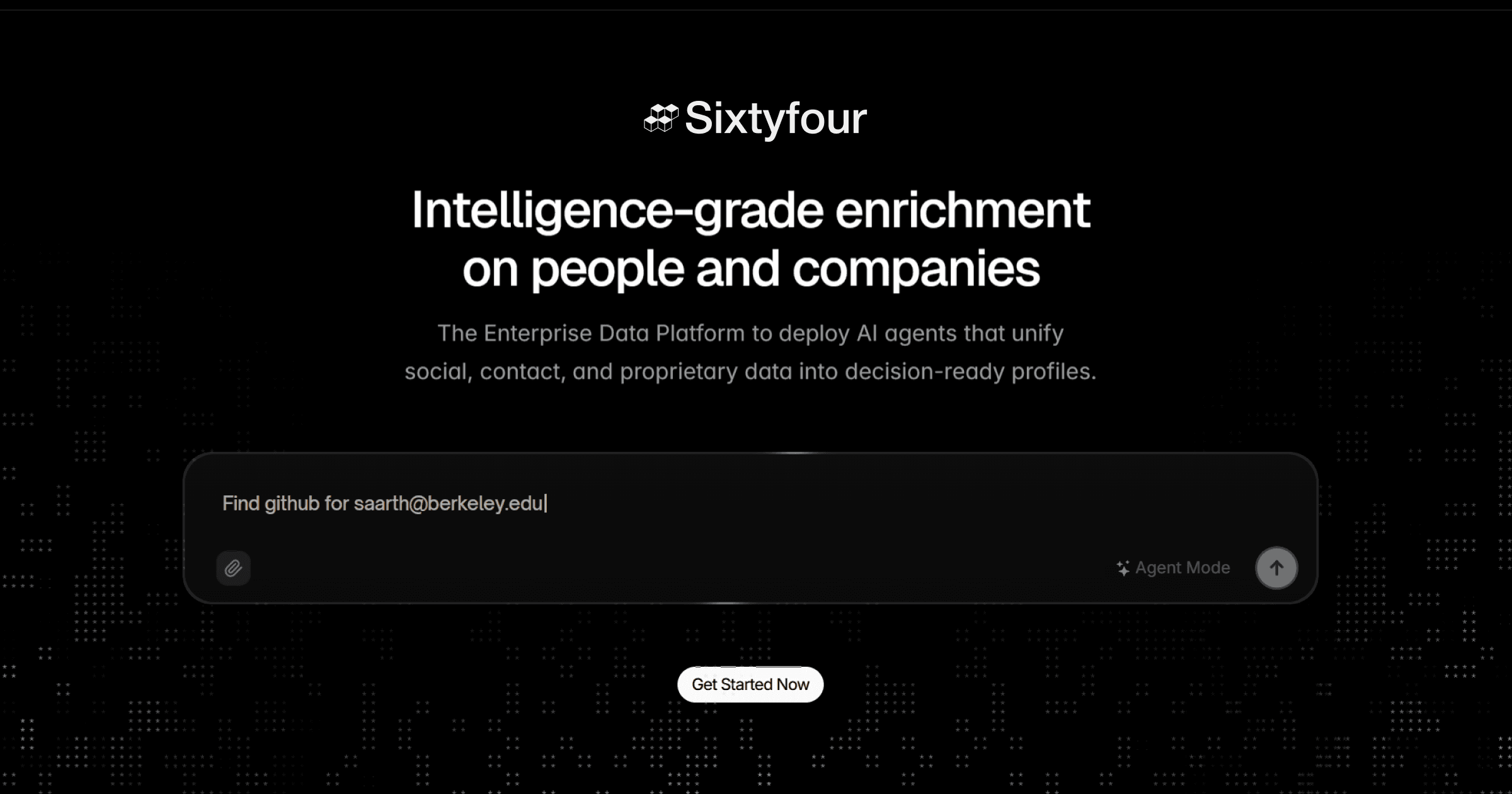
Sixtyfour
Sixtyfour deploys AI research agents that investigate any person or company from a single identifier — a name, email, phone number or username — and return a structured, fully cited profile through its web platform, REST API or MCP server.
What is Sixtyfour?
Sixtyfour is a people and company intelligence platform built on a simple premise: give it one piece of information and it returns the full picture. The starting point can be a name, an email address, a phone number, a username, a wallet address or a company name. From there, AI agents browse autonomously, extracting and cross-referencing across the open web and the dark web, official registries, social platforms and unstructured documents. What comes back is a structured profile in which every data point is sourced and cited — connected accounts and aliases, entity affiliations, professional history, contact details, and risk signals such as sanctions exposure, court records, adverse media or appearances in breach databases.
The company frames six territories of use. Identity resolution turns any identifier into a complete digital identity. Threat actor intelligence maps an adversary's full footprint across platforms, forums and the dark web. Entity intelligence serves financial data platforms and investment research teams where completeness decides the outcome. GTM intelligence builds org charts, finds hidden decision-makers and surfaces accounts too niche for conventional databases. Talent and recruitment intelligence qualifies candidates against a specific role using research papers, GitHub contributions and open-to-work signals. Intelligence infrastructure embeds the same research agents inside a customer's own product, workflow or data pipeline.
Delivery is deliberately plural. There is a web platform with a visual workflow editor, a documented REST API split into Intelligence, Search and Workflows, inbound and outbound webhooks with signing secrets, a hosted MCP server for AI coding tools such as Cursor, Claude Code and Windsurf, and a plugin published in the ChatGPT directory. Everything is metered in credits, and the credit cost of each operation is published endpoint by endpoint — although no monetary value is ever attached to a credit anywhere on the site.
Sixtyfour AI Inc. is based in San Francisco and went through Y Combinator's first spring batch in 2025. It publishes RECON, its own people-research benchmark covering 100 individuals and 474 verified fields, on which it claims first place ahead of Exa, Parallel and Grok. The platform holds a SOC 2 Type 2 audit and runs a public compliance portal naming sixteen subprocessors.
What it does
- Resolve a single identifier — name, email, phone number, username or wallet address — into a complete digital identity
- Run AI agents that search the open web, the dark web, official registries and unstructured documents autonomously
- Surface risk signals: sanctions and PEP status, court records, adverse media and breach-database exposure
- Map relationships between people and entities, from org charts to clusters of connected companies
- Enrich lead lists and discover niche accounts that conventional databases cannot reach
- Find and verify professional or personal email addresses and phone numbers, and reverse-look them up
- Build, schedule and automate multi-step research workflows, then push results to Slack or export them
When to use Sixtyfour / When not to
A quick filter to help you decide if Sixtyfour is the right fit.
When to use Sixtyfour
- Sales and go-to-market teams that need enriched, context-rich account data, org charts and hidden decision-makers rather than a plain name-and-email list
- Recruiters and talent sourcers who qualify candidates on research papers, GitHub contributions and open-to-work signals, however niche the role
- Trust and safety teams tracking banned users, counterfeit sellers and repeat offenders who return under new handles
- Compliance, KYC/KYB and AML analysts running due diligence, sanctions screening and shell-company detection
- Engineering and data teams embedding people or company research directly into their own product through the API, webhooks or MCP server
When not to use Sixtyfour
- Buyers who need a published price before speaking to sales: the site lists credit costs per operation but no monetary amount at all
- Organisations whose use would fall under HIPAA, FISMA or the Gramm-Leach-Bliley Act, which the terms of service explicitly exclude
- Anyone who needs a mobile app, since there is no iOS or Android release
- Teams that require European data residency, as all processing and storage happens in the United States
- Consumer-facing use cases: the platform is deliberately limited to professional B2B data and avoids personal emails, home addresses, financial and health data
How to use Sixtyfour
A typical end-to-end flow, from setup to results.
- Create an account on app.sixtyfour.ai, or book a walkthrough with the team first
- Choose an entry point: the web platform, the REST API, the MCP server or the ChatGPT plugin
- On the platform, bring in your data through a CSV upload, a CRM import or a webhook — all of which are free of credits
- Build a pipeline in the Workflow Editor by chaining enrichment, search and output blocks
- Pick an enrichment depth tier for each block: Micro, Low (the default), Medium, High or X-High
- For API work, generate a key from the dashboard, make a first call from the quick start, then experiment in the online playground
- For MCP, install the sixtyfour-intelligence server in Cursor, VS Code, Windsurf, Claude Code, Claude Desktop or Codex, or let Smithery configure it
- Authenticate through the OAuth browser flow or by pasting your API key
- Filter, deduplicate and transform the results, then export to CSV or push them into a Slack channel
- Track consumption in Usage & API Logs, and buy a top-up or set auto-recharge in the billing section
Pros & Cons
Pros
- Every returned data point is sourced and cited, and each field carries its own confidence score
- Research depth is adjustable per call across five tiers, so precision can be matched to budget
- A genuine developer surface: documented REST API, signed webhooks, MCP server, ChatGPT plugin and six MIT-licensed demo applications
- The credit cost of every operation is published endpoint by endpoint in the documentation
- Unusual compliance transparency — public portal, SOC 2 Type 2 audit, sixteen named subprocessors with their countries, a designated DPO and an Article 27 EU representative
- A permanent free plan of 64 credits per month allows real evaluation without a sales conversation
- Profile data retention is capped at twelve months, with deletion carried out within one month on request
Cons
- No monetary price is published anywhere: credits cannot be converted into dollars or euros without contacting the company
- The Pricing link in the documentation footer points to a page that returns a 404 error
- The two deepest enrichment tiers and the Slack integration are restricted to Enterprise customers
- There is no iOS or Android application, and no about or contact page — outreach goes through a mailto address or a demo form
- Top-up credits can cost three times the standard plan rate and expire after a year, while personal email discovery costs four times the professional mode
- The terms of service read as a generic template that describes the product poorly, including a liability cap of $0.00 and a clause denying that users can submit content at all
- The stated minimum age is contradictory: eighteen in the terms of service, sixteen in the privacy policy
Pricing & Plans
Sixtyfour operates a permanent free plan capped at 64 credits per month, which requires no payment method and is not a time-limited trial. Three paid tiers sit above it — Individual, Starter and Enterprise — but no monetary amount is published for any of them, either on the website or in the documentation, so the lowest paid price point cannot be stated. The terms of service specify that all payments are made in US dollars on a monthly billing cycle with automatic renewal. What is published is the credit cost of each operation, ranging from 0.005 credits for a subdomain lookup to 250 credits for a maximum-depth people enrichment; the conversion rate between credits and currency is not disclosed.
- Free — up to 64 credits per month
- no rollover
- exports limited to 100 results
- intended for exploring the platform
- Individual — 100 credits per month
- no rollover
- exports limited to 1
- 000 results
- aimed at solo users working through Claude Code
- OpenClaw or similar AI tools
- Starter — 1
- 200 credits per month
- rollover capped at twice the monthly allowance
- exports limited to 10
- 000 results
- aimed at small teams running enrichment workflows at scale
- Enterprise — custom credit allowance and rollover
- exports limited to 50
- 000 results
- the only plan unlocking the High and X-High enrichment tiers
- the Slack integration and credit-free searches from the platform interface
- Credit top-ups — one-off purchases from the dashboard at up to three times the standard plan rate
- expiring one year after purchase
- with optional auto-recharge
- No monetary amount is published for any of these plans
Data, GDPR & hosting
A consolidated view of how Sixtyfour handles your data.
GDPR overview
Implementation is concrete and unusually well documented. Sixtyfour runs a public compliance portal that declares GDPR alongside SOC 2 as a framework. The privacy policy names Sixtyfour AI Inc. as controller, designates a data protection officer at privacy@sixtyfour.ai, and appoints an Article 27 EU representative: Probo Inc., 7 rue commines 75003 Paris, privacy@getprobo.com. An entire section addresses Article 14, covering data gathered from sources other than the individual, and states legitimate interest under Article 6(1)(f) as the legal basis, with a documented balancing assessment. Transfers to the United States rely on Standard Contractual Clauses. Rights under Articles 15 to 21 are listed individually, with a one-month response deadline extendable by two months, and a request form hosted at compliance.sixtyfour.ai.
Who owns the data?
The terms draw a clear line. Sixtyfour AI Inc. owns the platform itself — source code, databases, design and marks — while customers keep full ownership of what they contribute: the agreement states that Sixtyfour asserts no ownership over contributions. One exception matters. Suggestions and feedback sent to the company are assigned to it outright, without acknowledgment or compensation. For the research output, the privacy policy makes each client an independent data controller of the profile data it obtains, so responsibility for lawful use passes to the buyer. Sixtyfour retains transmitted data and performs routine backups, but disclaims all liability for loss or corruption.
Reuse rights
Access is granted under a non-exclusive, non-transferable and revocable licence, limited to the customer's own internal business purpose. Within that scope, results can be downloaded, printed and used without asking further permission. Beyond it the terms are restrictive: content may not be copied, republished, resold, licensed or otherwise exploited commercially without prior written consent, and systematically retrieving platform data to compile a competing database or directory is expressly prohibited, as is using the service to compete with Sixtyfour. Because each client is an independent data controller for the profile data it receives, establishing a lawful basis for reusing personal data about individuals is the client's own responsibility, not the vendor's.
Data retention & training
Hosting summary
All personal data is processed and stored in the United States. The privacy policy states plainly that subprocessors are located there too, and the terms of service confirm the services are hosted in the US; there is no European or other regional hosting option. Sixteen subprocessors are named publicly with their categories and countries: Amazon Web Services and Vercel for cloud, Supabase for data storage and processing, OpenAI for AI models, Stripe for payments, PostHog for analytics, Pylon for customer support, Airtable, Google Workspace, Item and Slack for collaboration, Axiom, Langfuse and Resend for engineering, Framer for marketing and Temporal for product. Security measures cited are SOC 2 Type II compliance, encryption in transit and at rest, access controls and regular security monitoring. For data subjects in the European Economic Area, the United Kingdom or Switzerland, transfers to the United States rely on Standard Contractual Clauses adopted by the European Commission. Accessing the service from outside the US is treated in the terms as consent to that transfer.
Things to keep in mind
Risks and trade-offs to weigh before adopting Sixtyfour.
- The tool profiles real people from public sources. The vendor grounds its own collection in legitimate interest, but that reasoning does not transfer: anyone using the platform needs their own lawful basis for processing.
- The homepage and Trust & Safety page display an entirely fictional demo dataset — a "Kai Moran" with an invented email address and shell companies such as Meridian Labs and NovaTech. It is an illustration, not a customer reference, and search engines have been observed repeating it as fact about the company.
- Under the CCPA the company states it may "sell" or "share" personal information, with an opt-out available on request. This sits uneasily beside its statement that it does not sell profile data to advertisers.
- Risk signals such as adverse media, shell-company clusters or breach exposure are probabilistic. Acting on a confidently wrong identity match is precisely the failure mode the vendor's own benchmark describes.
- No option to exclude customer data from AI model training is documented anywhere, and the subject is never addressed in the terms or the privacy policy.
- The terms of service are a generic template whose clauses do not match the product, which makes them a weak guide to what the vendor actually commits to.
- The public Tip Box accepts anonymous reports about named third parties, a channel that invites misuse against individuals as readily as legitimate reporting.
Setup & Integrations
Technical difficulty
Low to moderate, depending on the route. The web platform needs no code: create an account, upload a CSV and chain blocks in a visual workflow editor. API use is a standard developer task — generate a key, follow the quick start, test in the online playground, with OAuth available. The MCP server is a single configuration line per client, or a guided install through Smithery, and the ChatGPT plugin installs from the directory with no setup at all. The real friction is commercial rather than technical: the deepest enrichment tiers and the Slack integration require an Enterprise plan.
Deployment
Integrations
Behind Sixtyfour
Fundraising
Social
Resources
All the official URLs gathered for verification and reference.
Alternatives
Tools that compete with or complement Sixtyfour.
Frequently asked questions
What can Sixtyfour actually find?
What do I need to start a search?
Is there an API?
How much does it cost?
Is there a free plan?
Which plans are available?
Where is my data hosted?
Does Sixtyfour publish its subprocessors?
How long is data kept?
What is the minimum age?
Should you pick Sixtyfour?
Sixtyfour is serious infrastructure wearing the clothes of a research tool. Its strongest feature is not the breadth of what it finds but the discipline around it: every field is cited, every field carries a confidence score, and the depth of a lookup is a parameter rather than a plan. For teams whose work fails when an identity match is confidently wrong — compliance, trust and safety, due diligence — that discipline is the whole product.
The developer surface is equally deliberate: a documented REST API, signed webhooks, an MCP server, a ChatGPT plugin and six MIT-licensed demos amount to a company that expects to be built on rather than logged into. Its compliance posture is more transparent than most vendors twice its age — a public portal, a SOC 2 Type 2 audit, sixteen named subprocessors, a DPO and an Article 27 EU representative.
Two reservations temper this. The first is commercial: Sixtyfour publishes the credit cost of every operation but never what a credit costs, and the Pricing link in its own documentation is broken. Budgeting is impossible without a sales conversation, which sits oddly beside an otherwise self-serve product. The second is documentary: the terms of service are a generic template whose clauses contradict the product, while the privacy policy is precise and specific. When the two disagree — on the minimum age, on the company's own legal name — the privacy policy is the one worth trusting.
Finally, this tool profiles real people from public sources. The vendor grounds its own collection in legitimate interest and caps retention at twelve months, but that reasoning does not transfer to the buyer: anyone deploying Sixtyfour needs their own lawful basis, and should treat its risk signals as leads to verify rather than conclusions to act on.
- Choosing a selection results in a full page refresh.
- Opens in a new window.